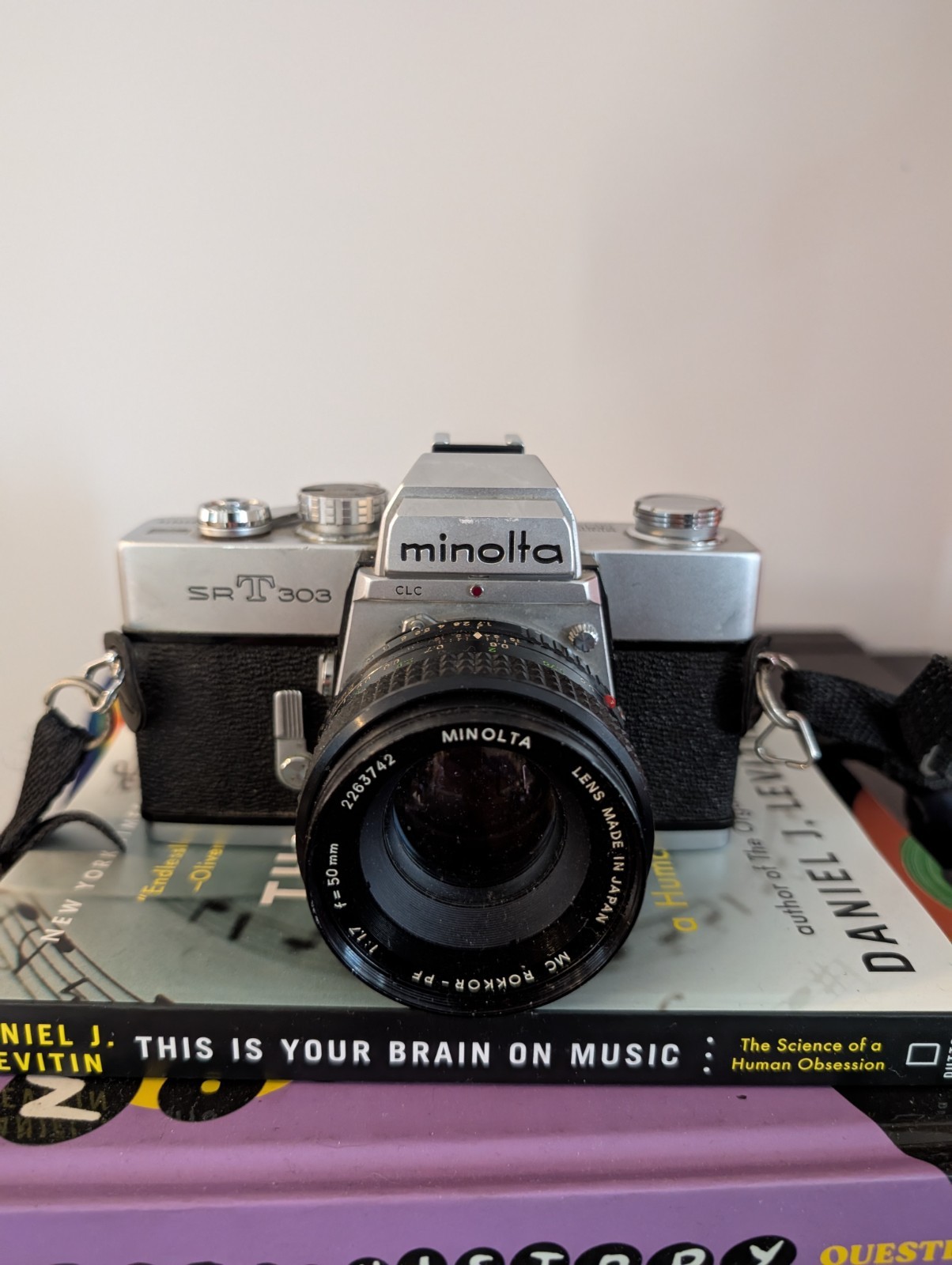
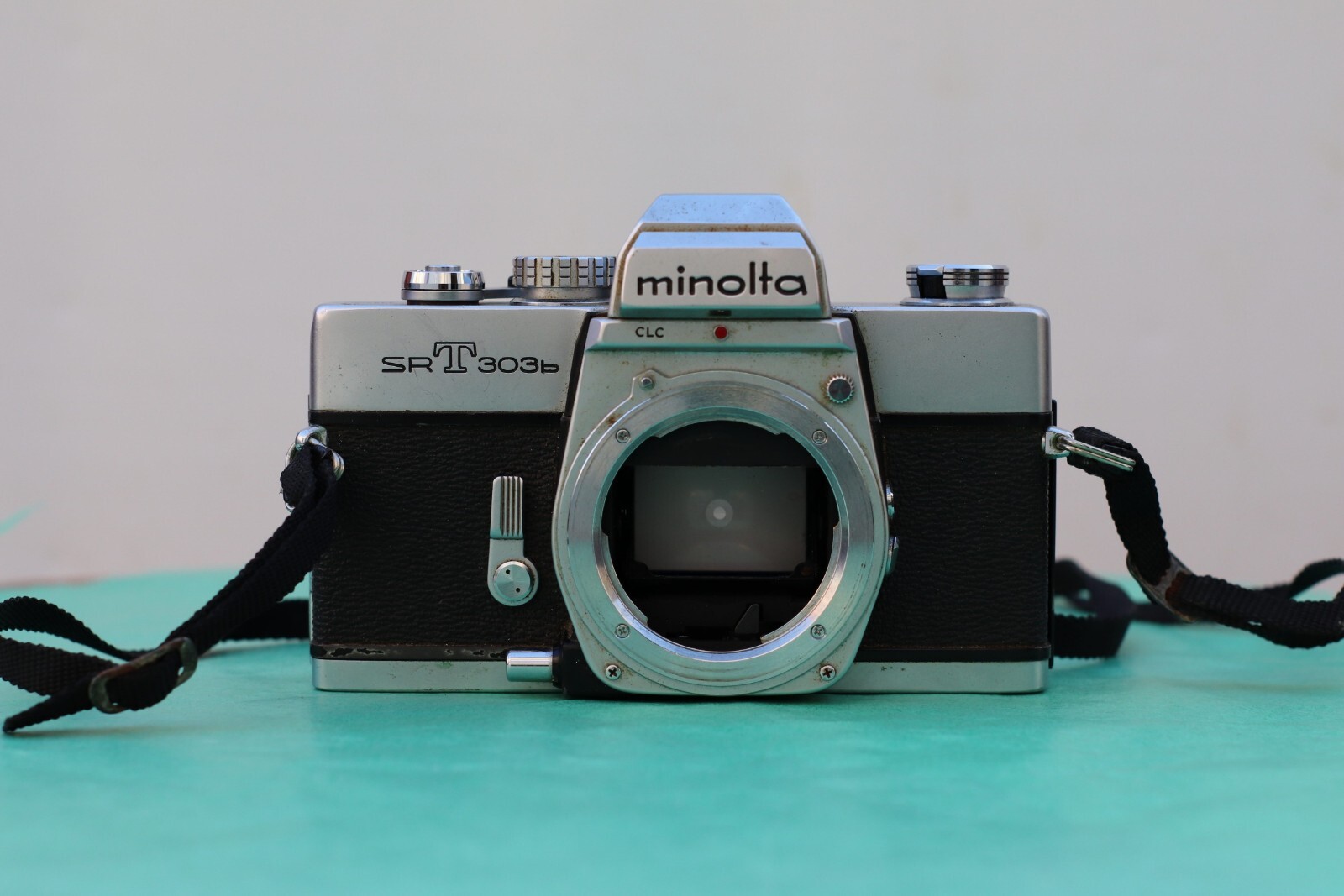
MINOLTA SR-T 303
The Minolta SR-T 303 is a 35mm single-lens reflex (SLR) camera introduced in 1976 as part of Minolta’s SR-T series. Designed specifically for the European market, the SR-T 303 combines the robust mechanical construction and advanced metering features of its siblings with a streamlined specification set tailored to mid-tier photographers seeking reliability and precision.
Overview
Launched in 1973, the Minolta SR-T 303 was positioned as an export-market variant within the broader SR-T family, which had established Minolta as a leader in professional and advanced amateur SLR photography throughout the late 1960s and early 1970s. Unlike the globally distributed SR-T 101 or the higher-end SR-T 102 and 202, the SR-T 303 was primarily marketed in Western Europe and featured slight modifications in cosmetics, metering circuitry, and production sourcing to meet regional demand and cost structures. It shares the core engineering DNA of the SR-T line: a fully mechanical shutter, TTL (through-the-lens) open-aperture metering, and Minolta’s proprietary MC/MD bayonet lens mount.
The SR-T 303 was engineered to offer photographers a dependable, mid-range SLR with professional-grade features at a competitive price point. It retained the hallmark CLC (Contrast Light Compensator) dual-cell metering system—Minolta’s innovative center-weighted metering technology that used two silicon photodiodes to average light from the center and periphery of the frame, improving exposure accuracy in high-contrast scenes. While lacking some of the refinements of its premium counterparts (such as a film rewind crank instead of a lever or a slightly simplified internal layout), the 303 maintained the rugged build quality, precise shutter mechanism, and tactile feedback that defined the SR-T series.
This model fits into Minolta’s SLR evolution as a transitional product bridging the early mechanical SR-Ts and the upcoming electronic MD series. It was produced from 1976 into the late 1970s, overlapping with the introduction of the Minolta XE (1975) and XD (1977). The SR-T 303 did not see significant distribution in North America or Japan, making it a regionally focused model with a cult following among European film enthusiasts and collectors today.
Specifications
| Specification | Value |
| Type | 35mm Single-Lens Reflex (SLR) |
| Film Format | 35mm (135 film), interchangeable lenses |
| Years Produced | 1973–1976 |
| Lens Mount | Minolta SR bayonet (compatible with MC and MD lenses; full open-aperture metering with MC series) |
| Shutter | Horizontal cloth focal-plane shutter, speeds from 1 sec to 1/1000 sec + B (bulb); flash sync at 1/60 sec |
| Metering | TTL full-aperture center-weighted metering using a single silicon photodiode; not CLC-equipped |
| Exposure Modes | Manual exposure only; stop-down metering via AE lock button |
| Viewfinder | Fixed pentaprism with microprism collar focusing aid, split-image rangefinder spot, and 95% frame coverage |
| Dimensions | Approx. 140 mm (W) × 93 mm (H) × 52 mm (D); weight approx. 615 g (body only, no battery) |
Key Features
- CLC TTL Metering System: Utilizes two silicon photodiodes to measure light from different areas of the scene, reducing exposure errors in backlit or high-contrast conditions.
- Fully Mechanical Shutter: Operates without batteries for all shutter speeds except metering, ensuring reliability even with dead or missing batteries.
- Open-Aperture Metering: Allows viewing and metering at maximum aperture, with stop-down metering available via a dedicated AE lock button.
- Robust Build Quality: Die-cast metal chassis with chrome or black finish options, leatherette covering, and precision mechanical controls.
- MC/MD Lens Compatibility: Supports all Minolta SR-mount lenses, with full metering functionality when used with MC-series lenses.
Historical Context
The Minolta SR-T 303 emerged during a period of intense competition in the 35mm SLR market, where Japanese manufacturers like Nikon, Canon, Pentax, and Olympus were rapidly advancing both mechanical and electronic camera technologies. By the early 1970s, TTL metering had become a standard feature in mid-to-high-end SLRs, and Minolta’s CLC system gave it a distinct edge in exposure accuracy. The SR-T 303 was not a new design but rather a cost-optimized version of the SR-T 101/102 platform, likely assembled in Minolta’s European production facilities or through localized assembly using Japanese components.
It was aimed at European photographers who desired a reliable SLR at a lower price point, sacrificing some features of the SR-T 101/102. Competitors included the Pentax Spotmatic SP500, the Zeiss Ikon SL706, and the Praktica PLC3. Unlike some of its rivals, the SR-T 303 retained full mechanical functionality—a selling point in an era where early electronic cameras were prone to failure. Its limited global distribution suggests it was part of Minolta’s strategy to maintain market share in Europe through region-specific models, avoiding import tariffs and aligning with local dealer networks.
Collectibility & Value
Today, the Minolta SR-T 303 is considered a niche collectible, primarily sought after by Minolta enthusiasts and users of vintage MC/MD lenses. While not as iconic as the SR-T 101, it is valued for its solid build, reliable metering, and status as a European-market variant. Units in good working condition typically sell for $100–$180 USD, depending on cosmetic condition, meter accuracy, and included accessories. Fully functional cameras with original straps, manuals, and lens hoods command a premium.
When purchasing an SR-T 303, buyers should verify the shutter operation across all speeds, check for mirror slap noise or sticking, and ensure the light seals are replaced (common deterioration point). The meter relies on a single 1.35V mercury battery (PX625), now obsolete; modern replacements (such as Wein Cell or adapters with 1.5V zinc-air batteries) may require meter recalibration for accurate readings. Common issues include degraded foam light seals around the film chamber, stiff shutter speeds due to dried lubricants, and cloudy viewfinders from internal prism haze.
Similar Cameras
- Pentax Spotmatic SP500 – Comparable in price and features, with TTL metering and M42 screw mount.
- Canon FTb – Offers similar mechanical reliability and TTL metering with Canon FD lenses.
- Nikkormat FT3 – Nikon’s mid-tier SLR with robust build and F-mount compatibility.
- Praktica PLC3 – East German SLR with TTL metering and M42 mount, popular in Europe.
- Yashica TL Electro-X – Electronically controlled shutter with aperture-priority AE, representing a different technological path.
Repair & Maintenance
The SR-T 303 uses a PX625 (1.35V) mercury battery for its light meter, though modern equivalents like the Wein Cell (zinc-air) or alkaline adapters (with voltage compensation) are commonly used. The camera’s shutter and film advance are fully mechanical and do not require batteries to operate. Common maintenance needs include replacing deteriorated light seals, cleaning the mirror and focusing screen, and servicing the shutter and aperture linkage if sluggish. Due to its mechanical simplicity and widespread parts availability from the SR-T series, the 303 is considered moderately easy to repair by experienced technicians. However, CLC meter circuit degradation can occur over time, requiring specialized recalibration or component replacement. Regular use and proper storage in dry conditions will preserve functionality for decades.
eBay Listings


As an eBay Partner, we earn from qualifying purchases. This helps support our independent vintage technology research.
Related Models
- Minolta SR-T 200 (1975–1981)
- Minolta Dynax 9 (1998-2004)
- Minolta Maxxum 7000 (1985-1988)
- Minolta SR-T 100 (1969-1975)
- Minolta SR-T 101 (1966-1981)
- Alpa 6 (1948-1953)
- Agfa Agfaflex
- Agfa Ambiflex
- Agfa Easy
- Agfa Futura Af zoom