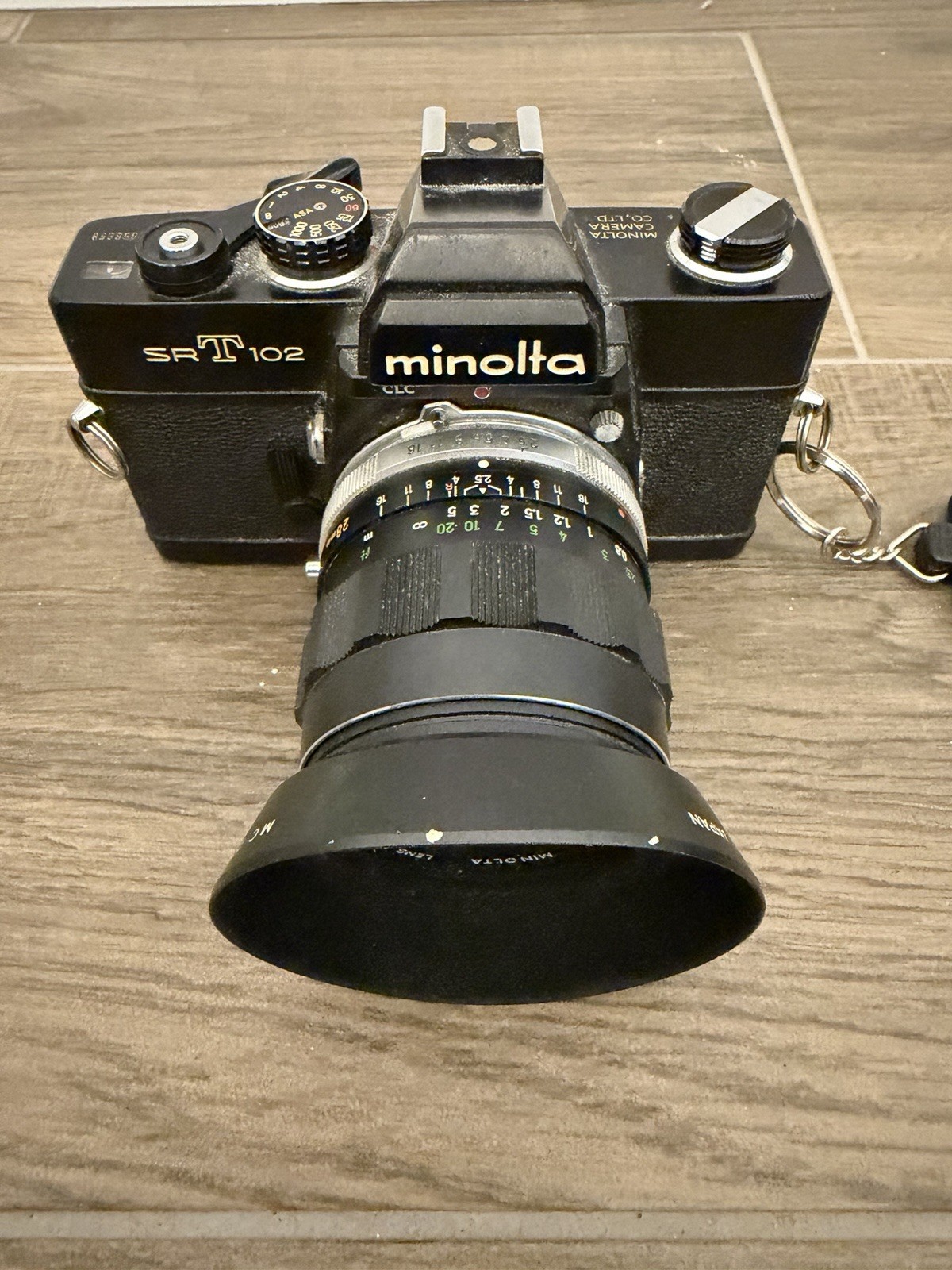
MINOLTA SR-T 102
The Minolta SR-T 102 is a 35mm single-lens reflex (SLR) camera produced by Minolta Camera Co., Ltd. from 1971 to 1974. As an enhanced version of the highly successful SR-T 101, the SR-T 102 refined its predecessor’s robust mechanical design with improved ergonomics, enhanced metering displays, and superior build quality, solidifying its place as one of the most respected manual-focus SLRs of the early 1970s.
Overview
Introduced in 1970, the Minolta SR-T 102 succeeded the SR-T 101 as part of Minolta’s professional-grade SR-T series, which had established a reputation for reliability, accurate through-the-lens (TTL) metering, and rugged construction. The SR-T 102 was designed for serious amateur and semi-professional photographers who demanded precision, durability, and consistent exposure control in a mechanical SLR system. It retained the core mechanical shutter and full manual operation of the SR-T 101, with no significant changes to the viewfinder exposure display., making exposure assessment faster and more intuitive.
The SR-T 102 was part of Minolta’s long lineage of manual-focus SLRs that utilized the company’s proprietary SR bayonet mount, ensuring compatibility with a wide range of Minolta Rokkor lenses. It featured Minolta’s renowned CLC (Contrast Light Compensator) metering system, a dual-cell TTL metering technology that measured light from both the center and periphery of the scene to reduce exposure errors in high-contrast situations. This innovation gave the SR-T series a competitive edge over many contemporaries that used single-cell meters.
Positioned above entry-level models like the SR-7 and SR-1, the SR-T 102 occupied a mid-to-upper tier in Minolta’s SLR lineup. It was succeeded by the SR-T 100 in 1974, though the SR-T 303 was not a direct successor and was introduced later as a lower-tier model., reflecting Minolta’s ongoing commitment to refining mechanical SLR performance before the advent of electronic automation.
Specifications
| Specification | Value |
| Type | 35mm Single-Lens Reflex (SLR) |
| Film Format | 35mm (135 film), interchangeable lenses |
| Years Produced | 1970–1976 |
| Lens Mount | Minolta SR bayonet mount (compatible with MC lenses; MD lenses can be used but require stop-down metering) |
| Shutter | Horizontal-travel, cloth focal-plane shutter; speeds from 1 sec to 1/1000 sec, plus B (bulb) |
| Metering | TTL full-aperture metering with CLC (Contrast Light Compensator) dual CdS cells |
| Exposure Modes | Manual exposure only; stop-down metering via AE lock button |
| Viewfinder | Fixed pentaprism, eye-level with microprism collar and split-image rangefinder; displays match-needle exposure meter |
| Dimensions | 142 mm (W) × 95 mm (H) × 53 mm (D); weight: ~695 g (body only, with battery and strap lug, but without lens or battery) |
Key Features
- CLC TTL Metering System: Dual CdS light meters (center and outer segments) provide balanced exposure readings in challenging lighting, reducing over- or underexposure in backlit or high-contrast scenes.
- Multiple Exposure Displays: Improved match-needle metering in the viewfinder with additional exposure indicators, allowing precise manual exposure adjustment.
- Fully Mechanical Shutter: Operates without batteries for all speeds except meter activation; ensures reliability even with dead or missing batteries.
- Minolta SR Bayonet Mount: Compatible with hundreds of Minolta Rokkor MC and MD lenses, as well as third-party lenses from brands like Vivitar, Sigma, and Tokina.
- Stop-Down Metering: AE lock button enables stop-down metering for accurate exposure with non-MC lenses or special optics.
Historical Context
The SR-T 102 was released during a pivotal era in 35mm photography, when mechanical SLRs dominated the market and manufacturers competed on build quality, metering accuracy, and lens ecosystems. Minolta had already built a strong reputation with the SR-T 101 (1966), which introduced CLC metering and rugged construction. The SR-T 102 refined this formula with subtle but meaningful improvements: enhanced viewfinder displays, a redesigned rewind crank, and minor cosmetic updates including a revised shutter speed dial and film rewind lock.
At the time, competitors included the Nikon F (and later Nikkormat series), Canon FX and FTb, Pentax Spotmatic SP and SPII, and Olympus FTL. The SR-T 102 was well-regarded for its CLC metering system and solid ergonomics. Unlike some rivals that used center-weighted averaging from a single cell, Minolta’s CLC system analyzed multiple zones, offering more consistent results—particularly valuable for slide photographers and professionals working in variable conditions.
Market reception was positive, with the SR-T 102 praised in photographic journals for its durability, intuitive handling, and metering accuracy. It was widely adopted by photojournalists, educators, and advanced amateurs, particularly in Europe and North America. Its mechanical reliability made it a favorite in harsh environments, and its compatibility with the extensive Rokkor lens line enhanced its appeal.
Collectibility & Value
Today, the Minolta SR-T 102 is a sought-after classic among film photography enthusiasts and collectors of vintage SLRs. The SR-T 102 is not significantly rarer than the SR-T 101 and was produced in comparable numbers; its collectible value is similar to other common mechanical SLRs of the era. In excellent working condition, with a clean viewfinder and responsive shutter, the SR-T 102 typically sells for $120–$200 USD. Cameras paired with original Rokkor lenses, especially fast primes like the 58mm f/1.4 or 50mm f/1.7, can command significantly higher prices.
When purchasing an SR-T 102, buyers should inspect for common issues: shutter accuracy at slow speeds, mirror bounce, light seals (which often degrade and cause light leaks), and the condition of the CdS cells (which can fail or become erratic). The battery used for the meter is a 1.35V mercury PX625, now obsolete; modern substitutes (e.g., Wein Cell or adapter with 1.5V alkaline) may require meter recalibration. Additionally, the self-timer mechanism and film advance lever can wear over time, particularly on heavily used bodies.
Despite its age, the SR-T 102 remains a functional and reliable camera. Its fully mechanical operation means it can still be used decades later with only routine maintenance. Enthusiasts appreciate its tactile controls, solid metal construction, and the optical quality of Rokkor lenses, making it a favorite for those exploring film photography with vintage gear.
Similar Cameras
- Pentax Spotmatic SP/SP II – Known for its reliable TTL metering and durable build; used M42 screw mount.
- Nikkormat FT2 – Nikon’s mechanical SLR with robust construction and excellent FD-mount lens compatibility.
- Canon FX/FTb – Early Canon SLRs with reliable mechanical shutters and FL/FD lens systems.
- Olympus FTL – Compact 35mm SLR with TTL metering and innovative Zuiko lens line.
- Yashica TL Electro-X – Mechanically timed with electronic metering; part of the popular Yashica TL series.
Repair & Maintenance
The SR-T 102 uses a 1.35V mercury PX625 battery to power its CdS meter cells. Since mercury batteries are no longer manufactured, users typically substitute with a Wein Cell (zinc-air) or a modern alkaline PX625 with a voltage reducer to avoid overexposing due to higher voltage (1.5V). The camera’s shutter and film advance are fully mechanical and do not require batteries to operate.
Common maintenance issues include degraded light seals (which should be replaced to prevent light leaks), stiff shutter curtains (especially at 1/30s or 1s), and worn leatherette. The CLC meter system is generally reliable but can suffer from sluggish needle response or inaccurate readings if the CdS cells are fatigued. Professional CLA (Clean, Lubricate, Adjust) services are recommended every 5–10 years for regular users.
Repair difficulty is moderate: while the camera’s modular design allows for disassembly, the shutter mechanism and meter linkage require precision tools and expertise. DIY repairs are feasible for experienced technicians, but beginners are advised to seek professional servicing. Spare parts are still available through vintage camera specialists and online marketplaces, though original Minolta service manuals are rare but occasionally found in collector circles.
eBay Listings


As an eBay Partner, we earn from qualifying purchases. This helps support our independent vintage technology research.
Related Models
- Minolta SR-T 200 (1975–1981)
- Minolta Dynax 9 (1998-2004)
- Minolta Maxxum 7000 (1985-1988)
- Minolta SR-T 100 (1969-1975)
- Minolta SR-T 101 (1966-1981)
- Alpa 6 (1948-1953)
- Agfa Agfaflex
- Agfa Ambiflex
- Agfa Easy
- Agfa Futura Af zoom