MINOLTA SR-T 101
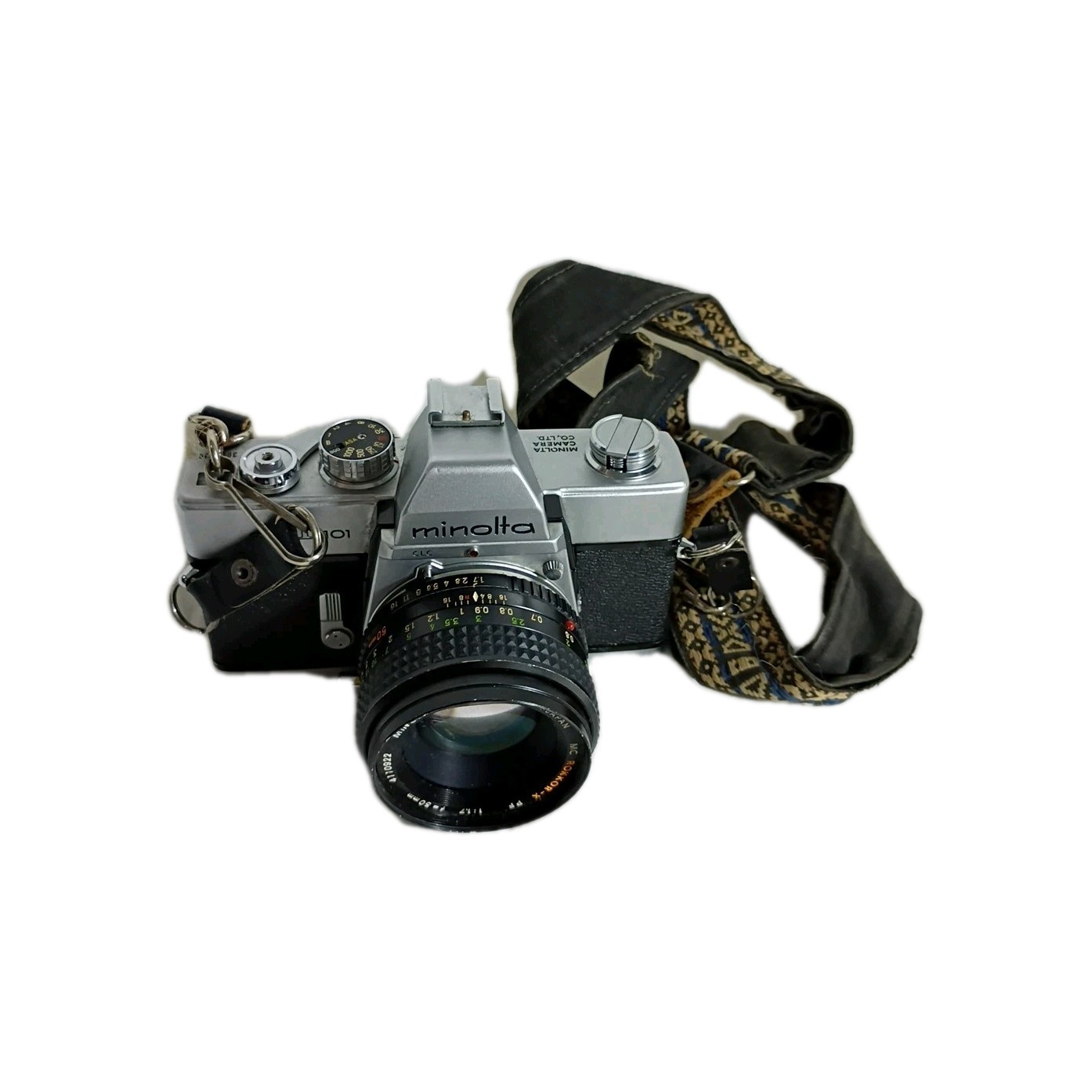
The Minolta SR-T 101 is a fully mechanical 35mm single-lens reflex (SLR) camera introduced in 1966, renowned for its innovative CLC (Contrast Light Compensation) metering system and rugged all-metal construction. As one of the first SLRs to offer through-the-lens (TTL) metering with a dual-cell system, the SR-T 101 set a new standard for exposure accuracy and reliability in its era.
Overview
Released in October 1966, the Minolta SR-T 101 was a pivotal model in Minolta’s transition from rangefinder to SLR dominance, marking the company’s commitment to professional-grade photography equipment. Designed for serious amateur and professional photographers, the SR-T 101 replaced the earlier Minolta SR-series models and became the flagship of Minolta’s SLR lineup until the introduction of the XD series in the late 1970s. It was manufactured in Japan at Minolta’s precision facilities in Osaka and remained in production for an impressive 15 years, a testament to its enduring design and mechanical robustness.
The SR-T 101 was engineered with a fully mechanical operation, requiring no batteries for shutter or film transport functions—batteries were used solely for the light meter. This made it highly reliable in field conditions where power sources were unavailable. Its most groundbreaking feature was the CLC (Contrast Light Compensation) metering system, which used two cadmium sulfide (CdS) cells positioned on either side of the viewfinder to measure light reflected from the film plane via the mirror. This dual-cell TTL metering system provided balanced exposure readings by averaging light from multiple points, significantly reducing errors caused by high-contrast scenes—a common flaw in contemporary center-weighted meters.
Built around the Minolta MC (Meter Coupled) bayonet mount, the SR-T 101 was compatible with a rapidly expanding line of Minolta Rokkor lenses, including fast primes and zooms. The camera featured a pentaprism viewfinder with a microprism collar and split-image rangefinder spot, enabling precise manual focusing. Its horizontal cloth-curtain focal-plane shutter offered speeds from 1 second to 1/1000th of a second, plus Bulb mode, and was fully synchronized with flash via PC terminal and hot shoe.
The SR-T 101 quickly gained a reputation for durability, optical precision, and metering accuracy, earning accolades from photographers worldwide. Over 800,000 units were produced during its production run, making it one of the most successful mechanical SLRs of the 1960s and 1970s. It laid the foundation for subsequent models like the SR-T 102, SR-T 201, and SR-T 303, all of which refined but did not fundamentally alter the original’s design philosophy.
Specifications
| Specification | Value |
| Type | 35mm Single-Lens Reflex (SLR) |
| Film Format | 35mm (135 cartridge) |
| Years Produced | 1966–1981 |
| Lens Mount | Minolta MC/MD Bayonet (incompatible with later MD-only features) |
| Shutter | Horizontal-travel cloth focal-plane shutter; 1 sec – 1/1000 sec + B |
| Metering | TTL CLC (Contrast Light Compensation) with dual CdS cells |
| Exposure Modes | Manual only (stop-down metering with open-aperture preview) |
| Viewfinder | Fixed pentaprism with split-image/microprism focusing aid, 92% coverage |
| Dimensions | 140 × 93 × 57 mm (5.5 × 3.7 × 2.2 in); ~670 g (body only, no battery) |
Key Features
- CLC TTL Metering System: Dual CdS cells provide balanced exposure readings by averaging light from two points, minimizing overexposure in backlit or high-contrast scenes.
- Fully Mechanical Operation: Shutter and film advance function without batteries; only the light meter requires power (1 × 1.35V mercury PX625 or modern equivalent).
- Minolta MC Lens Mount: Supports stop-down metering with MC-series lenses; enables automatic diaphragm return and open-aperture composition.
- Robust Build Quality: Die-cast zinc alloy chassis with metal top and base plates, designed for long-term durability.
- Flash Synchronization: X-sync at all speeds via PC terminal and built-in hot shoe; sync speed 1/60 sec.
Historical Context
The SR-T 101 was launched during a transformative period in 35mm photography, as SLR cameras began to displace rangefinders as the preferred tools for both professionals and advanced amateurs. Competing directly with the Nikon F, Pentax Spotmatic, and Canon FX, the SR-T 101 distinguished itself through its innovative CLC metering system, which addressed a critical limitation of early TTL meters: their tendency to underexpose in high-contrast lighting. Minolta’s solution—using two offset CdS cells to sample different areas of the frame—provided more consistent exposure across varied scenes, particularly in backlit conditions.
Market reception was overwhelmingly positive. The SR-T 101 received numerous awards and was adopted by photojournalists and studio photographers alike for its reliability and accurate metering. Its mechanical simplicity, combined with advanced metering, made it ideal for use in harsh environments, from war zones to mountain expeditions. Minolta leveraged the SR-T 101’s success to expand its global distribution, particularly in North America and Europe, where it competed head-to-head with Pentax and Nikon. The camera’s longevity—15 years of production—reflects both its solid engineering and Minolta’s conservative approach to updating a proven design.
Collectibility & Value
Today, the Minolta SR-T 101 is a sought-after classic among film photography enthusiasts and vintage camera collectors. While not rare due to its high production volume, well-maintained examples in working condition typically command $150–$300 USD, with mint specimens reaching higher prices. Cameras with original Rokkor lenses, especially fast primes like the 50mm f/1.4 or 58mm f/1.2, are particularly valuable.
When purchasing an SR-T 101, buyers should verify the functionality of the shutter at all speeds, the accuracy of the light meter (noting that original PX625 mercury batteries are obsolete and must be replaced with zinc-air or adapters), and the condition of the mirror and focusing screen. Common issues include stiff shutter curtains due to dried lubricants, inaccurate metering from aging CdS cells, and light seals degradation, which can lead to film fogging. The camera uses a non-replaceable battery soldered to the circuit board in early models, though later revisions allowed for easier access.
Despite these age-related concerns, the SR-T 101 remains highly repairable thanks to its mechanical simplicity and widespread availability of spare parts. Its robust construction ensures that properly serviced units continue to function reliably, making it a practical choice for those who shoot film regularly.
Similar Cameras
- Pentax Spotmatic (1964–1976): Comparable TTL metering SLR with M42 screw mount; slightly earlier but similarly influential.
- Nikon F (1959–1973): Professional system camera with interchangeable viewfinders and focus screens; more modular but lacked built-in metering initially.
- Canon FX (1964): Early Canon 35mm SLR with TTL metering, though less advanced than CLC.
- Yashica TL Electro-X (1970): Electronic successor with similar metering ambitions but reliant on batteries for shutter operation.
- Topcon RE Super (1963): High-end Japanese SLR with excellent optics and TTL metering, favored by professionals.
Repair & Maintenance
The SR-T 101 requires a 1.35V mercury PX625 battery for its light meter, though modern alternatives such as Wein Cell (zinc-air) or alkaline PX625A (with voltage compensation) are commonly used. Due to voltage differences, meter readings may require calibration when using non-mercury batteries. The camera’s shutter and film advance are entirely mechanical and do not depend on electrical power.
Common maintenance issues include sluggish shutter speeds caused by dried lubricants, especially in the cloth focal-plane shutter, and degraded light seals that can allow light leaks. The CdS cells may lose sensitivity over time, leading to inaccurate metering—professional recalibration or replacement is possible but requires technical expertise. The self-timer mechanism and mirror damping system should be checked for smooth operation. Given its mechanical nature and widespread support, the SR-T 101 is considered moderately easy to repair, with many technicians familiar with its design. Regular cleaning, lubrication, and calibration (CLA) every 5–10 years are recommended for continued reliable use.
eBay Listings


As an eBay Partner, we earn from qualifying purchases. This helps support our independent vintage technology research.
Service Manuals & Schematics
- Manual (1966) — archive.org
Related Models
- Minolta SR-T 200 (1975–1981)
- Minolta Dynax 9 (1998-2004)
- Minolta Maxxum 7000 (1985-1988)
- Minolta SR-T 100 (1969-1975)
- Minolta SR-T 102 (1970–1976)
- Alpa 6 (1948-1953)
- Agfa Agfaflex
- Agfa Ambiflex
- Agfa Easy
- Agfa Futura Af zoom