MINOLTA SR-T 100
The Minolta SR-T 100 is a 35mm single-lens reflex (SLR) camera introduced in 1969 as a simplified, cost-effective variant of the highly successful SR-T 101. Designed for amateur photographers seeking reliable mechanical performance with built-in TTL (through-the-lens) metering, the SR-T 100 offered core functionality without advanced features like a self-timer or rapid-wind lever, making it one of the most accessible models in Minolta’s SR-T series.
Overview
Released in 1969, the Minolta SR-T 100 was positioned as an entry-level alternative within the acclaimed SR-T line, which had established Minolta as a leader in mechanical SLR design during the late 1960s. While sharing the robust build quality, advanced CLC (Contrast Light Compensator) metering system, and bright viewfinder optics of its more advanced siblings—such as the SR-T 101 and SR-T 102—the SR-T 100 was stripped of certain features to reduce manufacturing costs and retail price. It lacked a self-timer mechanism and did not include the rapid-wind accessory shoe found on the top plate of higher-end models, though it retained full manual exposure control and compatibility with the full range of Minolta MC/MD Rokkor lenses.
The SR-T 100 was marketed toward beginner and intermediate photographers who prioritized reliability, accurate metering, and lens interchangeability over convenience features. Its mechanical shutter and fully manual operation ensured dependable performance without reliance on batteries for shutter function—only the light meter required power. This made it particularly suitable for travel, outdoor photography, and users in regions with limited access to replacement batteries. Despite its simplified feature set, the SR-T 100 maintained the hallmark durability and optical excellence associated with Minolta’s SLRs of the era, contributing to its reputation as a no-frills workhorse.
Specifications
| Specification | Value |
| Type | 35mm Manual Focus SLR |
| Film Format | 35mm (135 cartridge) |
| Years Produced | 1969–1975 |
| Lens Mount | Minolta SR (MC/MD compatible) |
| Shutter | Horizontal-travel cloth focal-plane shutter; speeds 1 sec to 1/1000 sec + B |
| Metering | TTL full-aperture metering via CLC (Contrast Light Compensator) dual CdS cells |
| Exposure Modes | Manual only (stop-down metering available) |
| Viewfinder | Fixed pentaprism, 0.92x magnification, 94% coverage; split-image rangefinder with microprism collar |
| Dimensions | 140 × 90 × 50 mm (approx.); Weight: ~650 g (body only, no battery) |
| Flash Sync | PC terminal and X-sync hot shoe (1/60 sec sync speed) |
| Battery | One 1.35V mercury PX625 (or modern 1.5V alkaline equivalent with exposure compensation) |
| Film Advance | Single-stroke lever (180° throw), frame counter automatic reset |
| Self-Timer | Not available |
| Depth-of-Field Preview | Yes, via button on lens mount |
Key Features
- CLC TTL Metering System: Utilizes dual CdS cells with contrast compensation for accurate exposure readings under mixed lighting conditions.
- Mechanical Shutter Operation: Fully functional without batteries; only the light meter requires power, ensuring reliability in long-term use.
- Compatibility with Rokkor Lenses: Supports all Minolta MC and MD series lenses (with stop-down metering for MD lenses).
- Bright Viewfinder with Focusing Aids: Features a split-image rangefinder surrounded by a microprism collar for precise manual focusing.
- Durable All-Metal Construction: Built with a brass shutter curtain housing and rugged chassis, typical of professional-grade SLRs of the period.
Historical Context
The Minolta SR-T 100 was introduced at a time when 35mm SLRs were transitioning from specialist tools to mainstream consumer products. The late 1960s saw increasing demand for affordable yet capable cameras that offered TTL metering and interchangeable lenses. Minolta had already gained acclaim with the SR-T 101 (1966), which set new standards for metering accuracy and build quality. The SR-T 100 allowed Minolta to capture a broader segment of the market by offering a streamlined version that retained the core technological advantages—particularly the CLC metering system—while removing non-essential components.
Competitors during this period included the Canon FTb, Nikon Photomic series (e.g., Nikkormat FT), and Pentax Spotmatic. While these models offered similar mechanical reliability and metering capabilities, the SR-T 100 distinguished itself through its refined ergonomics, intuitive meter display (center-the-needle system), and excellent lens ecosystem. Though lacking a self-timer—a feature considered minor for most users—it remained competitive due to its lower price point and strong resale value. The SR-T 100 was primarily sold in North America and Europe and was often bundled with a 50mm f/1.7 or f/1.8 Rokkor lens.
Collectibility & Value
Today, the Minolta SR-T 100 is regarded as a solid, functional classic with moderate collectibility. While not as sought-after as the SR-T 101 or limited editions like the SR-T Super, it remains popular among film photography enthusiasts for its reliability and accurate metering. Units in good working condition typically sell for $75–$150 USD, depending on cosmetic state, shutter accuracy, and lens inclusion. Fully functional meters with original mercury-compatible circuits (or properly adjusted for modern batteries) command higher prices.
When purchasing an SR-T 100, collectors should verify shutter operation across all speeds, check for mirror movement smoothness, and confirm the light meter responds accurately to changing light. Common issues include degraded light seals (causing stiff film advance or improper frame spacing), sticky shutter curtains (especially at 1 sec or B), and CdS cell aging leading to inaccurate meter readings. Replacement of the light seals and CLA (clean, lubricate, adjust) servicing can restore functionality and preserve long-term usability. The absence of a self-timer is not considered a defect but rather a model-specific trait.
Similar Cameras
- Pentax Spotmatic F – Similar 35mm SLR with TTL metering, manual focus, and M42 screw mount; produced until 1976.
- Nikkormat FT2 – Nikon’s budget-friendly SLR with mechanical shutter and match-needle metering; compatible with Nikon F-mount lenses.
- Canon FTb – Rugged 35mm SLR with TTL metering and interchangeable focus screens; part of Canon’s FL/FD lens system.
- Yashica TL Electro-X – Electronically controlled aperture-priority SLR with similar target market; uses M42 mount.
- Olympus OM-1 – Compact mechanical SLR introduced in 1972; praised for portability and optical quality.
Repair & Maintenance
The SR-T 100 operates mechanically and does not require batteries for shutter function; however, the TTL meter relies on a 1.35V mercury PX625 battery. Due to the discontinuation of mercury cells, users often substitute 1.5V alkaline or silver oxide equivalents (e.g., Wein Cell), though this may introduce slight metering inaccuracies (typically +⅓ to +½ stop), requiring manual exposure compensation. Some technicians modify the meter circuit to recalibrate for modern batteries.
Common maintenance needs include replacing deteriorated light seals (foam or rubber around the film chamber), cleaning the mirror and focusing screen, and ensuring the shutter curtains are free of oil or tears. The film transport mechanism is generally robust but may require cleaning if the counter or advance lever feels stiff. Given the age of these cameras, a professional CLA every 5–10 years is recommended for regular users. Replacement parts are moderately available through camera repair specialists and online markets, though the lack of a self-timer limits demand for specific top-plate components. Overall, the SR-T 100 is considered repairable and durable, with many units still functioning reliably after decades of use.
eBay Listings


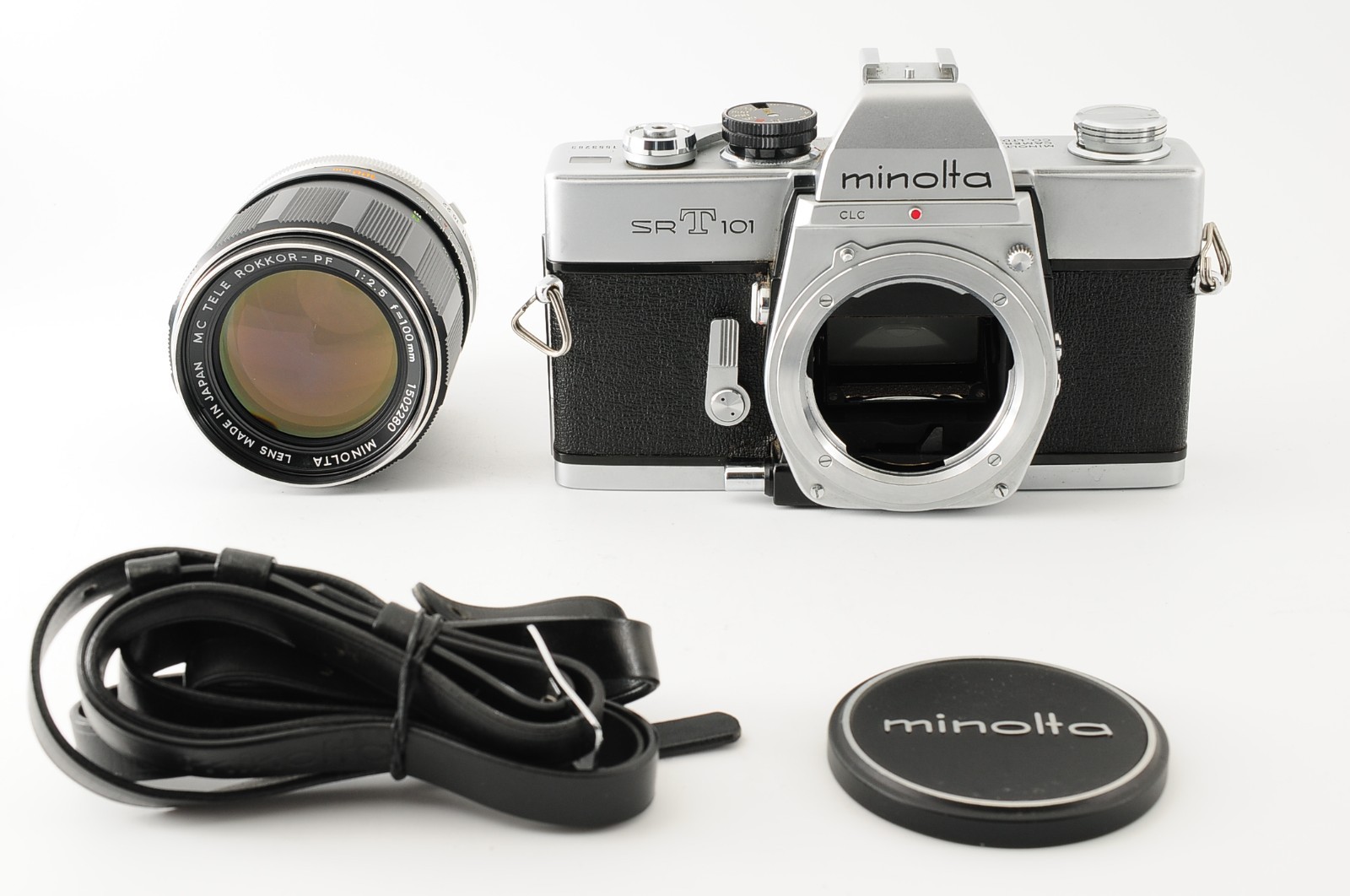

As an eBay Partner, we earn from qualifying purchases. This helps support our independent vintage technology research.
Related Models
- Minolta SR-T 200 (1975–1981)
- Minolta Dynax 9 (1998-2004)
- Minolta Maxxum 7000 (1985-1988)
- Minolta SR-T 101 (1966-1981)
- Minolta SR-T 102 (1970–1976)
- Alpa 6 (1948-1953)
- Agfa Agfaflex
- Agfa Ambiflex
- Agfa Easy
- Agfa Futura Af zoom