Minolta Maxxum 7000 (1985–1988): The Camera That Dragged SLRs Into the Future
The world’s first autofocus SLR with an in-body motor, the Maxxum 7000 didn’t just enter the market—it detonated a bomb in the middle of it.
Overview
If you were shooting 35mm film in 1985 and someone handed you a Minolta Maxxum 7000, you’d think it was from the future. It looked like a spaceship—a blocky, angular slab of black polycarbonate with buttons, dials, and a digital LCD panel where mechanical levers used to be. But the real shock wasn’t the design. It was the sound: a soft, insistent whir-click as the lens snapped into focus before you’d even fully raised it to your eye. That noise was the death rattle of manual focus dominance, and the birth cry of modern photography.
The Maxxum 7000 wasn’t just another incremental upgrade. It was the first 35mm SLR to integrate autofocus into the camera body itself, using a motor to drive focus through a mechanical coupling in the lens mount. Previous autofocus attempts—like the Konica C35 AF or even Minolta’s own 1981 X-500 prototype—relied on bulky, battery-guzzling motorized lenses. The Maxxum 7000 flipped the script: the intelligence lived in the body, and the lenses were lean, lightweight, and—dare I say—elegant. This wasn’t just convenience; it was a philosophical shift. Suddenly, autofocus wasn’t a gimmick for point-and-shoots. It was serious, fast, and precise enough for pros and enthusiasts alike. Photojournalists, wedding shooters, and even skeptical film purists began to notice. The future had arrived, and it ran on two CR123A batteries.
Specifications
| Film Format | 35mm |
| Lens Mount | Minolta A-mount |
| Shutter Speeds | 1/2000 to 4 seconds, bulb |
| Shutter Type | Vertical-travel, electronically controlled metal focal-plane shutter |
| Exposure Modes | Program AE, Aperture Priority, Shutter Priority, Manual |
| Autofocus System | TTL phase-detection with single AF sensor |
| Focus Modes | Full-time manual override, autofocus (single-shot and continuous) |
| Metering System | TTL full-aperture metering with 6-segment silicon photodiode |
| Metering Modes | Center-weighted average, spot metering |
| Viewfinder | Pentaprism eye-level, 94% coverage, 0.90x magnification |
| Flash Sync Speed | 1/100 second |
| Flash Connector | Dedicated hot shoe, PC terminal |
| Exposure Compensation | –2 to +2 EV in 1/2 EV steps |
| Self-Timer | 10-second delay |
| Battery | 2x CR123A lithium batteries |
| Battery Life | Approx. 50 rolls of 24 exposures (with typical use) |
| Dimensions | 140.5 x 96.5 x 65 mm (5.5 x 3.8 x 2.6 in) |
| Weight | 600 g (21.2 oz) body only |
| Drive Modes | Single frame, continuous advance (up to 2.5 fps) |
Key Features
- First In-Body Autofocus Motor: This wasn’t just “autofocus.” It was the first time the motor lived in the camera body, not the lens. That meant lighter lenses, faster focus, and a system that could evolve. The A-mount was born here, and it would serve Minolta (and later Sony) for decades.
- Four Exposure Modes Including Program AE: In 1985, most SLRs offered aperture or shutter priority, maybe manual. The Maxxum 7000 gave you full Program mode—yes, the camera could choose both shutter and aperture—and it worked. Paired with its dedicated flash system, it could even automate flash output. This was the dawn of “set it and forget it” without sacrificing image quality.
- TTL Phase-Detection AF with Full-Time Manual Override: The single AF sensor was basic by today’s standards, but it was revolutionary then. More importantly, you could tweak focus manually at any time—no switch needed. This “DMF” (Direct Manual Focus) feature would become a Minolta hallmark, and it felt like magic: autofocus gets you close, your fingers fine-tune. Still one of the most intuitive systems ever devised.
- 6-Segment Metering with Spot Option: While not multi-zone in the modern sense, the 6-segment silicon photodiode was unusually responsive for its time. Spot metering was precise, and center-weighted mode handled backlit portraits with surprising grace. It wasn’t perfect in extreme contrast, but it was leagues ahead of the CdS cells in older SLRs.
- Programmed Flash Integration: The dedicated hot shoe wasn’t just for mounting flashes. It communicated with Minolta’s new Program Flash units (like the 280PX), allowing the camera to set flash duration automatically in Program mode. This was the first true “smart flash” system in an SLR, and it worked beautifully for event photographers.
Historical Context
Before the Maxxum 7000, the SLR world was ruled by mechanical precision and manual control. Nikon’s F3 and Canon’s AE-1 were kings—beloved, reliable, but fundamentally analog. Autofocus existed, but only in niche products or as a lens-based afterthought. Minolta changed the game by betting everything on integration. While Nikon hesitated (their first F-mount AF body, the F-501, wouldn’t arrive until 1986 and was widely panned), and Canon went all-in on a new electronic lens mount (EOS 650, 1987), Minolta delivered a fully realized, user-friendly system in 1985. They didn’t just release a camera—they launched an ecosystem.
The impact was immediate. Within a year, Minolta’s market share in the U.S. jumped from 12% to over 20%. The Maxxum 7000 was everywhere: in photojournalists’ hands at the 1988 Seoul Olympics, in wedding bags across suburban America, on the wish lists of college photography students. It forced the entire industry to accelerate. Canon’s decision to abandon FD mount for EF was partly a reaction to Minolta’s A-mount success. Nikon’s slow AF rollout made them look stodgy. Even Pentax and Olympus scrambled to catch up. The Maxxum 7000 didn’t just win a product war—it redefined the battlefield.
Collectibility & Value
Today, the Minolta Maxxum 7000 is a sought-after icon. While not rare—production ran solidly from 1985 to 1988—it’s uncommon to find one in fully functional condition. Most have suffered from the two great killers: AF motor degradation and battery corrosion. The motor gears wear out, and dried lubricant turns the once-smooth focus into a labored grind. Worse, the CR123A batteries are prone to leaking, and the compartment’s metal contacts corrode easily. A working Maxxum 7000 is a prize.
In 2025, expect to pay $150–$300 USD for a tested, functional unit—higher if it comes with original packaging or a rare lens like the 35–70mm f/4 AF. Look for clean battery contacts, smooth film advance, and responsive autofocus. Avoid units with “gritty” focus sounds or fogged viewfinders. Bonus points if it still has the original strap with the red “Maxxum” logo. Despite its age, this camera still delivers sharp, well-exposed images. Pair it with a Minolta Maxxum 5000 as a backup, and you’ve got a time capsule of 1980s photographic innovation that actually works. It’s not just nostalgia—it’s a testament to bold engineering that dared to be first.
eBay Listings


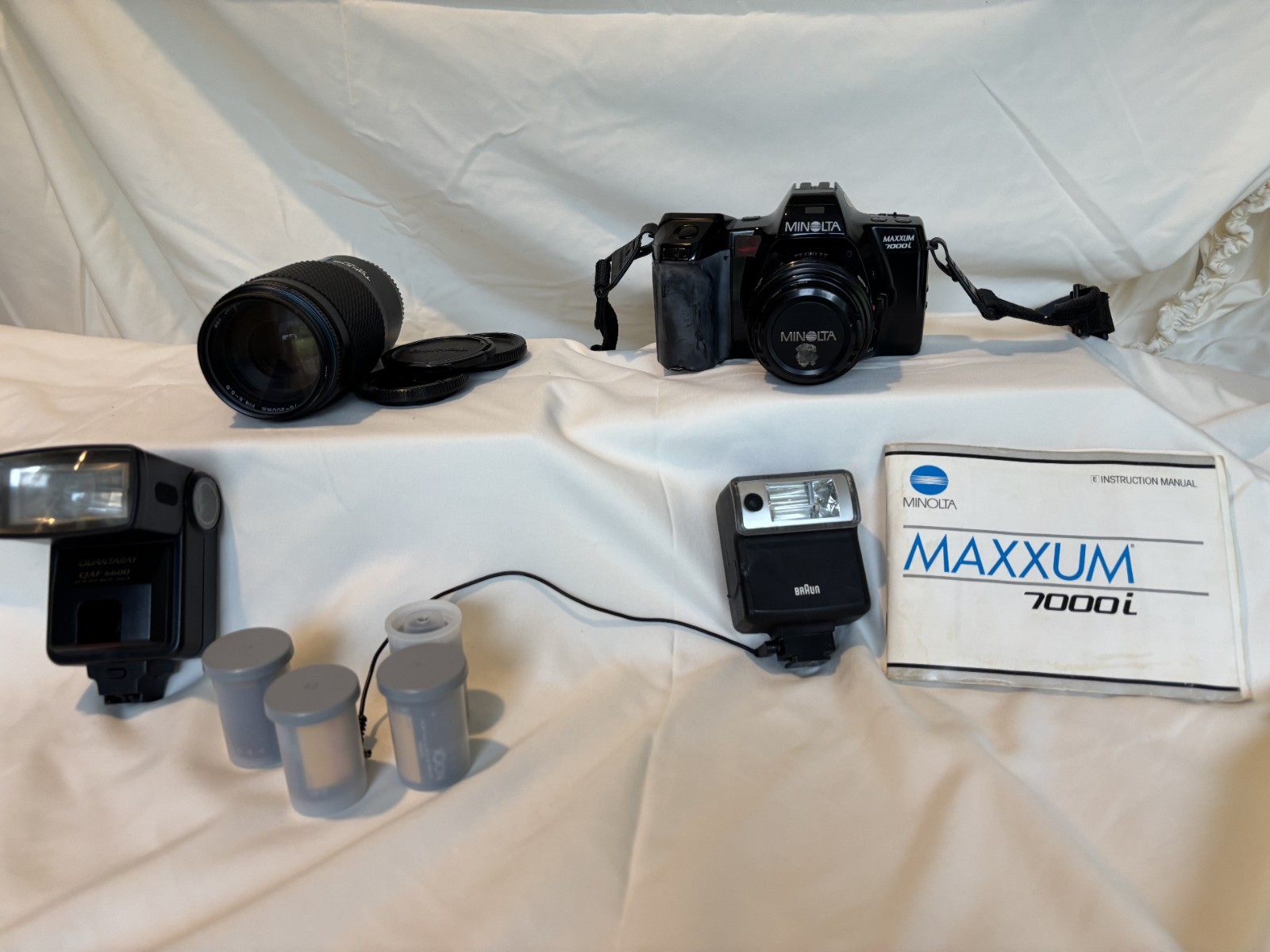
As an eBay Partner, we earn from qualifying purchases. This helps support our independent vintage technology research.
Service Manuals & Schematics
- Manual (1997) — archive.org
Related Models
- Minolta SR-T 200 (1975–1981)
- Minolta Dynax 9 (1998-2004)
- Minolta SR-T 100 (1969-1975)
- Minolta SR-T 101 (1966-1981)
- Minolta SR-T 102 (1970–1976)
- Alpa 6 (1948-1953)
- Agfa Agfaflex
- Agfa Ambiflex
- Agfa Easy
- Agfa Futura Af zoom