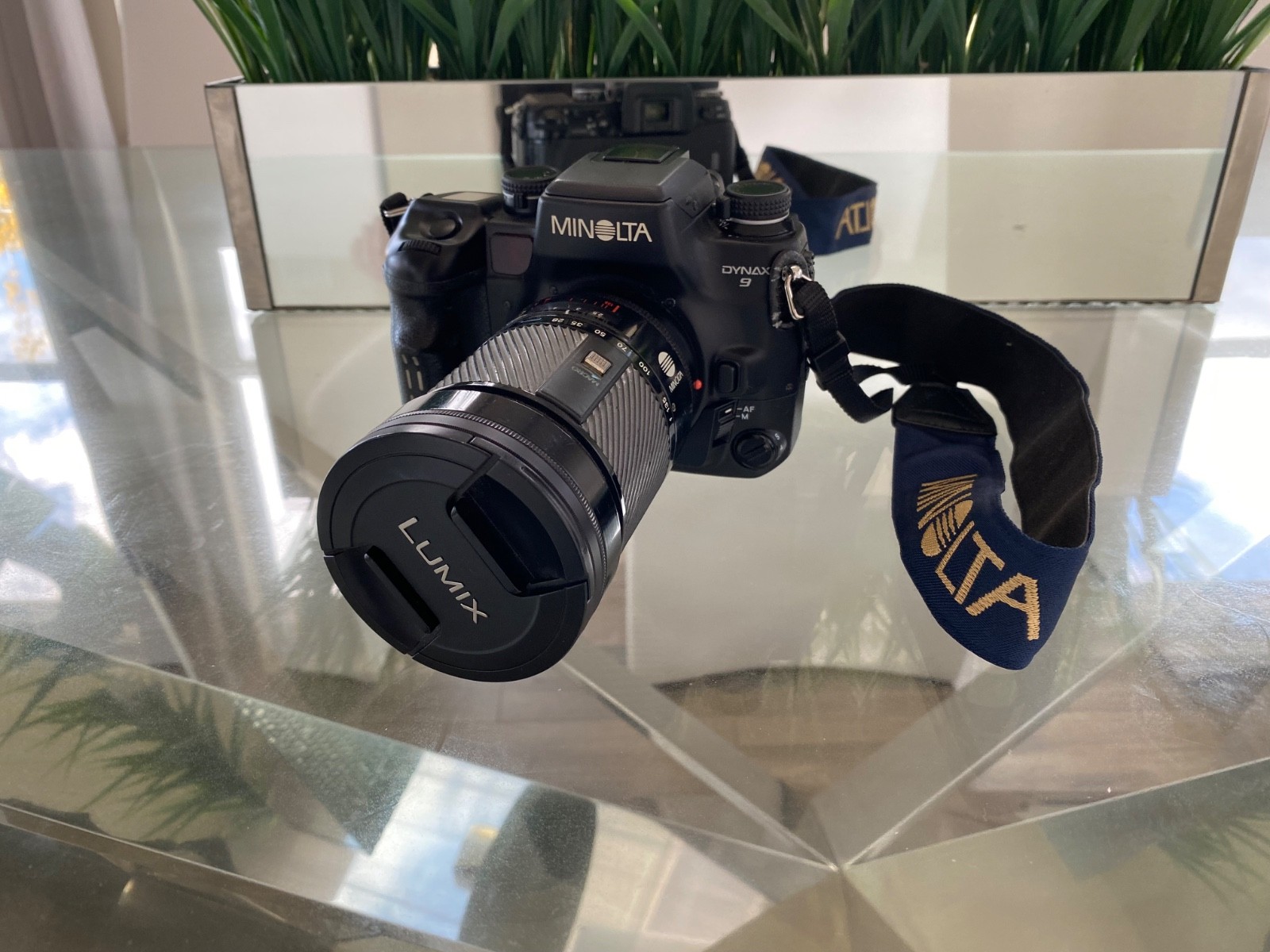
MINOLTA DYNAX 9
The Minolta Dynax 9 (marketed as the Maxxum 9 in North America and α-9 in Japan) is Minolta’s flagship professional 35mm autofocus SLR camera, introduced in 1998 as the pinnacle of the company’s film-era SLR engineering. Designed for demanding photojournalists, sports, and studio photographers, the Dynax 9 combines advanced autofocus, rugged weather-sealed construction, and a high-speed mechanical system in a sophisticated, modular body.
Overview
Launched in September 1998, the Minolta Dynax 9 represented the culmination of Minolta’s decades-long development in autofocus SLR technology. Positioned as a direct competitor to the Nikon F5 and Canon EOS-1V, the Dynax 9 was engineered to meet the rigorous demands of professional photographers across genres. It featured an advanced predictive autofocus system with 14-segment metering and a newly developed 9-point AF sensor array, building on earlier systems from the Dynax 7 and 800si, offering superior subject tracking and low-light performance. The camera’s body was constructed from a lightweight yet durable magnesium alloy chassis, with extensive weather and dust sealing at over 70 critical points, making it suitable for use in extreme environmental conditions.
The Dynax 9 was part of Minolta’s second-generation "Dynax/Maxxum" professional line, succeeding the Dynax 7 and Dynax 800si series. It was designed to work seamlessly with Minolta’s A-mount system and G-series lenses, particularly those with ADI (Advanced Distance Integration) flash metering and SSM (Super Sonic Motor) focusing. The camera also introduced Minolta’s innovative "Intelligent Function Control" (IFC), allowing users to customize operation via a dual-function joystick and LCD panel on the top deck. With a maximum continuous shooting speed of 5.5 frames per second and a shutter capable of 1/12,000 second, the Dynax 9 offered technical capabilities that rivaled or exceeded those of its contemporaries.
Specifications
| Specification | Value |
| Type | 35mm Autofocus SLR |
| Film Format | 35mm (135) |
| Years Produced | 1998–2001 |
| Lens Mount | Minolta A-mount (AF) |
| Shutter | Vertical-travel, electronically controlled focal-plane shutter; 30s to 1/12,000s, Bulb, X-sync at 1/300s (flash sync up to 1/250s with certain lenses) |
| Metering | 14-segment honeycomb-pattern metering using a silicon photodiode sensor, not TTL-OTF |
| Exposure Modes | Program AE (P), Shutter Priority (S), Aperture Priority (A), Manual (M), Auto Depth, Program Shift, Custom Program |
| Viewfinder | Fixed pentaprism with 100% vertical and 94% horizontal coverage; 0.75x magnification (50mm at ∞); interchangeable focusing screens |
| Dimensions | 150 × 121 × 83 mm (5.9 × 4.8 × 3.3 in); Approx. 845 g (body only, no batteries) |
Key Features
- High-Speed 1/12,000s Shutter: One of the fastest mechanical shutter speeds ever offered in a 35mm SLR, enabling wide-aperture use in bright daylight without ND filters.
- Advanced 9-Point AF System: Features three cross-type sensors in the center and predictive focus tracking with subject motion analysis, optimized for fast-moving action.
- Weather-Sealed Magnesium Alloy Body: Extensive gasketing and sealing for resistance to dust, moisture, and temperature extremes.
- Dual Control System: Dual command dials and an IFC joystick for rapid parameter adjustments without removing the eye from the viewfinder.
- ADI Flash Compatibility: Supports Advanced Distance Integration with Minolta’s dedicated flash units (e.g., 5600HS(D)) for precise TTL flash exposure based on lens-to-subject distance.
Historical Context
The Dynax 9 was released at a pivotal moment in photographic history—on the cusp of the digital revolution. While digital SLRs were beginning to emerge, high-resolution professional digital backs remained prohibitively expensive, and 35mm film was still the standard for most professionals. Minolta aimed the Dynax 9 squarely at the top tier of the market, where reliability, speed, and precision were paramount. It competed directly with the Nikon F5 (1996), Canon EOS-1V (2000), and later the Contax N1 (2000), all of which targeted professional photojournalists and sports photographers.
Despite its advanced feature set, the Dynax 9 faced an uphill battle in market penetration. Minolta’s professional presence outside Japan and parts of Europe was limited compared to Canon and Nikon, whose entrenched ecosystems of lenses, service, and user loyalty were difficult to overcome. Nevertheless, the Dynax 9 earned critical acclaim for its ergonomics, build quality, and innovative features—particularly its high-speed shutter and ADI flash system. It was one of the last major investments Minolta made in professional film SLRs before shifting focus toward digital imaging, culminating in the Konica Minolta Maxxum 7D (2004), one of the first DSLRs with in-body image stabilization.
Collectibility & Value
Today, the Minolta Dynax 9 is regarded as a well-regarded professional film SLR and is increasingly collected by enthusiasts of late-era film cameras and Minolta loyalists. Production numbers were relatively low due to its niche professional market, and surviving units in excellent condition are uncommon. As of 2024, used Dynax 9 bodies typically sell for $600–$1,000 USD, depending on condition, included accessories (such as the optional data back or battery grip), and provenance.
When purchasing a Dynax 9, collectors should verify the shutter operation, mirror movement, and light seals, as aging foam can cause light leaks. The camera uses two CR-V3 lithium batteries or six AA cells via a battery pack (AA pack GP-901 or lithium pack BP-901), and original battery grips are now scarce. Common issues include worn shutter contacts, sticky mode dials, and degradation of the rubberized grip. Due to its complexity and limited service support since Minolta exited the camera market in 2006, repair options are constrained, and specialized technicians familiar with high-end Minolta gear are rare.
Similar Cameras
- Nikon F5 (1996) – Professional 35mm SLR with 8fps, advanced 3D matrix metering, and extensive customization.
- Canon EOS-1V (2000) – Flagship Canon film SLR with 10fps, 45-point AF, and robust build quality.
- **Pentax *ist LS** (2002) – Though smaller, it shared advanced metering and weather sealing in a compact pro body.
- Contax N1 (2000) – High-end 35mm SLR with electronic lens mount and advanced metering, aimed at professionals.
- Olympus OM-4Ti (1986) – While manual focus, it was a benchmark for precision and durability in the professional SLR segment.
Repair & Maintenance
The Dynax 9 uses either two CR-V3 lithium batteries or six AA batteries (via the GP-901 grip or BP-901 lithium pack), providing approximately 2,000 exposures per set under normal conditions. Battery compartment corrosion is a known issue, especially if alkaline batteries were left in long-term. The camera’s electronic contacts and shutter mechanism require periodic cleaning and calibration. Common failures include worn encoder wheels (affecting aperture or shutter speed display), degraded light seals, and aging capacitors on internal circuit boards. Due to the camera’s complexity and discontinued status, repair is best handled by specialists experienced with late-model Minolta SLRs. Spare parts are increasingly scarce, making preventative maintenance—such as battery removal during storage and regular mechanical checks—essential for long-term preservation.
eBay Listings



As an eBay Partner, we earn from qualifying purchases. This helps support our independent vintage technology research.
Service Manuals & Schematics
- Service Manual — archive.org
Related Models
- Minolta SR-T 200 (1975–1981)
- Minolta Maxxum 7000 (1985-1988)
- Minolta SR-T 100 (1969-1975)
- Minolta SR-T 101 (1966-1981)
- Minolta SR-T 102 (1970–1976)
- Alpa 6 (1948-1953)
- Agfa Agfaflex
- Agfa Ambiflex
- Agfa Easy
- Agfa Futura Af zoom