Minolta CLE (1980–1985)
At 380 grams, it slips into a jacket pocket like a secret—light, compact, and the only M-mount rangefinder that dared to automate exposure in an analog world.
Overview
The Minolta CLE isn’t just another Leica M clone. It’s the outlier—the only TTL-metered, aperture-priority automatic exposure rangefinder ever built for the M mount, and it held that title alone for over two decades. Introduced in 1980 (or 1981) and produced until 1985, the CLE emerged from the same Leitz-Minolta cooperation that birthed the earlier CL, but this was no rehash. It was a leap: smaller than most M bodies, built with a blend of plastic and chrome-plated metal, and packed with electronics that no other M-mount camera of its time could match. Owners report it as a traveler’s dream—compact, precise, and unobtrusive, with a viewfinder bright enough to compose by in dim alleys. It wasn’t trying to beat the M6 at its own game; it was playing a different one entirely.
Where the Leica CL was a mechanical sibling to the M-series, the CLE was its electronic cousin. It retained the rangefinder’s soul—manual focus, M-lens compatibility, that tactile dial-based control—but added a brain. Aperture-priority autoexposure meant photographers could set the f-stop and let the camera choose the shutter speed, displayed via LED indicators in the viewfinder. That alone made it radical in 1980. The shutter itself was a vertically traveling metal focal-plane type, electronically controlled, syncing at 1/60 sec—a compromise for reliability and size, but one that didn’t hinder its use with flash in most real-world conditions. The metering system was TTL center-weighted, reading light through the lens and adjusting exposure in real time during the exposure, cutting it off when sufficient light had been received. This wasn’t guesswork; it was live monitoring, a technique that delivered consistent results when the batteries were fresh and the circuitry intact.
Still, the CLE’s brilliance came with fragility. It earned a reputation for the “dancing meter problem”—a flickering or erratic exposure display caused by aging capacitors or failing connections in the meter circuit. Once it starts, the camera becomes a paperweight unless repaired. And that’s the rub: factory parts are not available for the excellent but often un-repairable Minolta CLE. Some technicians have reverse-engineered fixes, swapping in modern components or resoldering cold joints, but success isn’t guaranteed. The camera was built with cost and size in mind, and the internal construction—plastic chassis under chrome plating—doesn’t age as gracefully as Leica’s all-metal bodies. Yet when it works, it sings. It’s been called “the most Zen of M-mount rigs,” and that feels right: simple, balanced, and focused on the act of seeing.
Specifications
| Manufacturer | Minolta |
| Dimensions | 124.5 mm × 77.5 mm × 32 mm (4.90 in × 3.05 in × 1.26 in) |
| Weight | 380.1 g (13.41 oz) (Wikipedia); 402g with batteries and film (Ken Rockwell) |
| Power | 2 A76 batteries |
| Body construction | Plastic and black metal chrome plating over plastic |
| Shutter | Electronically controlled, vertical-run, metal focal-plane shutter |
| Metering | TTL (through-the-lens) center-weighted metering |
| Flash sync speed | 1/60 sec |
| Compatible lenses | Leica M lenses |
| Viewfinder magnification | 0.6x |
| Viewfinder framelines | 28mm, 40mm, and 90mm |
Key Features
Aperture-Priority Autoexposure in an M-Mount Body
The Minolta CLE was the first and for a very long time the only M mount rangefinder camera with auto-exposure. This wasn’t a gimmick—it was a functional bridge between rangefinder tradition and electronic convenience. Set the aperture on the lens, look through the viewfinder, and the camera selected the shutter speed, displaying it via LED indicators. The system didn’t just calculate exposure before the shot; it monitored light during the exposure and cut it off when the correct amount had been received. That real-time feedback loop delivered remarkable consistency, especially in changing light, and made the CLE a favorite for street and travel photographers who valued speed and discretion.
LED Shutter-Speed Indicators and Scale in Viewfinder
Inside the 0.6x magnification viewfinder, framelines for 28mm, 40mm, and 90mm lenses pop up automatically when the corresponding lens is mounted. But what really sets the CLE apart is the array of LEDs along the bottom. They show the metered shutter speed; in aperture-priority mode, they indicate the speed the camera has chosen. It’s a clean, intuitive system—no needle to watch, no guessing. It’s the kind of interface that feels modern even now, and it’s one reason why owners who rely on autoexposure rarely go back to purely mechanical bodies.
Compact 124.5 mm × 77.5 mm × 32 mm Body with M-Lens Compatibility
At just 32mm thick, the CLE is an exceptionally compact M-mount rangefinder. Its dimensions—124.5 mm × 77.5 mm × 32 mm—make it pocketable in a way no Leica M can match. The body blends plastic and chrome-plated metal, keeping weight down to 380.1 grams. Yet it accepts Leica M lenses without adapter or modification. For shooters who love the 28mm focal length—especially on a body that doesn’t force them to use an external finder—the CLE is a revelation. It’s compact, precise, and perfect for travel shots, an ideal adventure companion that doesn’t sacrifice optical flexibility.
Historical Context
The Minolta CLE was developed during the cooperation agreement between Leitz and Minolta that began in 1972. While the earlier CL was a joint mechanical design, the CLE was Minolta’s solo electronic evolution—a digital-age brain in a rangefinder’s body. It filled a niche no one else had touched: automated exposure for M-mount users. Until the introduction of the Leica M7 in 2001, the CLE stood alone as the only M-mount rangefinder with aperture-priority autoexposure. It seems to have been a success particularly in Japan, where its compact size and advanced features resonated with photographers who valued both precision and portability. It didn’t replace the Leica; it offered an alternative path—one that embraced electronics without abandoning the rangefinder’s core ethos.
Collectibility & Value
Approximately 35,000 units of the Minolta CLE were produced, making it relatively scarce but not rare in the way of limited editions. The real barrier to ownership isn’t scarcity—it’s reliability. The “dancing meter problem” plagues many examples today, and factory parts are not available for the excellent but often un-repairable Minolta CLE. Some technicians have successfully repaired the issue by replacing capacitors or resoldering internal connections, but each fix is a custom job. On the market, body-only values range from $380 to $1,000 depending on condition and functionality, with mid-range estimates around $500–$520. A CLE with the 40mm f/2 lens—a common pairing—can fetch $700–$800 in good condition, with high-end examples reaching $1,300. In Japan, a perfect-condition body recently sold for ¥70,000. Buyers are advised to test the meter thoroughly; a working CLE is a gem, but a broken one is a lottery ticket with no prize guaranteed.
eBay Listings


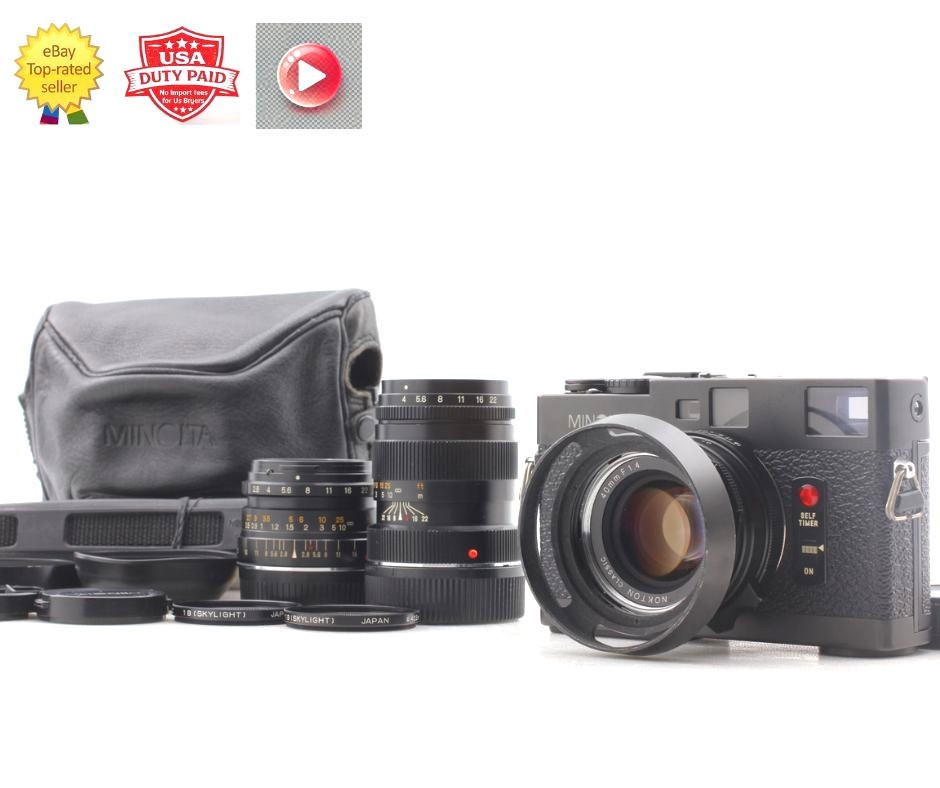
As an eBay Partner, we earn from qualifying purchases. This helps support our independent vintage technology research.