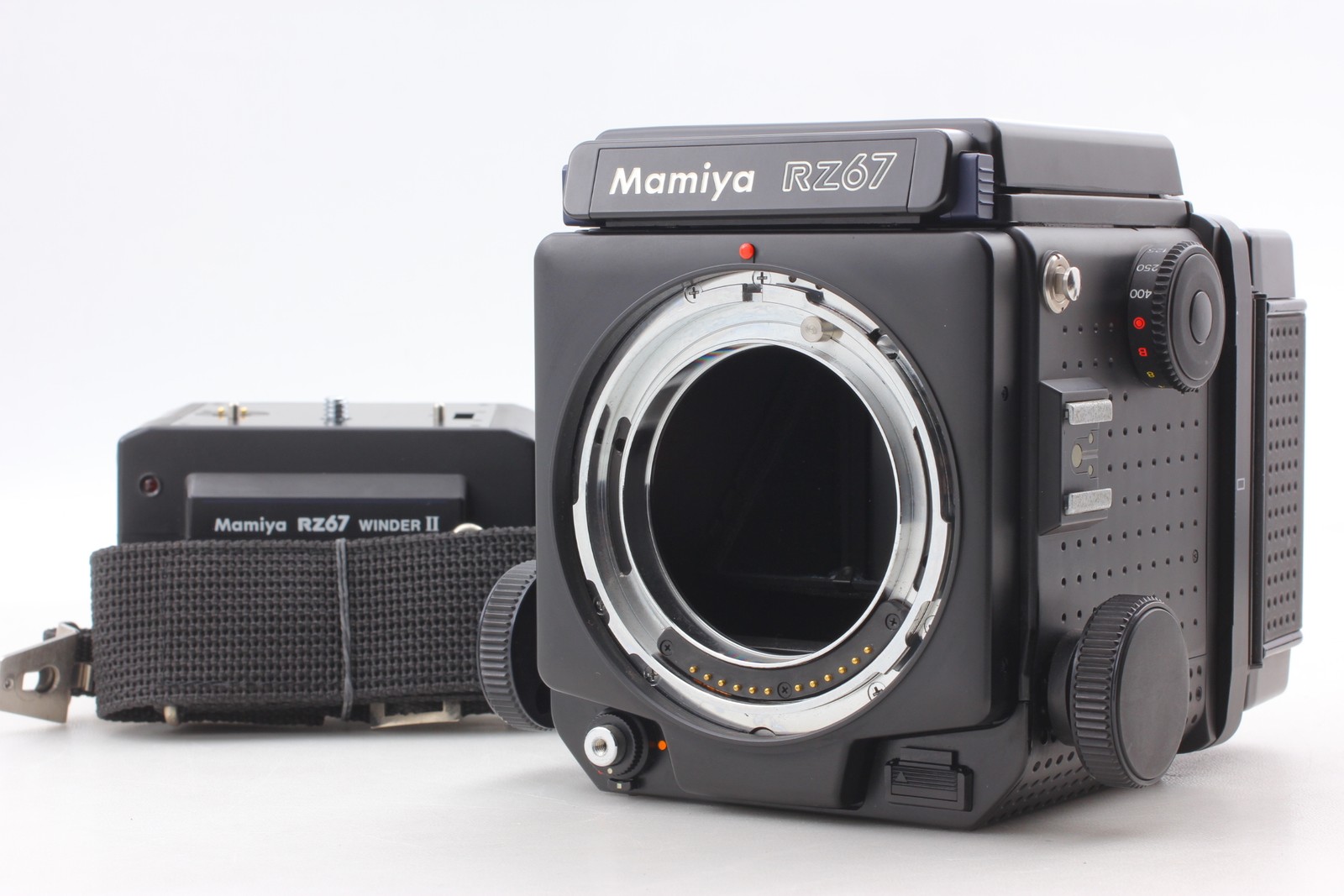
MAMIYA RZ67 PROFESSIONAL
The Mamiya RZ67 Professional is a modular, medium-format single-lens reflex (SLR) camera introduced in 1982 as the electronic evolution of the highly regarded Mamiya RB67 Professional. Designed for studio and professional field use, the RZ67 combines mechanical precision with electronic shutter control, offering reliable performance, interchangeable components, and a unique 90° revolving film back system.
Overview
The Mamiya RZ67 Professional was developed to meet the demands of professional photographers requiring high image quality, system flexibility, and precise exposure control. Released in 1982, it succeeded the manually operated RB67 and represented Mamiya’s shift toward integrating electronic shutter technology into its medium-format lineup. Unlike its predecessor, which used fully mechanical leaf shutters in the lenses, the RZ67 features electronically timed leaf shutters within the lenses, enabling more accurate exposure control, TTL flash metering, and compatibility with automated studio lighting systems.
Targeted primarily at studio, portrait, fashion, and commercial photographers, the RZ67 was engineered for maximum modularity. The camera system supports interchangeable film backs, viewfinders, focusing screens, and a wide array of lenses ranging from 50mm wide-angle to 500mm telephoto. Its 6×7 cm negative format produces exceptionally detailed images with minimal film waste compared to 6×6 or 6×9 formats, making it ideal for high-end reproduction and large-format printing.
A defining feature of the RZ67 is its rotating (revolving) film back, which allows the photographer to switch between horizontal and vertical compositions without repositioning the camera—critical in studio environments where precise lighting setups are difficult to alter. The camera’s robust die-cast aluminum body, coupled with a bellows-based lens mount, enables precise movements including close focusing and limited tilt/shift capabilities when used with optional accessories. The RZ67 remained in production until 1993, when it was succeeded by the RZ67 Pro II, which added improved battery efficiency and enhanced flash synchronization.
Specifications
| Specification | Value |
| Type | Single-Lens Reflex (SLR) |
| Film Format | 6×7 cm (on 120 or 220 roll film) |
| Years Produced | 1982–1993 |
| Lens Mount | Mamiya RZ bayonet mount |
| Shutter | Electronically controlled leaf shutter in lenses; 1 sec to 1/400 sec, plus Bulb (B) |
| Aperture Range | Typically f/4.5 to f/45 (varies by lens) |
| Metering | TTL full-aperture metering via focusing screen; optional AE Prism Finder for shutter-priority autoexposure |
| Exposure Modes | Manual, shutter-priority autoexposure (with AE Prism Finder), Bulb |
| Viewfinder | Interchangeable waist-level, prism, and AE prism finders |
| Focusing Screen | Interchangeable focusing screens with grid lines, split-image, or microprism options |
| Film Backs | Interchangeable, rotating 90° (6×7 format); accepts 120 and 220 film |
| Flash Sync | TTL flash metering supported; PC terminal and hot shoe with sync up to 1/400 sec |
| Battery | 4× SR44 or LR44 batteries (1.5V silver oxide or alkaline) for camera body; some lenses require additional 1× CR1/3N battery |
| Dimensions | Approx. 165 × 145 × 130 mm (body only) |
| Weight | Approx. 1,450 g (body with standard lens and film back) |
Key Features
- Electronic Leaf Shutter Lenses: Enables precise shutter speeds up to 1/400 sec and flash sync at all speeds, a significant advantage over focal-plane shutter medium-format cameras.
- 90° Revolving Film Back: Allows instant switching between horizontal and vertical formats without moving the camera, ideal for studio work.
- Modular System Design: Fully interchangeable film backs, viewfinders, lenses, and focusing screens support diverse shooting scenarios.
- TTL Metering and Shutter-Priority AE: With the optional AE Prism Finder, the camera supports automatic exposure, improving workflow efficiency.
- Bellows Focusing Unit: Permits close focusing without additional accessories and supports limited lens movements for macro and product photography.
Historical Context
The RZ67 Professional was introduced at a time when medium-format photography was undergoing a technological shift. While mechanical cameras like the Hasselblad 500 series and the original Mamiya RB67 dominated the market, the demand for electronic automation, faster flash sync, and improved metering accuracy was growing—especially in commercial and studio environments. The RZ67 answered this need by integrating electronic shutter control while retaining the modularity and image quality expected from a professional system camera.
Mamiya positioned the RZ67 as a direct upgrade to the RB67, offering faster operation and better integration with electronic flash systems. It competed primarily with the Bronica SQ-A, Hasselblad 503CW, and later the Contax 645. However, unlike the square-format Bronica or the 6×6 Hasselblad, the RZ67’s 6×7 format provided a more cinematic aspect ratio and larger negative area (56 × 69 mm), resulting in superior resolution and tonal gradation. The camera gained a strong following among fashion and portrait photographers, including renowned names like Annie Leibovitz, who used the RZ67 extensively in studio settings.
Collectibility & Value
Today, the Mamiya RZ67 Professional is highly sought after in the used and vintage camera market, particularly among film photographers and collectors interested in medium-format systems. While prices vary, a complete RZ67 kit with body, lens, film back, and finder typically sells for $800–$1,500 depending on condition and accessories. Lenses such as the 110mm f/2.8 and 180mm f/4.5 are especially prized for their sharpness and speed.
When purchasing an RZ67, buyers should inspect for common issues such as shutter inaccuracies (especially at high speeds), battery corrosion in the body or lenses, and light seals on the film back. The electronic shutters rely on consistent battery power; weak batteries can cause underexposure or failure to fire. Additionally, the revolving back mechanism may develop play or light leaks if seals are degraded. While repairable, servicing an RZ67 requires specialized technicians familiar with medium-format electronics.
Despite its age, the RZ67 remains functional and relevant due to the availability of film backs, lenses, and technical support from specialty repair shops. Its robust build and high-quality optics ensure it continues to deliver professional-grade results.
Similar Cameras
- Hasselblad 503CW – 6×6 cm SLR with modular design and excellent optics; slower flash sync (1/125 sec) but renowned image quality.
- Bronica SQ-Ai – 6×6 cm SLR with interchangeable backs and lenses; more affordable but less refined than the RZ67.
- Pentax 6×7 – 6×7 cm SLR with fixed back; exceptional optics but bulkier and less modular.
- Contax 645 – Later 6×4.5 cm autofocus SLR; more modern but smaller negative size.
- Mamiya RB67 Pro-S/Pro-SD – Mechanical predecessor to the RZ67; heavier but prized for durability and simplicity.
Repair & Maintenance
The RZ67 Professional uses 4× SR44 (or equivalent LR44) batteries for the camera body’s metering and shutter control, while certain lenses (e.g., 110mm f/2.8) require an additional CR1/3N battery for the leaf shutter. Battery corrosion is a common issue, especially in older units, and should be checked during inspection. Regular maintenance includes replacing light seals every 5–10 years, cleaning focusing screens, and verifying shutter accuracy with a timer.
The electronic shutters are generally reliable but may drift over time. Calibration requires specialized equipment and is best performed by technicians experienced with Mamiya’s RZ system. The revolving back’s rotation mechanism should operate smoothly without light leaks—check for worn seals or misalignment. Overall, while the RZ67 is more complex than mechanical counterparts, its serviceability and parts availability ensure long-term usability with proper care.
eBay Listings


As an eBay Partner, we earn from qualifying purchases. This helps support our independent vintage technology research.