MAMIYA RB67 PRO
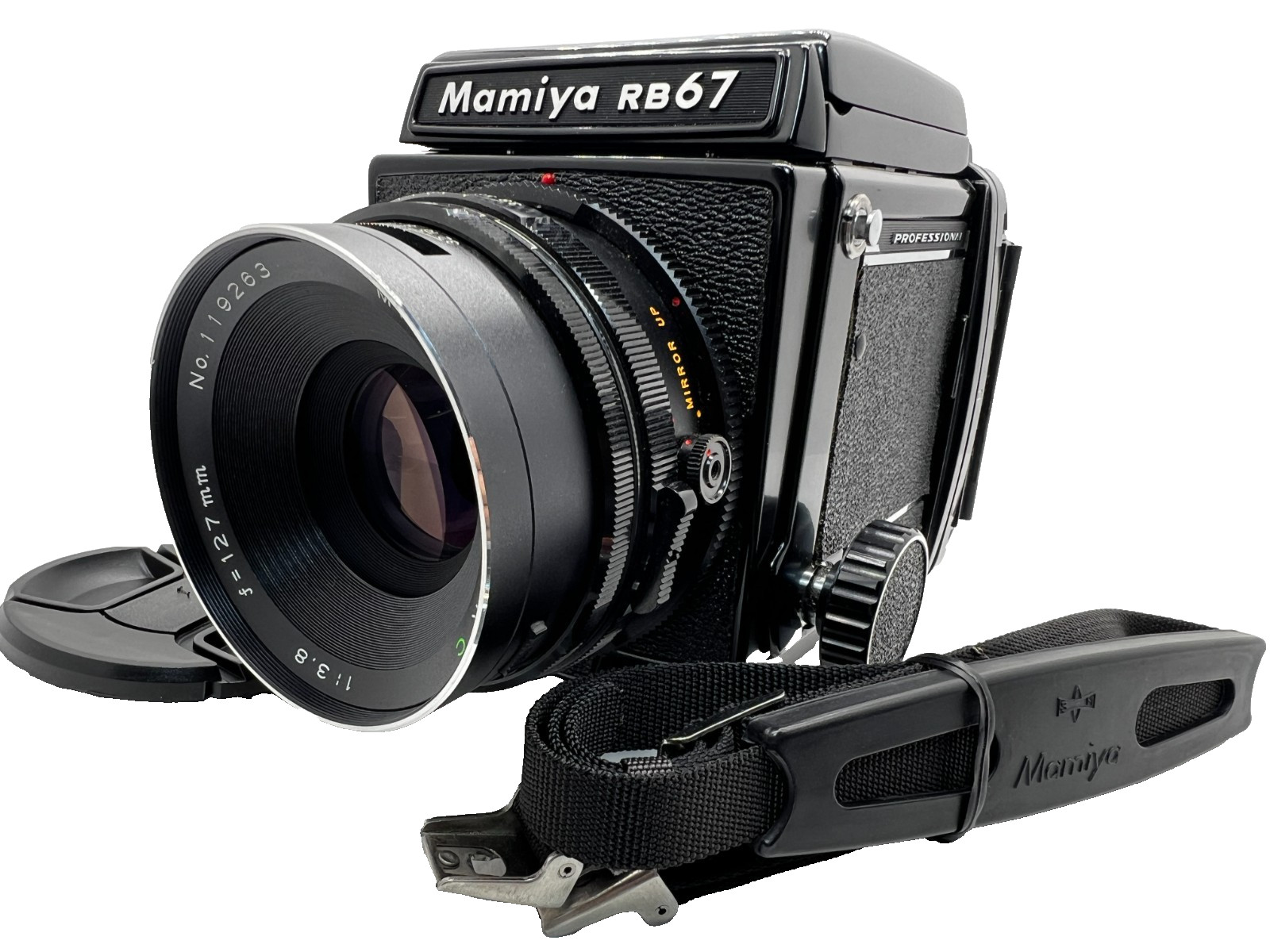
The Mamiya RB67 Pro is the first model in Mamiya's RB67 series of professional medium format single-lens reflex (SLR) cameras. Introduced in 1970, it had a modular design, a bellows focusing system and a rotating film back. The back lets you switch between horizontal and vertical compositions without repositioning the camera.
Overview
The Mamiya RB67 Pro was launched in 1970 as Mamiya's first entry into the professional studio medium format market. It targeted high-end portrait, fashion and commercial photographers. Other medium format systems of the time used helical focusing mechanisms. The RB67 Pro used a bellows instead, which allowed precise macro and close-up work with minimal lens extension. The design also contributed to the camera's optical alignment and reduced the risk of mechanical wear over time.
The RB67 Pro was modular. The camera came apart into core components - body, lens assembly, viewfinder and film back - each interchangeable and replaceable. Photographers could customize configurations for different shooting scenarios. The rotating film back pivoted 90 degrees between landscape and portrait orientations while keeping the film plane's position. That was revolutionary for studio use, since nobody had to re-rig lighting setups when changing aspect ratios.
The RB67 Pro competed directly with the Rolleiflex SL66 and later the Hasselblad 500 series. It stood out for its sturdy build quality, extensive serviceability and superior close-focusing capabilities. It started the RB67 lineage, which went on to the RB67 Pro-S, Pro-SD, and ultimately the RZ67 series. Its success cemented Mamiya's reputation as a leader in professional medium format systems during the 1970s and beyond.
Specifications
| Specification | Value |
| Type | Single-Lens Reflex (SLR) |
| Film Format | 6x7cm (nominal; image size 56 x 68 mm) |
| Years Produced | 1970–1974 |
| Lens Mount | Mamiya RB bayonet mount |
| Shutter | Leaf shutter in lenses; speeds 1–1/400 sec, B, and X-sync at all speeds |
| Metering | None (body-integrated metering not available; requires external or viewfinder-mounted meter) |
| Exposure Modes | Manual only (shutter speed and aperture controlled manually) |
| Viewfinder | Interchangeable focusing screens and viewfinders; standard waist-level finder with 45° prism option |
| Dimensions | Approx. 130 mm (W) × 125 mm (H) × 120 mm (D) without lens; weight approx. 1,250 g (body only) |
Key Features
- Rotating Back Mechanism: The film back rotates 90° via a locking knob, allowing instant switching between horizontal and vertical formats without moving the camera—ideal for studio precision.
- Bellows Focusing System: Provides continuous focusing from infinity down to close distances (varies by lens), with up to 100 mm of extension on standard lenses, enabling high magnification macro work.
- Modular Design: All major components (lens, body, back, finder, screen) are interchangeable, facilitating rapid setup changes and easy servicing.
- Lens-Based Leaf Shutters: Each lens contains a Copal Square-Type leaf shutter with flash synchronization at all speeds, a significant advantage for studio strobe work.
- Interchangeable Focusing Screens: Multiple screens available (matte, grid, split-image) to suit different focusing needs and user preferences.
Historical Context
The RB67 Pro arrived when professional photographers wanted more flexibility and reliability from medium format systems. Before its release, the market was dominated by Rollei's TLRs and Hasselblad's 500-series SLRs. Both had limitations in close focusing and modularity. Mamiya filled that gap with a system built for studio demands, where precision, repeatability and adaptability were paramount.
The bellows focusing system gave the RB67 Pro an edge over helical-focusing rivals, particularly in product and macro photography, where fine focus adjustments were critical. Its all-metal construction and serviceable design appealed to working professionals who needed dependable equipment. It was heavier and bulkier than competitors at first, but its performance justified the trade-off. The RB67 Pro was succeeded in 1974 by the RB67 Pro-S, which brought a re-engineered film back and enhanced lens compatibility. The original Pro stayed in widespread use for decades because of its durability and repairability.
Collectibility & Value
Today, the Mamiya RB67 Pro is a sought-after collector's item and still works fine for film photography. It is not as rare as some limited-production European systems, but complete and well-maintained RB67 Pro kits are increasingly scarce due to age and mechanical wear. On the secondary market, a working body-only unit typically sells for $300 - $500 USD. Full systems (including lenses, back, finder, and accessories) run $800 to $1,200 depending on condition and lens selection.
When buying an RB67 Pro, check several areas: the bellows (cracks or pinholes will cause light leaks), the smoothness of the focusing helical, the lens shutter and aperture mechanisms, and the film back's dark slide and pressure plate. Replace light seals if they have deteriorated. Common issues include sticky shutters (especially in humid climates), worn rotating back detents, and viewfinder prism clouding. Even so, the RB67 Pro is highly serviceable, and many parts are still available through specialty repair shops or third-party suppliers.
Similar Cameras
- Hasselblad 500C/M – Swedish-made modular SLR with 6x6cm format, leaf shutter lenses, and extensive accessory system.
- Rolleiflex SL66 – German 6x6cm SLR with built-in bellows, macro capability, and rotating lens standard.
- Bronica SQA – Japanese 6x6cm SLR with interchangeable backs and viewfinders, more compact but less rugged than the RB67.
- Pentax 6x7 – Fixed-lens 6x7cm SLR with excellent optics and helical focusing, popular for portraits but less modular.
- Mamiya C330 – TLR with interchangeable lenses and bellows focusing, offering similar macro capability but fixed 6x6 format.
Repair & Maintenance
The Mamiya RB67 Pro needs no batteries for mechanical operation, so it works without any power source. That is a significant advantage for reliability and longevity. External light meters or metered viewfinders (such as the AE Prism Finder, introduced later) may need batteries (typically PX625 or equivalent 1.35V mercury cell, adaptable with modern substitutes).
Common maintenance concerns include shutter timing calibration, lubrication of the focusing mechanism, and replacement of light seals every 10-15 years. The Copal leaf shutters in RB lenses are generally durable but may need cleaning or re-timing if speeds become inaccurate. The rotating back mechanism can loosen over time. Tightening the detent screw or replacing the spring secures the position. Inspect the bellows regularly for light leaks and replace it if compromised. Because the design is modular, individual components can be serviced independently, which makes the RB67 Pro one of the most repairable medium format systems ever produced. Professional servicing is recommended for shutter or lens work, though experienced users can do basic maintenance with proper tools and documentation.
Market Value
┌──────────────────────────────────────────────────────────────────────────┐
│ MAMIYA RB67 PRO                                                 Nov 2026 │
├──────────────────────────────────────────────────────────────────────────┤
│ High      $960                                    Latest            $139 │
│ Median    $459                                    Trend                — │
│ Low       $82                                     Volume          ~19/mo │
├──────────────────────────────────────────────────────────────────────────┤
│ $1,000 ┤                                                                 │
│        │                                        .       .    .   .       │
│        │                                        .   ..  .     ..  .  ..  │
│   $593 ┤                                        .  . ....... ... ....... │
│        │.                                      ... ...... ... .  .. ...  │
│        │                                     .  .  . .. . .. .. ...  . . │
│        │.          .                    .          .... .  .  .. ..  ... │
│    $50 ┤                        .    .  . .    .... ....  .  ... ...   ..│
│        ├─────────────────────────────────────────────────────────────────│
│    vol │▁          ▁            ▁    ▁  ▁ ▁  ▁ ▂▆▂▁▅▆▅▄▄▄▁▃▃▁▃▆▄▁▄█▂▁▄▃▄▁│
│        └─────────────────────────────────────────────────────────────────│
│         2025-12                      2026-04                      2026-08│
└──────────────────────────────────────────────────────────────────────────┘
eBay completed sales. Excludes accessories, parts, and non-working units. Hover points for details.
eBay Listings
Recently sold on eBay: $122–$749 (median $459, based on 149 completed sales, past 12 months)


As an eBay Partner, we earn from qualifying purchases. This helps support our independent vintage technology research.