Mamiya RZ67 (1982–2004): The Studio Workhorse That Redefined Medium Format
A modular, leaf-shuttered titan that brought precision, flexibility, and TTL metering to professional 6x7cm photography—where image quality was non-negotiable.
Overview
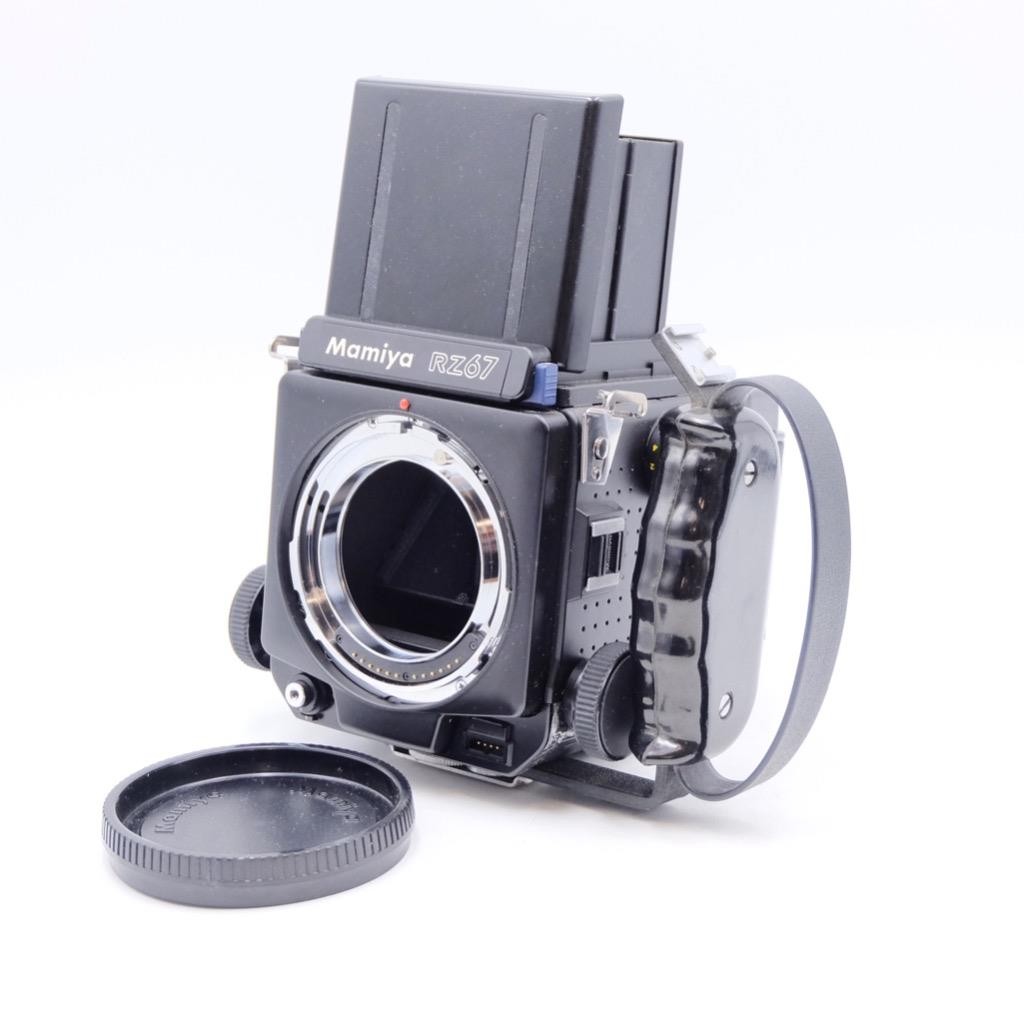
If medium format cameras were racehorses, the Mamiya RZ67 would be the thoroughbred that won every studio portrait, fashion shoot, and commercial campaign from the Reagan era well into the digital dawn. Introduced in 1982, the RZ67 wasn’t just another film camera—it was a system, engineered for photographers who needed absolute control over every variable: format, film type, focus, exposure, and even mid-roll film changes. This wasn’t a camera you casually picked up; it was a tool you committed to, like mastering a Stradivarius or calibrating a Hasselblad in a darkroom. And once you did, it rewarded you with 56mm x 68mm negatives (that’s 6x7cm, for the uninitiated) of such clarity and tonal depth that even today, scanned on a high-end drum scanner, they rival modern digital backs.
The RZ67 was the brainchild of Mamiya’s ambition to modernize its legendary Mamiya RB67, a bulky but beloved studio staple since 1970. The RZ67 kept the RB’s modular soul—interchangeable backs, lenses, viewfinders—but injected it with electronic precision. TTL (through-the-lens) full-aperture metering? Check. Leaf shutters in every lens enabling flash sync at all speeds? Double check. A sleeker body with improved ergonomics and battery-powered shutter control? Triple check. It became the go-to for photographers who couldn’t afford downtime or technical failure—think Vogue cover shoots, high-end product photography, and architectural work where depth of field and detail were paramount. At $2,495 in 1982 (over $7,500 today), it wasn’t cheap, but for pros, it was a career investment.
Specifications
| Specification | Value |
|---|---|
| Film Format | 6x7 cm, 6x6 cm, 6x4.5 cm via interchangeable backs |
| Lens Mount | Mamiya RZ bayonet mount |
| Shutter Speeds | 1 - 1/400 second, Bulb |
| Flash Sync Speed | 1/30 second (sync at all speeds due to leaf shutters) |
| Shutter Type | Leaf shutter in lenses |
| Viewfinder | Interchangeable focusing screens, waist-level and prism finders |
| Metering | TTL full-aperture metering, center-weighted |
| Exposure Modes | Manual |
| Aperture Control | Preset aperture on lens, controlled via camera body |
| Focus System | Manual focus via ground glass screen |
| Film Advance | Lever wind (RZ67 Pro), built-in crank (RZ67 Pro II) |
| Dimensions | 165 x 135 x 125 mm (body only) |
| Weight | 1.65 kg (body with standard lens and back) |
| Power Source | 4 x AA batteries (for metering and shutter control) |
Key Features
- Interchangeable Film Backs: This wasn’t just a convenience—it was a game-changer. You could switch from color negative to slide film mid-roll, or even swap between 6x7, 6x6, and 6x4.5 formats without unloading. For a studio photographer shooting a model in multiple lighting setups, this meant no wasted frames and maximum flexibility. Each back locked with a satisfying, tank-like clunk, and the dark slide system was foolproof—once you got the hang of the “up to open, down to close” ritual (backwards from some systems, yes, but logical once internalized).
- Leaf Shutter Lenses with Full-Speed Flash Sync: Unlike focal-plane shutter cameras limited to 1/60s or 1/125s sync, every RZ67 lens had a built-in leaf shutter, allowing flash sync at all speeds up to 1/400s. This meant you could wide-open flash portraits in bright daylight without ND filters, or freeze motion with strobes at high shutter speeds. The thwick-thunk of the lens shutter at 1/400s was quieter than a Canon F-1, and far more precise.
- TTL Full-Aperture Metering: The RZ67 metered through the lens at full aperture, then stopped down automatically when you pressed the shutter. No more stop-down metering guesswork. The center-weighted meter was accurate within 0.5 EV, and the viewfinder display—using LEDs around the focusing screen—was unobtrusive yet clear. It felt like the camera was whispering exposure advice directly into your eye socket.
- Modular Design: Want a prism finder for eye-level shooting? Swap it in. Need a high-mag waist-level for precise focus on a still life? Done. The rotating back (standard on Pro II) let you switch from landscape to portrait in seconds—no tripod repositioning. This wasn’t just modularity; it was photographic Lego for adults with six-figure portfolios.
Historical Context
The RZ67 didn’t emerge in a vacuum. It was Mamiya’s answer to the dominance of Hasselblad in the pro medium format world and a direct evolution of its own RB67, which had earned cult status among studio shooters for its ruggedness and bellows focusing. But the RB67 was entirely mechanical—no batteries, no metering, just pure optics and brass gears. The RZ67 kept the bellows (allowing macro and tilt via accessories) but embraced electronics to stay competitive in the 1980s, where photographers increasingly demanded automation without sacrificing image quality.
Its main rival? The Bronica ETR, a lighter, cheaper 6x4.5cm system that appealed to photojournalists and travelers. But the ETR couldn’t match the RZ67’s 6x7 negative size or modularity. Meanwhile, Hasselblad’s V-system offered similar image quality but with slower leaf shutters (max 1/500s on later models) and a steeper price. The RZ67 struck a sweet spot: not as expensive as a Hassy, not as limited as a Bronica, and with a negative size that was simply bigger—literally and figuratively. It dominated fashion and portrait studios through the 1990s, even as 35mm DSLRs began their rise. When digital finally arrived, the RZ67 Pro IID (2004) got data back compatibility, a nod to photographers transitioning to hybrid workflows. But by then, the writing was on the wall: the era of film as the default was ending.
Collectibility & Value
Today, the RZ67 is uncommon but not rare—thousands were made, but many were heavily used in studios and show wear. On the used market in 2025, a fully functional RZ67 Pro II with standard lens and back fetches $1,200 to $2,800, depending on condition and accessories. Complete sets with multiple backs, prisms, and rare lenses (like the 37mm f/4.5 or 250mm f/4.5) can exceed $4,000. The Pro IID, being the last and most digital-ready, commands a slight premium.
But buyer beware: shutter timing drift in older lenses is a known issue, especially on units stored in humid environments. These leaf shutters need periodic calibration—don’t trust a “fully tested” listing without proof. Also inspect film back seals; degraded foam causes light leaks, the silent killer of medium format negatives. Look for a Pro II with the crank winder (smoother than the Pro’s lever) and check that the mirror lock-up and stop-down levers operate crisply. If the body still powers on with four AAs and the LEDs light up, you’re in business. And if you hear that soft, electronic beep when the shutter fires? That’s the sound of 1980s engineering perfection.
eBay Listings


![No Corrosion [OPT MINT] Mamiya RZ67 AE Prism Finder FE701 RZ](https://i.ebayimg.com/images/g/Pf8AAeSwDwJprXQu/s-l1600.jpg)
As an eBay Partner, we earn from qualifying purchases. This helps support our independent vintage technology research.
Related Models
- Mamiya M645 1000S (1976-1990)
- Mamiya M645 Super (1985-1999)
- Mamiya M645 (1975–1987)
- Mamiya M645J (1979–1983)
- Mamiya RB67 (1970-1990)
- Alpa 6 (1948-1953)
- Agfa Agfaflex
- Agfa Ambiflex
- Agfa Easy
- Agfa Futura Af zoom