MAMIYA M645 1000S
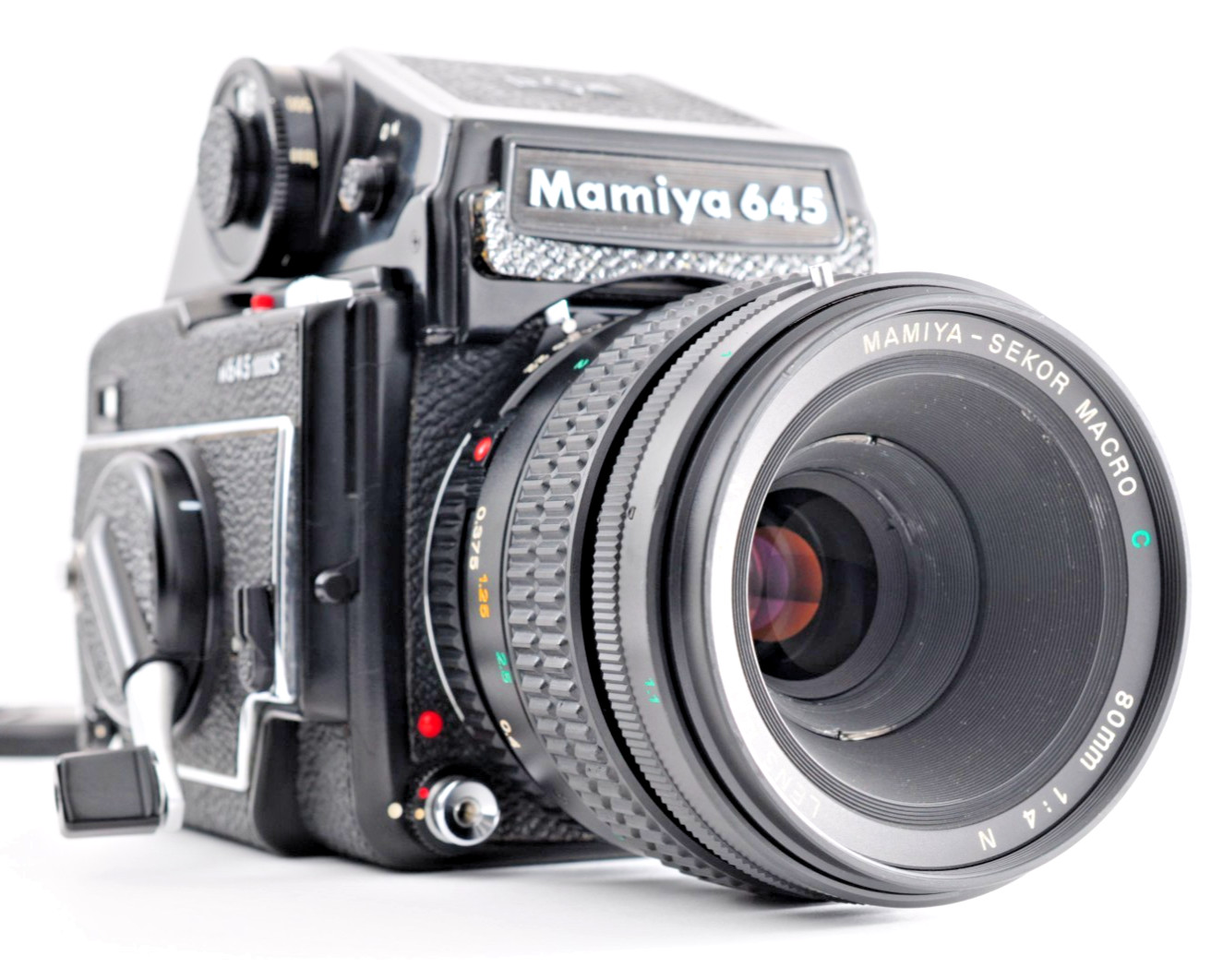
The Mamiya M645 1000S is a manual focus, medium format single-lens reflex (SLR) camera produced by Mamiya from 1976 to 1990. Designed as an evolution of the original M645, the 1000S introduced a faster maximum shutter speed of 1/1000 second, improved mechanical reliability, and refined ergonomics, making it a preferred choice among professional and advanced amateur photographers seeking high image quality in a portable 6x4.5cm format system.
Overview
The Mamiya M645 1000S was introduced in 1976 as a significant upgrade to the original M645, which had been released in 1975. Positioned as a professional-grade medium format SLR, the 1000S was engineered to deliver reliable performance in studio, portrait, and field photography environments. It retained the modular design philosophy of its predecessor, supporting interchangeable film backs, viewfinders, and focusing screens, while introducing a new vertical-travel focal plane shutter capable of 1/1000 second—making it one of the fastest medium format SLRs of its era.
Targeted at working photographers who required the image quality of medium format without the bulk of larger systems like the Mamiya RB67 or Hasselblad 500 series, the M645 1000S offered a compact, lightweight body with full mechanical operation. The camera featured no electronic exposure control, relying instead on fully mechanical shutter timing and manual exposure settings, ensuring operational reliability without batteries for basic functions. Its lens mount is compatible with the extensive range of M645 Sekor lenses, many of which are still in use today.
The M645 1000S played a crucial role in establishing Mamiya’s reputation in the professional medium format market. It served as the mechanical foundation for later models such as the M645 Super and M645 Pro, which added features like built-in metering and aperture-priority automation. However, the 1000S remains prized for its simplicity, robustness, and pure mechanical operation, appealing to photographers who favor manual control and mechanical redundancy.
Specifications
| Specification | Value |
| Type | Single-Lens Reflex (SLR) |
| Film Format | 6x4.5cm (on 120/220 roll film) |
| Years Produced | 1976–1990 |
| Lens Mount | M645 screw-thread bayonet (Mamiya 645 system) |
| Shutter | Vertical-travel metal focal plane shutter; speeds 1 sec to 1/1000 sec, plus B |
| Metering | None (body-integrated); requires external or viewfinder-mounted meter |
| Exposure Modes | Manual only |
| Viewfinder | Interchangeable (waist-level, prism, etc.); standard with waist-level finder |
| Dimensions | Approx. 148 x 100 x 102 mm (w/ standard finder); Weight: ~950 g (body only) |
Key Features
- 1/1000 second shutter speed: The fastest in its class at launch, enabling greater flexibility with wide apertures in daylight.
- Fully mechanical operation: No batteries required for shutter function, ensuring reliability in extreme conditions.
- Interchangeable components: Supports multiple film backs, viewfinders, and focusing screens for versatile shooting.
- Robust metal construction: Precision-machined aluminum and die-cast alloy body built for professional durability.
- Compatibility with M645 lens system: Works with over 30 Mamiya Sekor lenses ranging from 35mm to 1000mm.
Historical Context
The M645 1000S was released during a pivotal period in medium format photography, when demand was growing for more portable and agile systems compared to traditional modular cameras like the Hasselblad 500C/M or Bronica SQ. Mamiya capitalized on this trend by offering a 6x4.5cm SLR that combined high image quality with rapid handling and system expandability. The 1/1000 second shutter speed was a major differentiator, allowing photographers to use fast lenses wide open in bright light—something not possible with competing models limited to 1/500 or 1/400 second.
Competitors at the time included the Bronica S2A (max 1/500s) and the earlier Hasselblad 500 series (1/500s), both of which lacked the speed advantage of the M645 1000S. While the Pentax 6x7 offered excellent optics and a larger negative, it was significantly bulkier and slower to operate. The M645 1000S carved out a niche in photojournalism, event photography, and commercial work where speed, reliability, and image quality were all critical. Its success laid the groundwork for Mamiya’s long-term dominance in the 645 format, culminating in the later M645 Pro TL and digital-era M645DF models.
Collectibility & Value
Today, the Mamiya M645 1000S is considered a classic among medium format film cameras and is highly collectible, particularly in fully functional condition with matching viewfinders and film backs. Prices on the used market typically range from $300 to $600 USD for a complete kit, depending on condition and included accessories. Fully working shutters and light-tight film backs are essential, as repair parts are limited and specialized technicians are rare.
Common issues include shutter timing inaccuracies, light leaks from aging film back seals, and stiff mirror mechanisms due to dried lubricants. The camera uses no batteries for shutter operation, but light metering requires external devices or metered viewfinders (such as the AE prism finder, which uses a 6V PX28 battery). Collectors should verify that the film advance and shutter cocking mechanisms operate smoothly and that the mirror returns consistently. Due to its mechanical simplicity and robust build, the 1000S is relatively durable, but regular CLA (Clean, Lubricate, Adjust) servicing is recommended for long-term reliability.
Similar Cameras
- Bronica S2A – Manual 6x4.5cm SLR with interchangeable backs, max 1/500s shutter.
- Hasselblad 500C/M – Iconic modular medium format SLR, 6x6cm format, 1/500s max.
- Pentax 6x7 – Large-format SLR with superb optics, but bulkier and slower handling.
- Kiev 88 – Soviet-built TLR-style SLR with 6x6cm format, interchangeable backs, but less refined mechanics.
- Minolta CLE (with adapter) – Not a direct competitor, but a compact system for high-quality film imaging.
Repair & Maintenance
The Mamiya M645 1000S requires no batteries for shutter operation, making it highly reliable in field conditions. However, light metering must be performed using external meters or optional metered viewfinders (e.g., AE Prism Finder Type 3, which uses a 6V PX28 battery). Common maintenance issues include shutter blade lubrication, mirror damping fluid degradation, and film back pressure plate alignment. The focal plane shutter is complex and should only be serviced by technicians experienced with medium format systems.
Due to the age of the camera, original parts are no longer manufactured, though some third-party suppliers offer replacement foam light seals and focusing screens. Regular use and periodic CLA servicing every 5–7 years are recommended to maintain optimal performance. The camera’s mechanical design, while robust, is sensitive to impact and moisture, so storage in a dry, temperature-stable environment is advised. Overall, the M645 1000S is considered repairable with proper expertise, though costs can be significant due to labor intensity.
eBay Listings


As an eBay Partner, we earn from qualifying purchases. This helps support our independent vintage technology research.
Related Models
- Mamiya M645 Super (1985-1999)
- Mamiya M645 (1975–1987)
- Mamiya M645J (1979–1983)
- Mamiya RB67 (1970-1990)
- Mamiya RZ67 (1982-2004)
- Alpa 6 (1948-1953)
- Agfa Agfaflex
- Agfa Ambiflex
- Agfa Easy
- Agfa Futura Af zoom