LUBITEL 2
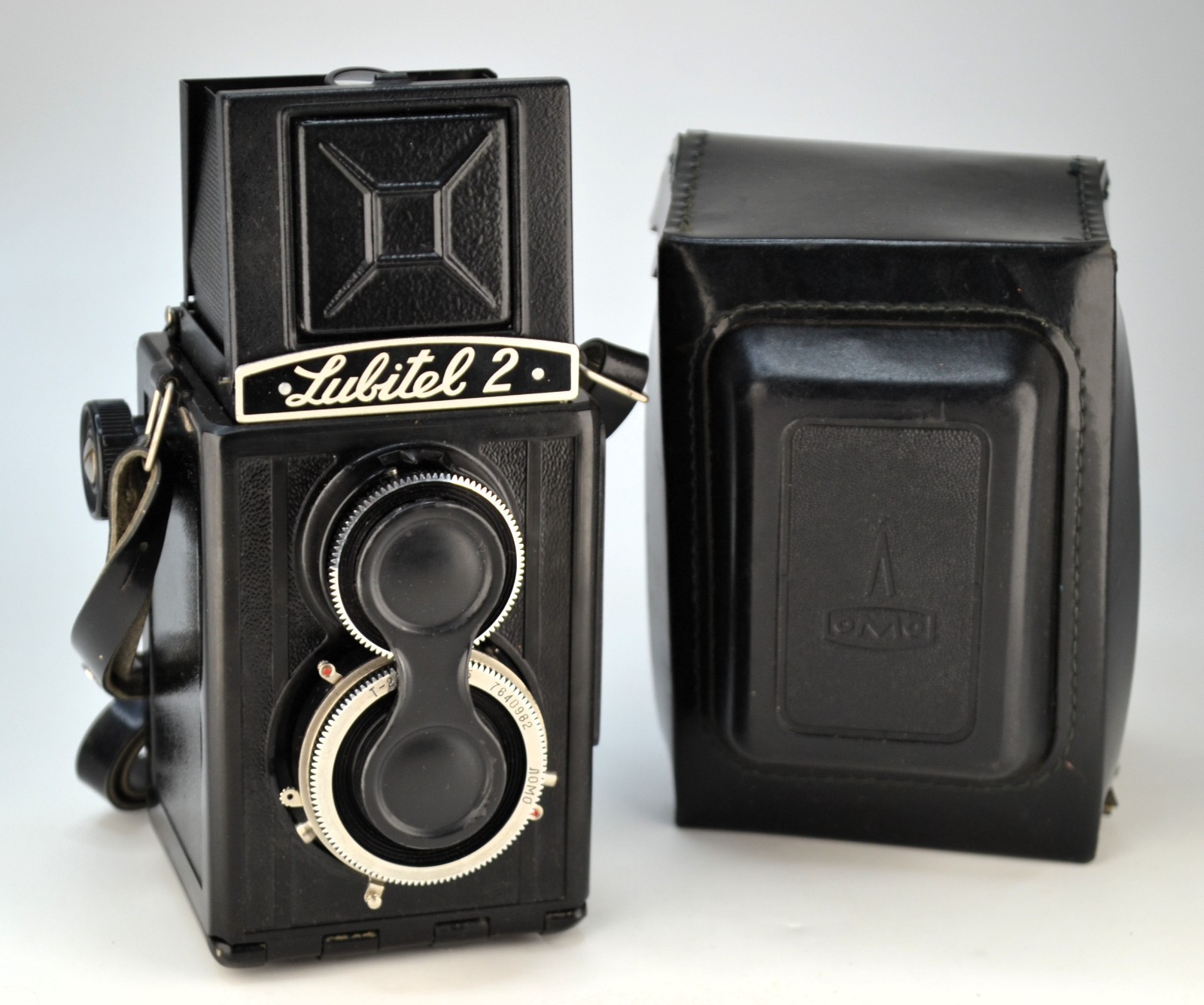
The Lubitel 2 is a twin-lens reflex (TLR) medium format camera produced in the Soviet Union by LOMO (Leningrad Optical Mechanical Association) from 1955 to 1979. Designed as an affordable and lightweight alternative to premium TLRs like the Rolleiflex, it features a plastic-bodied construction and triplet lenses, making it a popular choice among amateur photographers in Eastern Europe and beyond during the mid-20th century.
Overview
Introduced in 1955 as an evolution of the original Lubitel (1954), the Lubitel 2 was engineered to provide accessible medium format photography to the Soviet public and export markets. Marketed as a budget-friendly TLR, it targeted amateur photographers, students, and enthusiasts who desired the image quality of 6x6cm film without the high cost of German or Western European counterparts. The camera retained the classic TLR layout: a viewing lens above and a taking lens below, both fixed to a rigid body with a waist-level finder. Unlike its metal-bodied competitors, the Lubitel 2 utilized a lightweight phenolic resin (Bakelite-type) body, reducing manufacturing costs and weight while maintaining structural integrity under normal use.
The Lubitel 2 was part of LOMO’s broader strategy to democratize photography in the Soviet bloc, emphasizing simplicity, durability, and mass production. It featured fully manual operation with a leaf shutter and a coupled diaphragm system. While optically modest, its lenses were capable of producing sharp, contrast-rich images when used under optimal conditions. The camera was exported widely under various names, including "Lubitel Universal" in some markets, and remained in production for nearly 25 years, a testament to its functional design and low-cost appeal. It was eventually succeeded by the Lubitel 166 series in the late 1970s, which introduced minor refinements but retained the core design philosophy.
Specifications
| Specification | Value |
| Type | Twin-Lens Reflex (TLR) |
| Film Format | 120 roll film, 6x6 cm format (12 exposures) |
| Years Produced | 1955–1979 |
| Lens Mount | Fixed lens assembly (non-interchangeable) |
| Taking Lens | LOMO-31, 75mm f/4.5 triplet |
| Viewing Lens | 75mm f/4.5 triplet |
| Shutter | LOMO leaf shutter, speeds: B, 1/30, 1/60, 1/125, 1/250 sec |
| Aperture Range | f/4.5 to f/16 (6 blades) |
| Focusing | Manual via front-panel lever, coupled to both lenses |
| Metering | None (manual exposure only) |
| Exposure Modes | Manual only (shutter speed and aperture set manually) |
| Viewfinder | Waist-level finder with pop-up hood, ground glass screen with Fresnel lens |
| Film Advance | Manual knob advance with red window for frame numbering |
| Flash Sync | PC sync socket and M/X switch (M-sync at all speeds, X-sync at 1/30 and below) |
| Dimensions | 170 mm (H) × 95 mm (W) × 105 mm (D) |
| Weight | Approx. 680 g (without film) |
Key Features
- Affordable 6x6 TLR Design: One of the least expensive medium format TLRs ever produced, making 120 film photography accessible to a broad audience.
- Lightweight Plastic Construction: Utilizes phenolic resin body panels, reducing weight and production cost while maintaining rigidity.
- Fully Coupled Shutter and Aperture: Manual controls with detented settings for precise exposure adjustment.
- Integrated Flash Sync: Includes PC terminal and M/X selector for use with electronic flash and bulbs.
- Simple Maintenance and Repair: Designed for ease of servicing with widely available mechanical components.
Historical Context
The Lubitel 2 emerged during the postwar expansion of consumer goods in the Soviet Union, a period when state-run manufacturers like LOMO were tasked with producing functional, mass-market optical equipment. Its release in 1955 coincided with a growing interest in amateur photography across Eastern Europe, fueled by rising literacy rates and state-sponsored cultural programs. The camera was explicitly designed to mimic the form and function of high-end TLRs like the Rolleiflex and Yashica-Mat, but at a fraction of the cost. While lacking the precision engineering and high-grade optics of its Western counterparts, the Lubitel 2 offered a viable entry point into medium format photography.
Competitors included the German Rolleiflex 2.8F (a professional-grade TLR) and the Japanese Yashica 44, but the Lubitel 2’s primary competition was economic rather than technical. It competed not with cameras, but with the idea that photography should remain an elite pursuit. By contrast, the Lubitel 2 embodied the Soviet ideal of accessible technology. It was widely distributed across the Eastern Bloc and exported to Western markets under neutral branding, where it gained a cult following among students and experimental photographers. Despite its limitations—such as inconsistent build quality and modest optics—it was praised for its reliability and image quality under good lighting conditions.
Collectibility & Value
Today, the Lubitel 2 is a sought-after item among analog photography enthusiasts and collectors of Soviet-era technology. While not rare—hundreds of thousands were produced—cameras in good working condition with clean lenses and smooth mechanics command moderate prices, typically ranging from $50 to $120 USD depending on condition and provenance. Fully functional units with undamaged viewfinders and accurate shutters are preferred, as many surviving examples suffer from degraded foam light seals, stiff focusing mechanisms, or cloudy lenses.
When purchasing a Lubitel 2, buyers should inspect the shutter operation at all speeds, check for lens fungus or separation, and verify that the film advance and frame counter operate correctly. The red window on the back must be intact and light-tight when closed. Common issues include cracked plastic body corners, sticky aperture blades, and misalignment of the viewing and taking lenses (leading to parallax or focus errors). Despite these potential flaws, the camera remains highly repairable using basic tools and spare parts available through online collector communities. Its simplicity and mechanical nature make it an excellent candidate for restoration.
Similar Cameras
- Rolleiflex Standard (2.8F/3.5F) – German-engineered TLR with superior optics and build, but significantly more expensive.
- Yashica 44 – Japanese 6x4.5 TLR offering interchangeable film backs and better optics.
- Minolta Autocord – Professional-grade TLR with coupled metering and high-quality lenses.
- Zenza Bronica G (early models) – Modular TLR system with interchangeable components.
- Kiev 2 – Soviet-built TLR based on the Contax design, though larger and more complex than the Lubitel.
Repair & Maintenance
The Lubitel 2 requires no batteries and operates entirely mechanically, enhancing its longevity and reliability. Common maintenance tasks include replacing deteriorated light seals (typically around the film chamber and back), cleaning the viewing screen, and lubricating the focusing rack and shutter mechanism. The leaf shutter can be disassembled and cleaned, though care must be taken with the delicate spring assembly. Aperture blades should be checked for oil buildup, which can cause sticking at smaller f-stops. The film advance system relies on a manual knob and red window for frame counting; users should ensure the red window cover is functional to prevent film fogging. Due to the widespread availability of parts and strong online community support (particularly in forums like Photo.net and Reddit’s r/analog), the Lubitel 2 is considered moderately easy to repair, even for intermediate hobbyists.
eBay Listings



As an eBay Partner, we earn from qualifying purchases. This helps support our independent vintage technology research.
Related Models
- Lubitel 166 (1976-1990)
- Mamiya C220 (1968-1975)
- Mamiya C330 (1969-1974)
- Mamiya C330f (1975-1983)
- Mamiya C330S (1983–1994)
- Rollei 2.8F (1960-1981)
- Rolleicord V (1954–1957)
- Rolleicord Va (1957–1962)
- Rolleicord Vb (1962-1976)
- Rolleiflex 2.8F (1960–1981)