LUBITEL 166
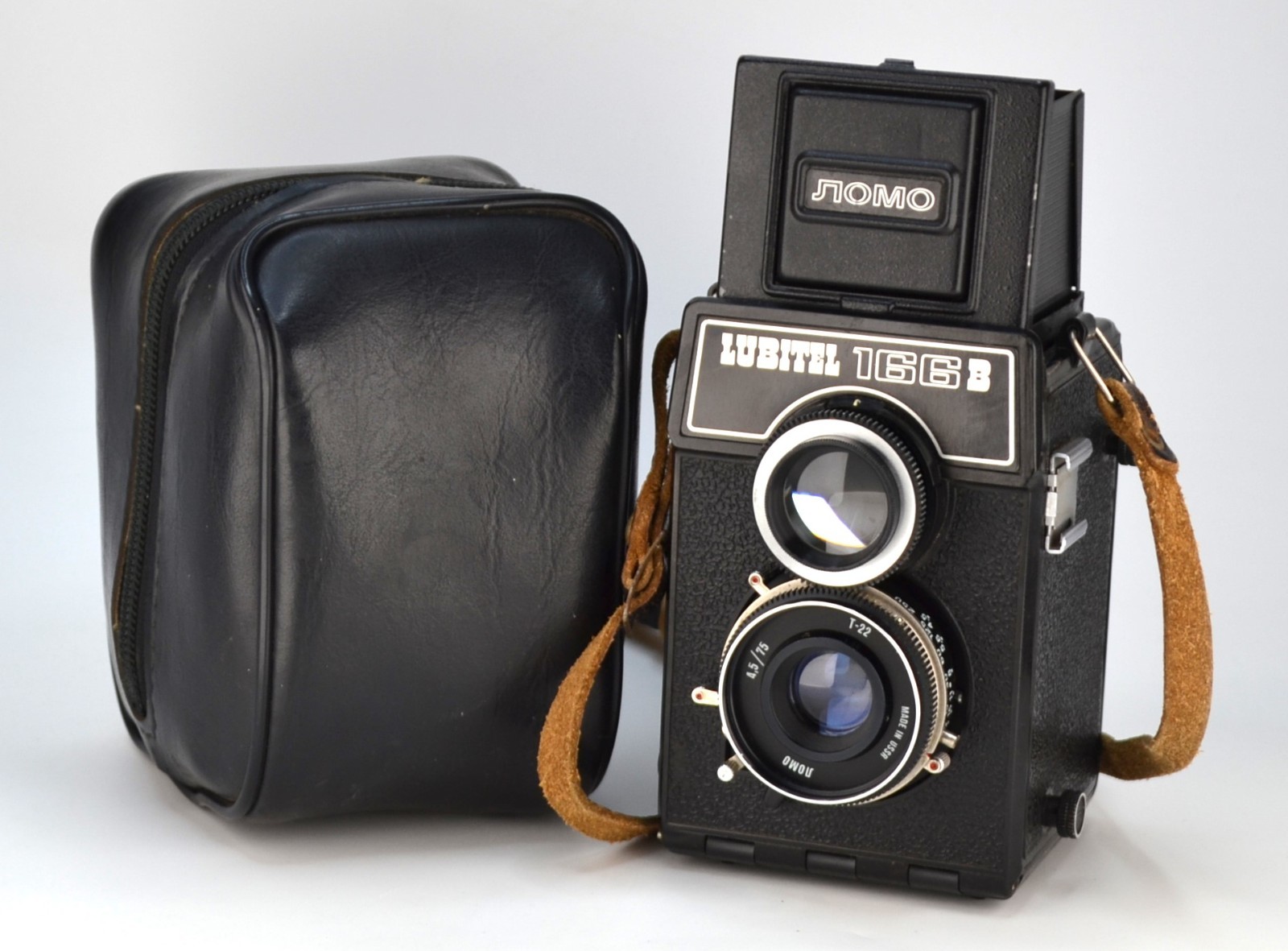
The Lubitel 166 is a twin-lens reflex (TLR) medium format camera produced in the Soviet Union by LOMO (Leningrad Optical Mechanical Association) from 1976 to 1990. Designed as a modernized and improved version of the earlier Lubitel 166 Universal, it represents one of the final evolutions of Soviet mass-market TLR technology, offering 6x6cm image format on 120 roll film with fully mechanical operation and a bright waist-level viewfinder.
Overview
The Lubitel 166 was developed during a period of modernization within the Soviet photographic industry, aiming to refine earlier TLR designs for improved usability and optical performance. It succeeded the Lubitel 166 Universal and replaced the long-running Lubitel 16, which had been in production since the 1950s. Unlike its predecessors, the 166 incorporated several design enhancements, including a redesigned body with improved film transport, a more robust focusing mechanism, and upgraded lenses. Marketed primarily for amateur photographers and students, the Lubitel 166 was positioned as an affordable, durable, and easy-to-use medium format alternative to more expensive Western TLRs like the Rolleiflex or Yashica models.
The camera features a dual-lens configuration typical of TLRs: a viewing lens on top and a taking lens below, both fixed and non-interchangeable. The viewing system uses a ground glass screen with a Fresnel lens to enhance brightness, facilitating manual focusing via a pop-up hood. The Lubitel 166 retains the fully mechanical operation of earlier models, requiring no batteries for shutter or aperture functions, which contributes to its reliability and longevity. Despite its utilitarian construction—largely made of plastic and lightweight metal alloys—the camera delivers surprisingly capable image quality, particularly when stopped down.
Within the Lubitel lineage, the 166 marks a significant upgrade over the original Lubitel 16, which used triplet lenses and a rudimentary viewing system. The 166 series introduced Tessar-type optics, improved shutter mechanisms, and better film flatness control. The 166 model specifically refined the earlier 166 Universal by simplifying some of the features (such as removing the multiple exposure mechanism and parallax correction marks) to reduce manufacturing costs while maintaining core functionality. It remained in production until the late 1980s, reflecting the continued domestic demand for simple, functional medium format cameras in the Eastern Bloc.
Specifications
| Specification | Value |
| Type | Twin-Lens Reflex (TLR) |
| Film Format | 6x6 cm on 120 roll film |
| Years Produced | 1976–1990 |
| Lens Mount | Fixed lens assembly (non-interchangeable) |
| Taking Lens | LOMO-31, 75mm f/4.5 (4 elements in 3 groups, Tessar-type) |
| Viewing Lens | LOMO-32, 75mm f/4.5 |
| Shutter | LOMO-I leaf shutter, speeds: B, 1/30, 1/60, 1/125, 1/250 sec |
| Aperture Range | f/4.5 to f/22 (adjustable in full stops) |
| Focusing | Manual via rack-and-pinion, focusing knob on side, range: 0.8m to ∞ |
| Metering | None (manual exposure only) |
| Exposure Modes | Manual (shutter speed and aperture set manually) |
| Viewfinder | Waist-level with ground glass and Fresnel lens, pop-up hood |
| Film Advance | Manual knob advance with red window for frame numbering |
| Frame Count | 12 exposures per 120 roll film |
| Dimensions | Approx. 100 × 105 × 125 mm (W×H×D) |
| Weight | Approx. 680 g (without film) |
| Construction | Plastic body with metal lens panels and internal components |
Key Features
- Tessar-type 75mm f/4.5 taking lens – Offers improved sharpness and contrast over earlier triplet designs, particularly at mid-apertures.
- Fully mechanical operation – No batteries required; shutter speeds and aperture settings are manually controlled.
- Bright waist-level viewfinder – Features a ground glass screen with Fresnel lens for improved focusing accuracy and image clarity.
- Robust film transport with red window – Allows precise frame spacing and verification of film position.
- Lightweight plastic body – Makes the camera portable and durable for student and amateur use.
Historical Context
The Lubitel 166 was introduced in 1976 as part of a broader effort by LOMO to modernize Soviet consumer optics and compete more effectively with imported TLRs in Eastern European markets. At the time, medium format photography was still widely used for portrait, documentary, and amateur applications, and the TLR design offered a balance of simplicity, image quality, and portability. The 166 was intended to replace the aging Lubitel 16, which had changed little since its 1950s debut. By adopting a Tessar-type lens design and improving mechanical reliability, the 166 aimed to deliver near-professional image quality at a fraction of the cost of Western equivalents.
Despite its modest construction, the Lubitel 166 faced competition not only from high-end TLRs like the Rolleiflex 2.8F and Mamiya C330 but also from increasingly affordable Japanese models such as the Yashica 44 and Minolta Autocord. However, due to import restrictions and economic conditions in the Eastern Bloc, the Lubitel 166 remained a popular choice for Soviet and Eastern European consumers. It was widely distributed through state-run retail channels and often used in photography clubs and educational institutions. While never exported in large numbers to the West during its production run, it gained a cult following in later years among analog photography enthusiasts drawn to its low cost and distinctive aesthetic.
Collectibility & Value
Today, the Lubitel 166 is considered a budget-friendly entry point into medium format film photography. It is relatively common on the secondhand market, particularly through online auction sites and vintage camera dealers, with prices typically ranging from $30 to $80 USD depending on condition and included accessories. Fully functional units with clean lenses and smooth shutter operation command higher prices, while examples with haze, fungus, or sticky shutters are often sold for parts or repair.
When purchasing a Lubitel 166, collectors should inspect several key areas: the condition of both lenses (especially for internal haze or scratches), the accuracy and smoothness of the shutter speeds (particularly at 1/250 sec), and the integrity of the film advance mechanism. The red window should be intact and free of cracks, and the focusing mechanism should move smoothly without play. Common issues include light leaks from deteriorated film door seals, inaccurate frame spacing due to worn advance gears, and misalignment of the viewing and taking lenses (parallax error). While repair parts are scarce, the camera’s simple design allows for basic servicing by experienced hobbyists.
Despite its limitations, the Lubitel 166 has gained a following in the Lomography movement, where its plastic construction and optical imperfections are celebrated for producing dreamy, soft-focused images with high contrast and vignetting—qualities prized in experimental film photography.
Similar Cameras
- Yashica 44 – Japanese-made TLR with 75mm f/3.5 lens, metal body, and built-in exposure meter.
- Rolleiflex SL66 – Professional-grade TLR with interchangeable lenses and advanced features.
- Minolta Autocord – Compact TLR with high-quality 75mm f/3.5 lenses and coupled metering.
- Kiev 4A – Soviet-built rangefinder (not TLR), but a contemporary medium format camera with similar target users.
- Lubitel 166 Universal – Direct predecessor with additional features like multiple exposure and parallax correction.
Repair & Maintenance
The Lubitel 166 requires no batteries and operates entirely mechanically, making it highly reliable in the field. However, long-term storage can lead to shutter lubricant degradation, resulting in slow or inconsistent shutter speeds. Cleaning and re-lubrication of the LOMO-I shutter may be necessary for optimal performance. The plastic film pressure plate can warp over time, affecting film flatness and focus accuracy; replacing it with a metal shim is a common modification. Light seals around the film door should be replaced if deteriorated to prevent light leaks. Due to the scarcity of original spare parts, repairs often rely on donor cameras or creative improvisation. Regular cleaning of the viewing screen and lenses, along with proper storage in a dry environment, will extend the camera’s lifespan significantly.
eBay Listings


As an eBay Partner, we earn from qualifying purchases. This helps support our independent vintage technology research.
Related Models
- Lubitel 2 (1955–1979)
- Mamiya C220 (1968-1975)
- Mamiya C330 (1969-1974)
- Mamiya C330f (1975-1983)
- Mamiya C330S (1983–1994)
- Rollei 2.8F (1960-1981)
- Rolleicord V (1954–1957)
- Rolleicord Va (1957–1962)
- Rolleicord Vb (1962-1976)
- Rolleiflex 2.8F (1960–1981)