LINHOF TECHNIKA IV
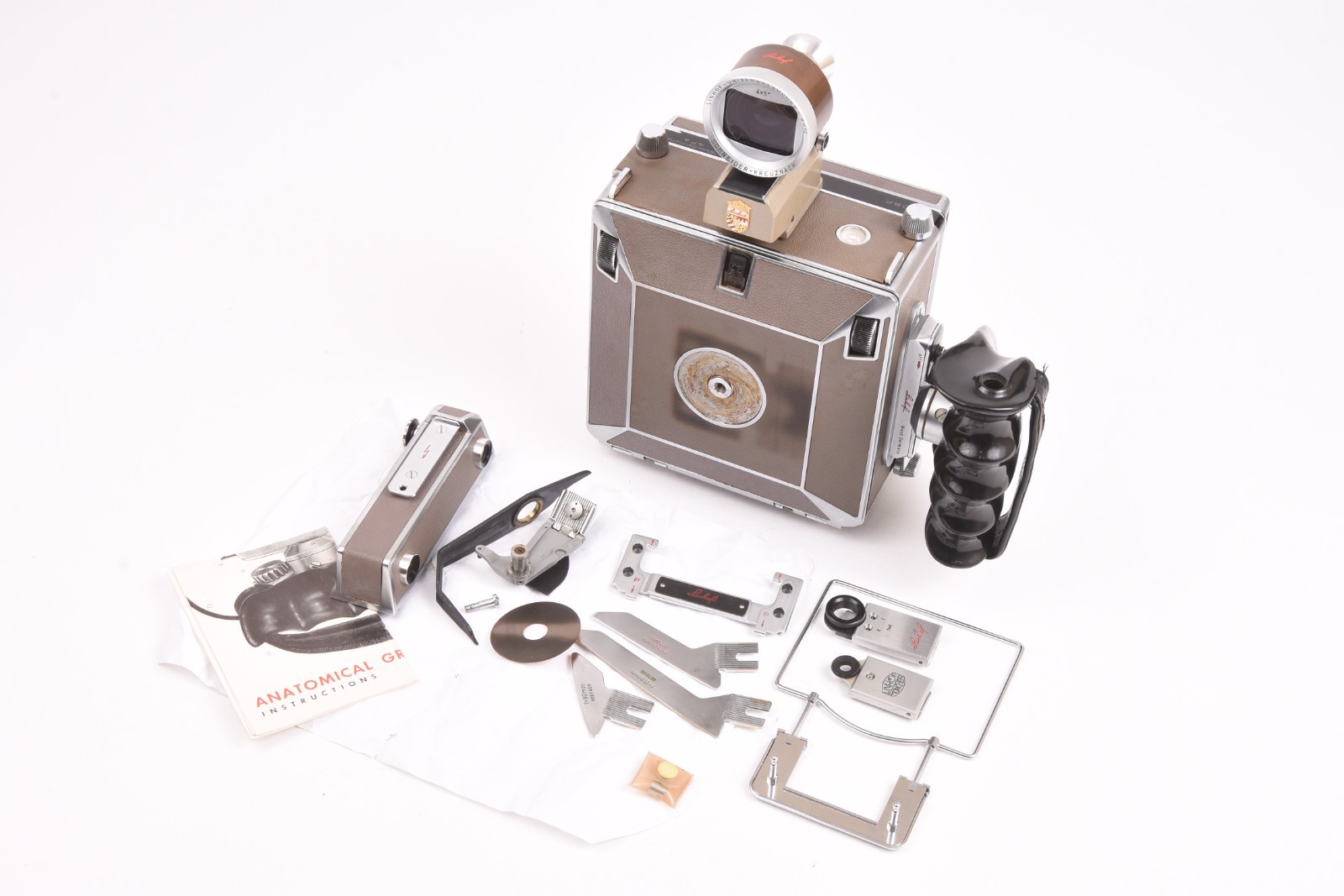
The Linhof Technika IV is a professional-grade 4×5 inch view camera introduced in 1956 as an evolution of the Technika series, designed for press, studio, and field photographers requiring precise optical control and rugged reliability. It represents the culmination of Linhof’s post-war engineering in large-format press camera design, combining refined mechanical movements with modular adaptability.
Overview
The Linhof Technika IV was developed during a transitional period in photography, bridging the gap between traditional field cameras and the increasing demand for precision in photojournalism, architectural, and commercial photography. Building upon the foundation of the earlier Technika II and III models, the Technika IV incorporated numerous mechanical refinements, including improved rail construction, enhanced bellows design, and a more robust standard for lensboard compatibility. It was specifically engineered to meet the needs of working professionals who required a portable yet highly capable large-format system with extensive camera movements.
Linhof positioned the Technika IV as a premium press camera, though its versatility made it equally suitable for studio and landscape applications. The camera featured a double-extension monorail design with a folding body, allowing for a compact form factor when collapsed while maintaining full 4×5 inch functionality. It supported front and rear standard movements including rise/fall, shift, tilt, and swing, with the rear standard offering full 360-degree rotation for horizontal and vertical orientation changes without repositioning the tripod. This level of adjustability was rare in press-oriented cameras of the era and underscored Linhof’s commitment to optical precision.
The Technika IV was part of Linhof’s broader Technika line, which began in the 1930s and evolved to meet changing photographic demands. The IV model marked the final major iteration before Linhof shifted focus toward the more modular and technically advanced Technika V and later the Linhof Master Technika. Its production span from 1956 to 1972 coincided with the gradual decline of large-format press photography in favor of 35mm systems, yet the Technika IV remained a favorite among photographers who prioritized image quality and control over speed and portability.
Specifications
| Specification | Value |
| Type | Large-format view camera |
| Film Format | 4x5 inch (with optional 6x9 cm roll film backs) |
| Years Produced | 1956–1972 |
| Lens Mount | Linhof Standard (interchangeable lens boards, 70mm diameter) |
| Shutter | Leaf shutter lenses (Compur, Prontor, Synchro-Compur); shutter speeds typically T, B, 1–1/1000 sec |
| Metering | None (external meter required) |
| Exposure Modes | Manual only (via shutter speed and aperture) |
| Viewfinder | Ground glass focusing screen with Fresnel lens, 4x5 inch size |
| Dimensions | Approx. 38 x 12 x 10 cm (folded); weight ~3.2 kg (7 lbs) without lens or film back |
Key Features
- Comprehensive Camera Movements: Front standard offers rise (±24 mm), fall (24 mm), lateral shift (±15 mm), tilt (±10°), and swing (±10°); rear standard provides similar movements with additional 360° rotation.
- Double Extension Bellows: Allows focusing on close subjects and use of wide-angle lenses with movements.
- Modular Design: Compatible with a wide range of Linhof and third-party lens boards, film holders, and roll film backs (e.g., Linhof 6x9 roll film adapter).
- Precision Machining: Constructed from aluminum alloy and brass with finely machined knobs and locking levers for smooth, repeatable adjustments.
- Folding Press Format: Collapsible frame with locking struts enables rapid setup and transport, meeting the demands of press photographers.
Historical Context
The Linhof Technika IV was introduced in 1956 at a time when photojournalism was rapidly evolving. While 35mm cameras like the Leica M3 and Nikon F were gaining dominance due to their speed and portability, there remained a niche for large-format cameras in assignments where image resolution, tonal range, and perspective control were paramount. The Technika IV filled this role, particularly in architectural, industrial, and high-end documentary photography. It competed with other precision view cameras such as the Sinar F and Toyo View, but distinguished itself with its folding design and press-ready form factor.
Linhof’s reputation for engineering excellence was well established by the 1950s, and the Technika IV reinforced that legacy. It was adopted by press agencies, government photographers, and fine art practitioners across Europe and North America. Unlike studio-bound monorails, the Technika IV could be deployed in the field with relative ease, making it a favorite among photographers who needed both mobility and optical precision. Its release also coincided with the expansion of flash synchronization and color film use, and the Technika IV was often equipped with lenses featuring Synchro-Compur shutters capable of X-sync at all speeds—a significant advantage for studio and available-light work.
Collectibility & Value
Today, the Linhof Technika IV is a sought-after collector’s item, particularly in fully functional condition with original accessories such as lens boards, film holders, and roll film backs. Units in excellent mechanical condition typically command prices between $800 and $1,800 on the secondary market, depending on completeness and included optics. Fully restored examples with high-quality lenses (e.g., Schneider Kreuznach or Rodenstock) can exceed $2,500. Rarity is moderate—while not uncommon, many surviving units suffer from stiff movements, light leaks, or damaged bellows due to age and storage conditions.
When evaluating a Technika IV for purchase, collectors should inspect the smoothness of all movement controls, the integrity of the bellows (checking for pinholes or tears), and the clarity of the ground glass. The locking mechanisms for both front and rear standards must function securely to prevent image shift during exposure. Original finish and serial number consistency are also important for provenance. Due to the complexity of its mechanics, disassembly and servicing require specialized tools and expertise, making well-maintained examples more desirable than those needing restoration.
Similar Cameras
- Sinar F – A modular monorail view camera with similar movements, though less portable than the Technika IV.
- Toyo View 45C – A Japanese-built 4x5 field camera with extensive movements and high build quality.
- Plaubel Peco Profia – A folding press camera with 4x5 capability and professional-grade movements.
- Graflex Super Graphic – An American press camera with 4x5 format and limited movements, popular in photojournalism.
- Linhof Technika V – The direct successor to the Technika IV, offering further refinements and improved ergonomics.
Repair & Maintenance
The Linhof Technika IV requires no batteries, as it is a fully mechanical camera. However, regular maintenance is essential to preserve its functionality. Common issues include stiff or frozen movement knobs, which often result from dried lubricants or dirt accumulation in the precision-threaded shafts. These can typically be resolved with careful disassembly, cleaning, and re-lubrication using light camera oil. The leather bellows are prone to deterioration; replacement requires skilled craftsmanship due to the exacting fit and light-tight requirements.
Lens shutters mounted on the Technika IV may require separate servicing, particularly if they exhibit inconsistent speeds or sticking blades. Compur and Prontor shutters from the era are generally serviceable by specialist technicians. The camera’s aluminum body is durable but susceptible to corrosion if stored in humid environments. Users are advised to store the camera in a dry, temperature-controlled space with silica gel desiccants. Given the complexity of the movements and alignment requirements, major repairs should be entrusted to technicians experienced with large-format view cameras.
eBay Listings


As an eBay Partner, we earn from qualifying purchases. This helps support our independent vintage technology research.
Related Models
- Linhof Super Technika 23 (1956-1972)
- Linhof Technika III (1946-1956)
- Linhof Technika V (1972-1986)
- Graflex Century Graphic (1949-1970)
- Graflex Crown Graphic (1947-1973)
- Graflex Speed Graphic (1912–1973)