LINHOF TECHNIKA III
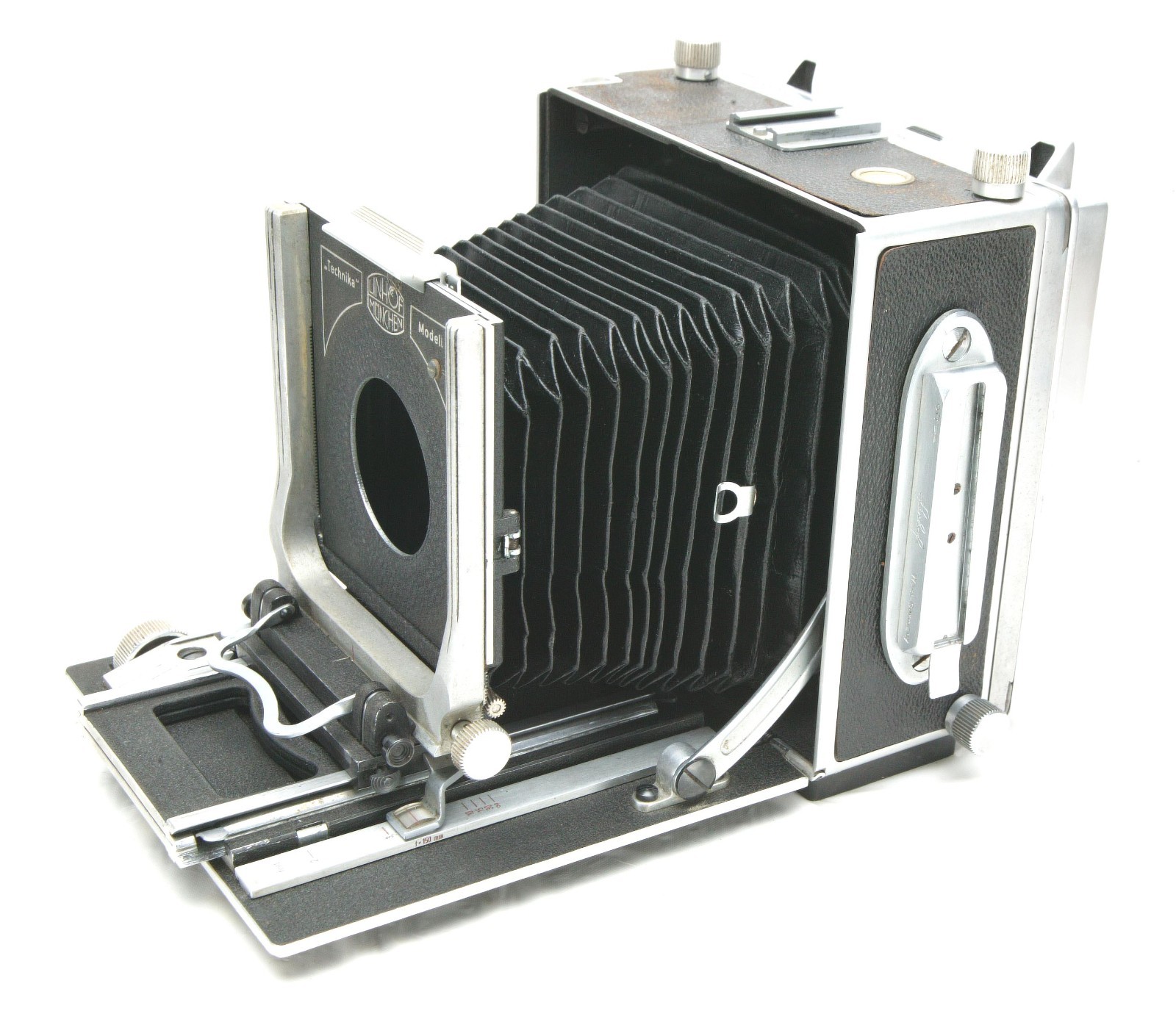
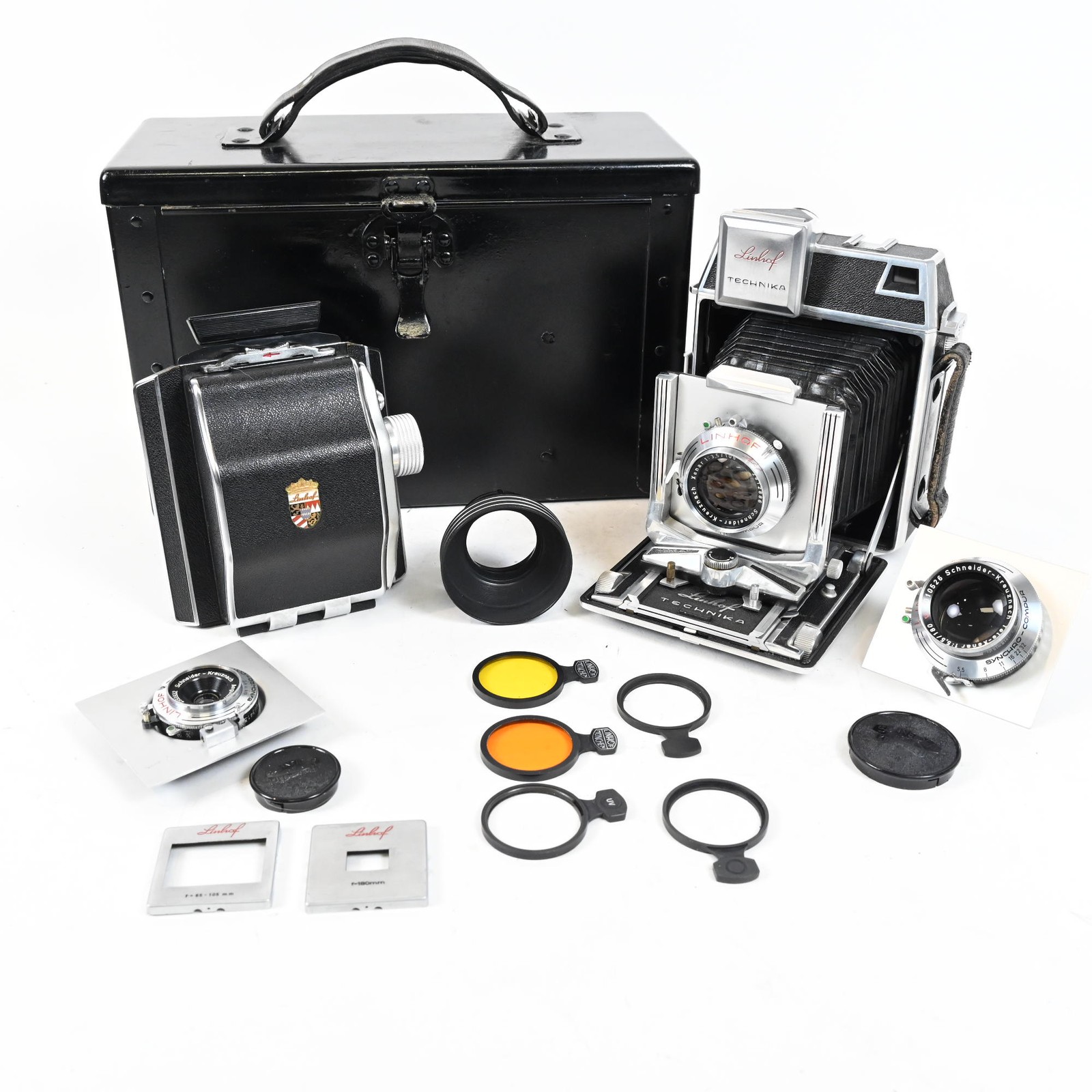
The Linhof Technika III is a precision-engineered 4×5 inch folding field camera produced by the German manufacturer Linhof from 1946 to 1956. Designed as a robust and versatile press camera, it combines a rigid folding bed with a built-in rangefinder and extensive movements, making it a favorite among photojournalists and studio photographers requiring high image quality with field mobility.
Overview
Introduced in the immediate post-World War II era, the Linhof Technika III represented a significant evolution in large-format press camera design. It succeeded the pre-war Technika II and incorporated refinements that improved durability, usability, and optical precision. Built in Munich, Germany, the Technika III was constructed from high-grade aluminum and steel, reflecting Linhof’s commitment to engineering excellence. Its primary market was professional photographers—particularly press, documentary, and architectural photographers—who required the image quality of 4×5 film combined with the portability and operational speed of a folding field camera.
The Technika III featured a rigid base with a folding struts-and-rails bed system that locked securely when extended, ensuring stability without sacrificing compactness when folded. Its most distinguishing feature was the integrated coupled rangefinder, a rarity among large-format cameras of the time, which greatly expedited focusing for fast-paced assignments. The camera supported extensive front standard movements—rise, fall, tilt, swing, and shift—allowing for precise control over perspective and depth of field, aligning it with technical camera standards despite its press orientation.
Within Linhof’s product lineup, the Technika III occupied a critical niche between the simpler folding field cameras and the more complex studio view cameras. It laid the groundwork for the later Technika IV (1956) and ultimately the Linhof Technika V (1965), which expanded on its modular design. The Technika III is considered one of the first truly integrated technical press cameras, blending the accuracy of view camera movements with the rapid deployment and focusing aids needed in field conditions.
Specifications
| Specification | Value |
| Type | Rangefinder Press Camera |
| Film Format | 4x5 inch (using sheet film holders) |
| Years Produced | 1946–1956 |
| Lens Mount | Linhof Standard Front (interchangeable lens panels) |
| Shutter | Leaf shutter lenses (Compur, Synchro-Compur, Prontor) typically used; speeds from 1 sec to 1/400 sec, B, T |
| Metering | None (external meter required) |
| Exposure Modes | Manual only |
| Viewfinder | Built-in coupled rangefinder, ground glass focusing screen, pop-up optical viewfinder (sports finder) |
| Dimensions | Approx. 27 × 20 × 10 cm (folded); weight ~3.2 kg (7 lbs) without lens or film holder |
Key Features
- Integrated Coupled Rangefinder: One of the few 4×5 cameras with a built-in, accurately coupled rangefinder, enabling rapid focusing essential for press work.
- Rigid Folding Bed Design: Utilizes a strut-braced folding rail system that locks firmly when open, providing stability comparable to monorail cameras while remaining portable.
- Extensive Front Standard Movements: Front standard offers ±15 mm rise/fall, ±12 mm shift, ±10° tilt, and ±10° swing, allowing for Scheimpflug adjustments and perspective control.
- Interchangeable Lens Panels: Uses removable lens standards secured by a bayonet or screw lock, facilitating quick lens changes in the field.
- Dual Viewfinding System: Combines ground glass focusing (with 4x loupe) and a pop-up reverse Galilean optical viewfinder for quick framing and action shooting.
Historical Context
The Linhof Technika III was developed during a period of industrial rebuilding in postwar Germany. Linhof, having survived the war with its tooling and expertise intact, resumed production in 1946 by refining its pre-war designs to meet the demands of a changing photographic landscape. The rise of photojournalism in the 1940s and 1950s—fueled by publications like Life and Der Spiegel—created a need for durable, high-resolution cameras that could be used in the field. The Technika III directly addressed this need, offering 4×5 image quality with operational speed previously unattainable in large format.
Competitors during this period included the Graflex Speed Graphic (USA), which dominated the American press market, and the Plaubel Peco Profia (Germany), a more studio-oriented technical camera. While the Speed Graphic offered faster operation with its focal-plane shutter and coupled rangefinder, it lacked the Technika III’s extensive movements and build precision. The Technika III carved a niche among European and high-end professional photographers who valued optical control and image fidelity over brute speed. It was particularly popular in architectural, industrial, and documentary photography, where its movements and large negative size provided unmatched detail and perspective correction.
Collectibility & Value
Today, the Linhof Technika III is a sought-after collector’s item, valued for its historical significance, precision engineering, and role in the evolution of technical cameras. In good working condition, with a clean rangefinder and intact leather covering, examples typically sell for $1,200 to $2,500 USD, depending on rarity, included accessories (such as lens panels or original cases), and provenance. Fully serviced units with calibrated rangefinders command premium prices, especially when paired with high-quality vintage lenses like Schneider Kreuznach or Rodenstock.
Collectors should inspect several key areas when acquiring a Technika III: the rangefinder’s calibration (often misaligned due to age or impact), the integrity of the folding struts and locking mechanisms, and the condition of the bellows (which are prone to pinholes and light leaks). The ground glass may also be scratched or cloudy, requiring replacement. Due to the complexity of the rangefinder linkage and bed mechanics, repairs are best handled by specialists in vintage large-format equipment. Despite these challenges, well-maintained Technika III models remain functional and are still used by fine art and architectural photographers who appreciate their tactile precision and optical capabilities.
Similar Cameras
- Graflex Speed Graphic 4×5 (USA) – Iconic American press camera with focal-plane shutter and rangefinder; faster operation but fewer movements.
- Plaubel Peco Profia SV (Germany) – Technical camera with similar movements and build quality, but less portable and no integrated rangefinder.
- Toyo View 45A (Japan) – Later field camera with modular design and movements, though lacking a built-in rangefinder.
- Sinar F (Switzerland) – Early technical camera with modular components and precision engineering, targeting studio and architectural use.
- Linhof Technika IV (Germany) – Direct successor with improved ergonomics, extended movements, and updated rangefinder design.
Repair & Maintenance
The Linhof Technika III requires no batteries, as it is fully mechanical. However, the coupled rangefinder contains a delicate联动 (linkage) mechanism that can become misaligned from impact or wear, necessitating optical recalibration by a specialist. Common issues include stiff or seized focusing rails, worn strut hinges, and deteriorated bellows—especially at the corners and folds. Regular maintenance includes lubrication of rail mechanisms, inspection of lens panel locks, and cleaning of the ground glass and viewfinder optics. Due to the precision tolerances and scarcity of replacement parts, repairs are considered moderately difficult and should be performed by technicians experienced with vintage German large-format cameras. Original service manuals and exploded diagrams are available through Linhof archives and collector networks, aiding in restoration efforts.
eBay Listings

As an eBay Partner, we earn from qualifying purchases. This helps support our independent vintage technology research.
Related Models
- Linhof Super Technika 23 (1956-1972)
- Linhof Technika IV (1956-1972)
- Linhof Technika V (1972-1986)
- Graflex Century Graphic (1949-1970)
- Graflex Crown Graphic (1947-1973)
- Graflex Speed Graphic (1912–1973)