Leica III (1933–1939)
At 1/500th and 1 second, it opened the shutter to a new era—smaller than a brick, heavier than a promise.
Overview
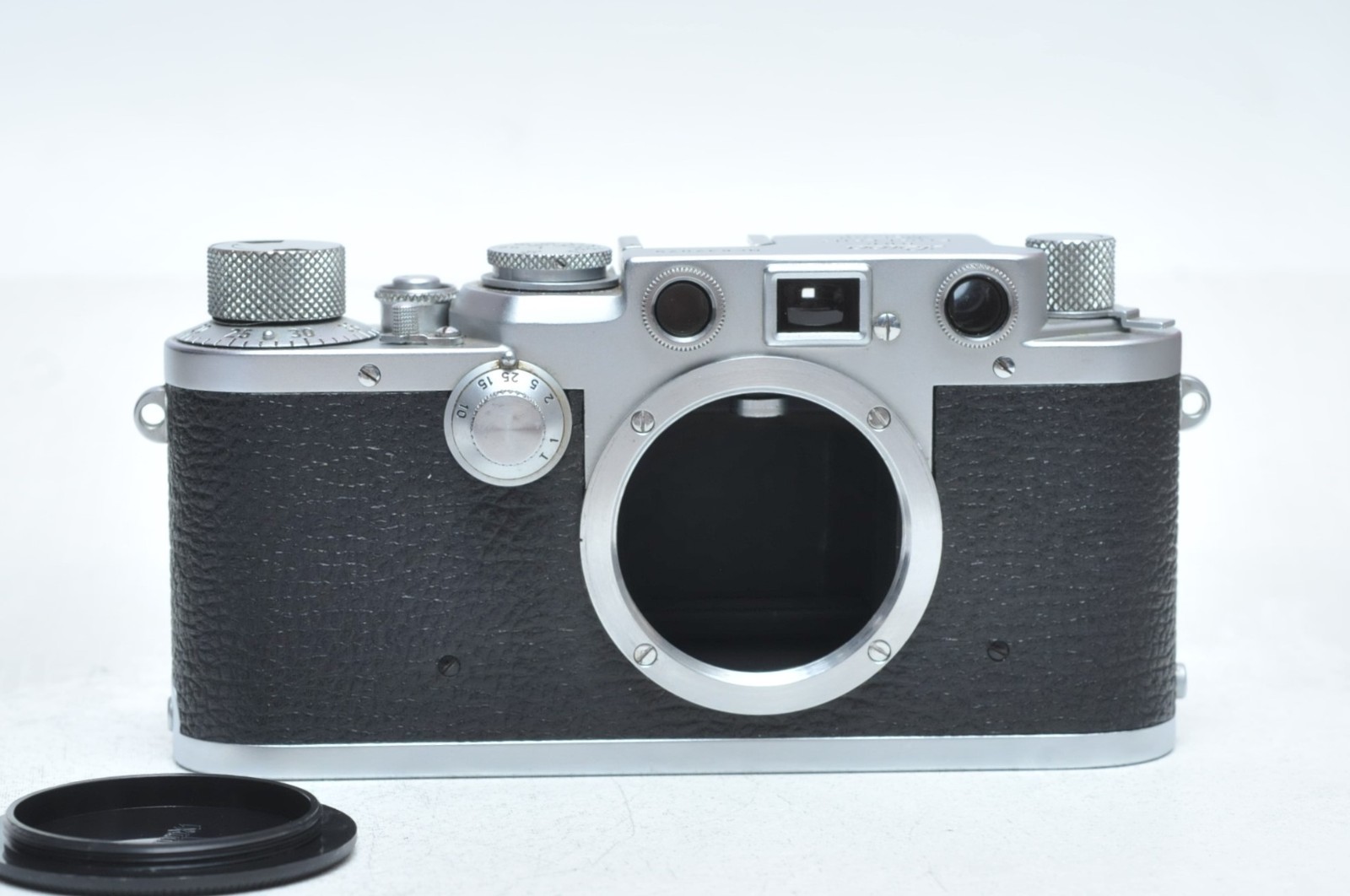
The Leica III isn’t a reinvention. It’s an evolution, quietly significant in its tweaks. Introduced in 1933, it arrived alongside the Leica II series, carrying over nearly all its DNA—same compact M39 screw-mount body, same coupled rangefinder, same 35mm film format—but with one critical addition: slow shutter speeds down to 1 second. That single upgrade transformed its utility, giving photographers control in lower light and opening the door to longer exposures without external timers. For collectors and users familiar with the Barnack lineage, the III is the moment Leica began refining its formula rather than redefining it.
The slower speeds down to 1 second live on a dial mounted on the front of the camera, just ahead of the lens mount. The faster speeds occupy the top plate, adjacent to the film advance knob. Notably, that top dial rotates during exposure, a mechanical ballet visible to the user, linking action to outcome. Film transport? Entirely by knob—both advance and rewind. No levers here, no automatic stroke. Each frame is earned manually, a tactile rhythm that modern shooters might find archaic but enthusiasts often praise for its precision.
Despite its age, the III wasn’t left behind as technology advanced. Leica offered factory upgrades for earlier models well into the 1950s, and many cameras originally built as Leica IIs or even Is were converted to III specification—and later, to IIIa or IIIf—at the Wetzlar factory. These upgraded bodies kept their original serial numbers, which explains why a camera bearing a 1932 serial might emerge from service with III features. This practice blurs the line between model and modification, making provenance tricky but also adding layers to the camera’s legacy.
Specifications
| Manufacturer | Leica / Leitz |
| Exact product name | Leica III (also known as Model F) |
| Product type | 35mm rangefinder camera |
| Lens mount | M39 screw mount |
| Film format | 35mm |
| Shutter speed range | 1 second to 1/500 plus Z (time) — note: some sources report up to 1/1000 sec, but this is unconfirmed for the base III model |
| Viewfinder | Set for 50mm lens; requires accessory viewfinder for other focal lengths |
| Production years | 1933–1939 |
| Code number | AFOOV |
Key Features
Slow Speeds Down to 1 Second Added
This is the defining upgrade over the Leica II. Prior models lacked slow speeds down to 1 second, limiting low-light flexibility. The addition of slow speeds down to 1 second gave photographers real creative control—enough to shoot interiors, night scenes, or motion-blurred subjects without guesswork. It wasn’t a flashy change, but a functional one, and it laid the groundwork for the IIIa’s further refinements.
Front and Top Shutter Speed Dials
The dual-dial system splits the exposure range for ergonomic access. The front dial handles slow speeds, reducing the chance of accidental selection during handheld shooting. The top dial, rotating during exposure, gives immediate feedback—its motion confirms the shutter is running.
Knob-Driven Film Advance and Rewind
No lever here. The III demands manual winding via a knurled knob on the baseplate side. It’s slower than a lever advance, yes, but The rewind knob is similarly manual. It’s laborious by modern standards, but part of the camera’s tactile appeal.
Accessory Viewfinder Socket for 50mm Calibration
The built-in viewfinder is optimized for 50mm lenses. Use a 35mm or 90mm, and framing becomes guesswork—unless an external viewfinder is clipped into the accessory shoe. This socket accepts a range of Leica’s framelines, allowing accurate composition across focal lengths. It’s a modular system that defined Leica’s rangefinder philosophy: adaptability over integration.
Factory Upgrade Path to Later Models
Leica didn’t treat early cameras as disposable. Owners could send their II or III bodies back to the factory for updates to the latest model, including IIIa conversions. These factory-modified cameras retain their original serial numbers, making authentication a challenge. A III with a 1932 serial isn’t a fake—it’s a survivor, upgraded and extended.
Historical Context
The Leica III emerged in 1933, one year after the Leica II, and was produced in parallel with later variants of that model. It marked the beginning of iterative development in the Barnack line, where each new model built on the last with targeted improvements. The III was succeeded by the IIIa, which extended the top shutter speed to 1/1000 sec. The III’s production spanned until 1939, with chrome-finish models designated as "Mod.F" under the AFOOV code. In the US, these cameras are commonly referred to as "screw mounts" or "LTM"; in Japan, collectors often call them "Barnack Cameras" in honor of designer Oskar Barnack.
Collectibility & Value
Market values for the Leica III vary widely based on condition and completeness. According to recent reports, a body with functional shutter and rangefinder might fetch around $300. In mint condition, with a lens, values climb to $800–$900. A 2024 listing for a Leica III (Mod.F) chrome body noted $1,102 for condition A- and $1,296 for A-B, suggesting strong demand for well-preserved examples. However, condition is critical—common issues include inaccurate fast shutter speeds (where 1/500 may actually fire at 1/250) and degraded rangefinder mirrors. One owner described a "bashed up pre-war Leica III" needing shutter repair, mirror replacement, and body re-covering, a reminder that functionality is never guaranteed. Despite these challenges, the III is often seen as a practical entry point into Leica ownership, offering authentic Barnack experience without the premium of rarer variants.
eBay Listings


As an eBay Partner, we earn from qualifying purchases. This helps support our independent vintage technology research.