KONICA PEARL III
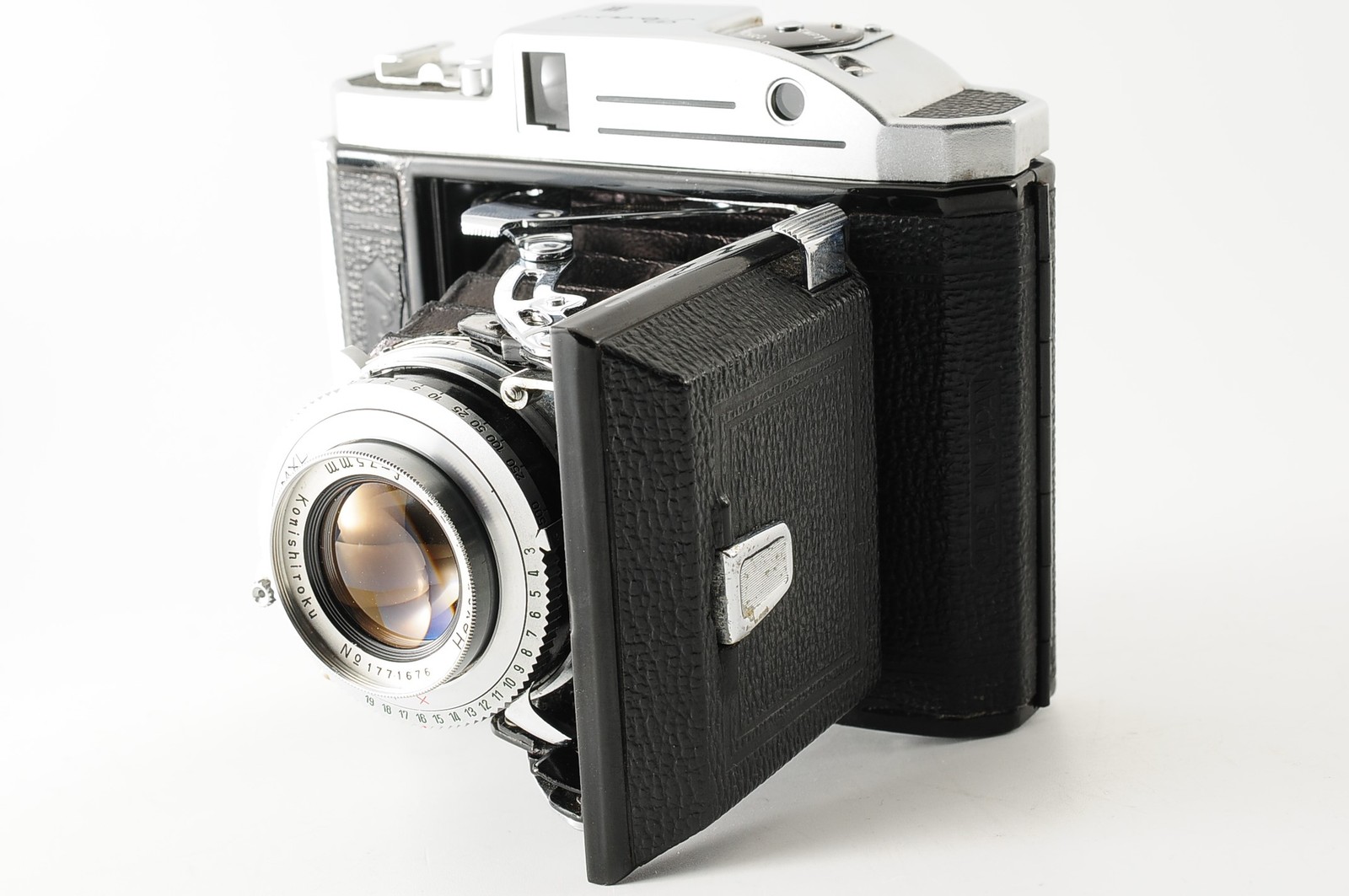
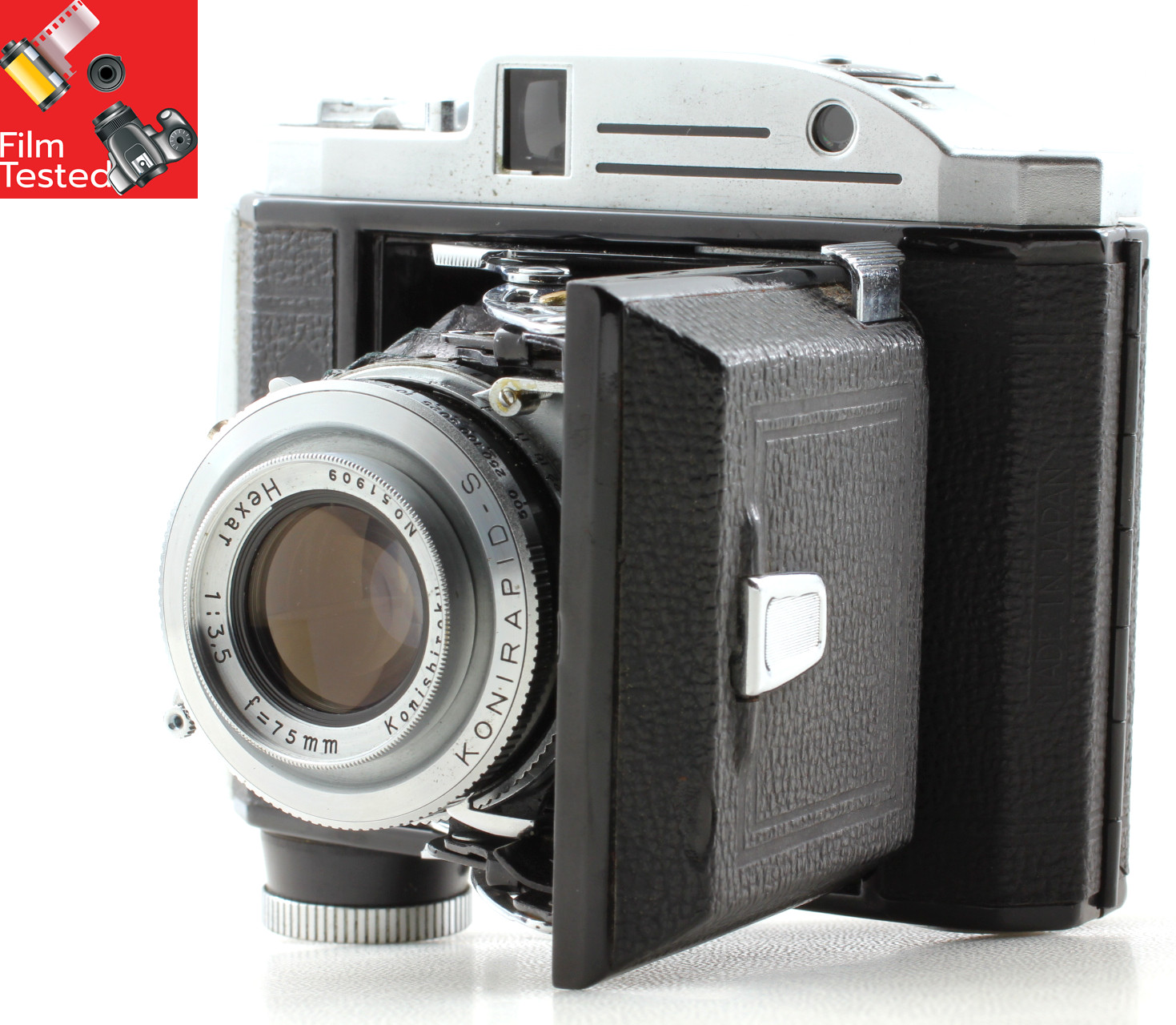
The Konica Pearl III is a folding medium format camera produced by Konica (then known as Konishiroku) between 1955 and 1960. It represents the final evolution of the Pearl series, offering modest but meaningful improvements over its predecessors in ergonomics, lens quality, and mechanical reliability.
Overview
The Konica Pearl III was introduced in 1955 as the third and most refined model in Konica’s line of 6x4.5cm folding roll-film cameras. Positioned as an affordable yet capable medium format option, the Pearl III targeted amateur photographers and enthusiasts who desired higher image quality than 35mm cameras could offer, without the expense or complexity of larger professional systems. It succeeded the Pearl II and built upon its foundation with a redesigned body, improved focusing mechanism, and enhanced lens assembly. As a folding camera, the Pearl III utilized a bellows system that allowed the lens standard to collapse into the body for portability, making it a compact and travel-friendly option for its time.
Konica, then still operating under the full name Konishiroku, was rapidly expanding its photographic product line during the mid-1950s, transitioning from its earlier focus on photographic paper and chemicals into a full-fledged camera manufacturer. The Pearl III played a key role in this strategy, offering a balance of quality and affordability. It was marketed as a "snapshot" medium format camera but was capable of producing high-resolution negatives suitable for enlargements. The camera used 120 roll film and produced sixteen 6x4.5cm exposures per roll, a popular format in Japan and Europe for its efficient balance of negative size and frame count.
The Pearl III was part of a broader trend in postwar Japan of producing high-quality, precision-engineered cameras that could compete with European models at lower price points. While not as advanced as contemporaneous TLRs like the Rolleiflex or SLRs like the Asahiflex, the Pearl III offered a compelling alternative for photographers seeking simplicity and portability. Its design emphasized ease of use, with a fixed lens and shutter system that required minimal user intervention. Despite its modest feature set, the Pearl III reflected Konica’s growing expertise in optical engineering and mechanical design, serving as a stepping stone toward more sophisticated models like the Konica Auto Reflex series in the 1960s.
Specifications
| Specification | Value |
| Type | Folding viewfinder camera |
| Film Format | 6x4.5cm on 120 roll film |
| Years Produced | 1955–1960 |
| Lens Mount | Fixed lens (non-interchangeable) |
| Lens | Hexar 75mm f/3.5 (4 elements in 3 groups) |
| Aperture Range | f/3.5 to f/22 |
| Shutter | Konica Synchro-Kompass leaf shutter |
| Shutter Speeds | 1 sec to 1/300 sec, plus B |
| Flash Sync | Yes, via PC terminal (X-sync at all speeds) |
| Metering | None (manual exposure) |
| Exposure Modes | Manual only |
| Viewfinder | Optical frame-type viewfinder with parallax correction marks |
| Focusing | Scale focusing with helical focus mechanism (from 3.3 ft to infinity) |
| Film Advance | Red window with frame numbers on back |
| Dimensions | Approx. 130 x 90 x 55 mm (folded); 130 x 90 x 105 mm (unfolded) |
| Weight | Approx. 580 g (without film) |
Key Features
- Hexar 75mm f/3.5 lens: A high-quality, four-element optical design known for sharpness and contrast, derived from the renowned Hexanon line.
- Synchro-Kompass leaf shutter: Offers a wide range of shutter speeds from 1 second to 1/300 sec, with flash synchronization at all speeds.
- Compact folding design: Bellows collapse into the body for portability, making it one of the more travel-friendly 6x4.5cm cameras of its era.
- Parallax-corrected viewfinder: Includes framing guides for near and far distances to improve composition accuracy.
- Red window film advance: Simple and reliable, with numbered frames visible through the back for precise winding.
Historical Context
The Konica Pearl III was released during a transformative period for the Japanese camera industry. In the mid-1950s, Japanese manufacturers were gaining international recognition for producing well-engineered, affordable cameras that challenged German dominance in the photographic market. The Pearl III entered a competitive segment populated by folding cameras from brands like Minolta (Autocord variants), Petri, and Fujica, as well as TLRs and early SLRs. While the Pearl III lacked the dual-lens reflex design of premium models, it offered a compelling value proposition: a sharp lens, reliable shutter, and medium format image quality in a compact body.
Konica’s strategy with the Pearl series was to provide an accessible entry point into medium format photography. The Pearl III improved upon earlier models by refining the focusing mechanism—earlier Pearls used less precise sliding focus systems, while the III introduced a helical focus mount for smoother, more accurate adjustments. Additionally, the updated body design featured a more rigid folding mechanism and improved leather covering, enhancing durability. Despite its lack of built-in metering or automatic exposure, the Pearl III was well-received in domestic and export markets for its optical performance and build quality. It was particularly popular among students, hobbyists, and photo clubs in Japan, where medium format roll film was widely adopted.
Collectibility & Value
Today, the Konica Pearl III is a moderately collectible camera, valued more for its historical significance and optical quality than for rarity. While not as sought-after as contemporaneous Rolleiflex or Yashica TLRs, it holds a niche appeal among collectors of Japanese folding cameras and Konica enthusiasts. In good working condition, with a clean lens and functional shutter, the Pearl III typically sells for $150–$300 USD. Cameras with original cases, instruction manuals, or accessories may command higher prices. The Hexar lens is a key factor in valuation—units with haze-free glass and smooth aperture blades are preferred.
When purchasing a Pearl III, collectors should inspect the bellows for pinholes or deterioration, as these can compromise image quality. The Synchro-Kompass shutter should be tested across all speeds, as lubricants can dry out over time, leading to inaccurate timing. The red window should be intact and free of cracks, and the film pressure plate should be flat to ensure even film plane alignment. Because the camera uses no batteries and has no electronic components, it is generally reliable if mechanically sound. However, the red window advance system requires user attention to avoid overlapping frames, a common issue for inexperienced users.
Similar Cameras
- Minolta Autocord III (1958) – TLR with 75mm f/3.5 lenses, offering superior focusing and build at a higher price.
- Fujica Six III (1958) – Folding 6x6cm camera with interchangeable lenses, larger format but less portable.
- Petri 35mm RF with 120 back – While primarily 35mm, some Petri models offered medium format backs, providing format flexibility.
- Yashica 44 (1958) – Compact 6x4.5cm folder with Yashinon lens, similar in concept and target market.
- Rollei 4×4 (1961) – Later Rollei folding camera for 127 film, smaller format but similar design philosophy.
Repair & Maintenance
The Konica Pearl III requires no batteries and operates entirely mechanically, making it inherently durable and long-lasting with proper care. The primary maintenance concerns are the leaf shutter and bellows. The Synchro-Kompass shutter should be serviced by a technician experienced with vintage leaf shutters, as incorrect disassembly can lead to timing inaccuracies. Common issues include slow shutter speeds due to dried lubricants or stuck blades. The bellows are made of accordion-fold black leather and fabric; over time, they may develop pinholes or lose light-tightness. Replacement bellows are rare but can be custom-made by specialist restorers.
The Hexar lens is generally robust, but internal haze or fungus can occur if the camera has been stored in humid conditions. Aperture blades should move smoothly and fully close at f/22. Cleaning should be limited to the front and rear elements using appropriate lens solution and microfiber cloth. The red window should be kept clean and free of paint flaking, which can obscure frame numbers. As the camera uses a red window for film advance, users must advance the film carefully, checking the numbers in low light to avoid exposure. Overall, the Pearl III is a low-maintenance camera ideal for occasional use, provided it has been stored properly and receives periodic mechanical inspection.
eBay Listings


As an eBay Partner, we earn from qualifying purchases. This helps support our independent vintage technology research.