KONICA PEARL II
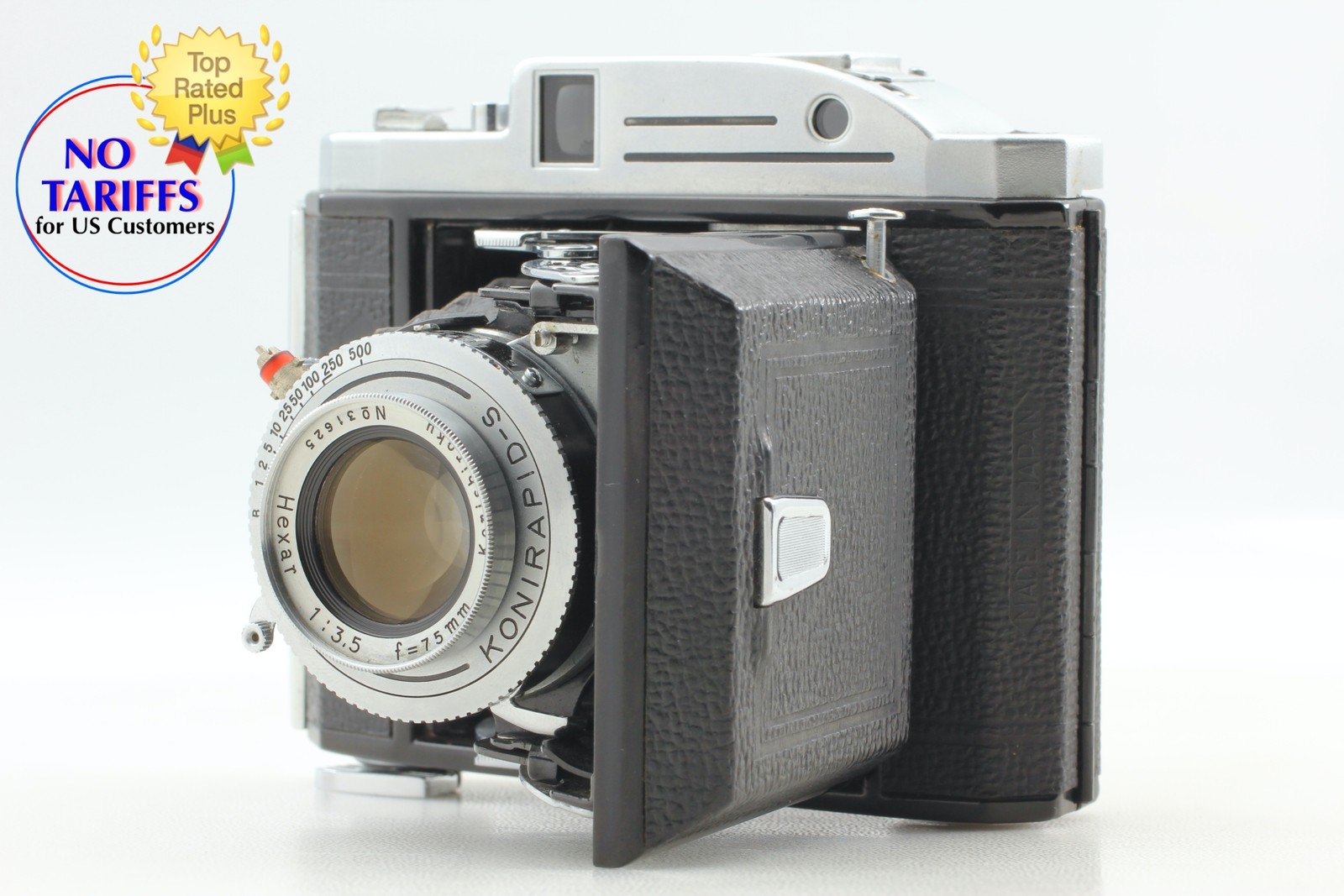
The Konica Pearl II is a folding medium format rangefinder camera produced by Konica (then Konishiroku) between 1952 and 1959. Designed for amateur and enthusiast photographers, it captures 12 exposures of 6x4.5cm on 120 roll film and features a high-quality Hexar lens, making it a compact yet capable medium format option in the postwar Japanese camera market.
Overview
Introduced in 1952, the Konica Pearl II occupies a significant place in Konica’s early transition from optical instrument manufacturer to producer of sophisticated consumer cameras. It was part of the Pearl series, which aimed to deliver premium folding camera performance at a more accessible price point than the company’s flagship Autoreflex and Hexar models. The Pearl II succeeded the original Pearl and featured refinements in lens quality, rangefinder integration, and build precision. Marketed primarily to amateur photographers seeking high image quality without the bulk of larger format systems, the Pearl II combined portability with the image resolution advantages of 6x4.5cm negatives.
The camera employs a collapsible strut-and-lever folding design, allowing the lens standard to retract into the body for transport. This compactness, coupled with its leather-covered body and metal fittings, made it a favorite among travelers and street photographers of the era. Unlike TLRs or SLRs, the Pearl II uses a direct optical viewfinder with a separate coupled rangefinder patch in the viewfinder housing, enabling accurate manual focusing. Its use of 120 film provided 12 exposures per roll—double that of 6x6 TLRs—offering economical shooting without sacrificing negative size.
Within Konica’s lineup, the Pearl II sat below the premium Hexar-series rangefinders but offered many of the same optical and mechanical traits. It represented Konica’s commitment to quality optics and precise engineering, even in mid-tier models. The camera was manufactured at Konica’s Tokyo factory and reflects the rapid advancement of Japanese camera technology in the early 1950s, a period when domestic manufacturers were beginning to challenge European dominance in the high-end camera market.
Specifications
| Specification | Value |
| Type | Rangefinder |
| Film Format | 6x4.5cm on 120 roll film |
| Years Produced | 1952–1959 |
| Lens Mount | Fixed Hexar 75mm f/3.5 lens (non-interchangeable) |
| Shutter | Konica Synchro-Kompass Focal Plane Shutter; speeds 1–1/400 sec, B, X & M flash sync |
| Metering | None (uncoupled light meter required) |
| Exposure Modes | Manual only |
| Viewfinder | Optical viewfinder with superimposed brightline frames and coupled rangefinder patch |
| Dimensions | Approx. 150 x 95 x 55 mm (closed); Weight: ~680 g |
Key Features
- Konica Hexar 75mm f/3.5 Lens: A high-performance, four-element optical design renowned for sharpness, contrast, and smooth bokeh—on par with contemporary Zeiss Tessar designs.
- Coupled Rangefinder Focusing: Integrated patch-type rangefinder enables precise manual focus, a significant upgrade over scale-focusing predecessors.
- Focal Plane Shutter with High Speeds: Offers shutter speeds up to 1/400 sec, rare in folding medium format cameras of the era, allowing greater flexibility in daylight shooting.
- Compact Folding Design: Collapsible body with strut lock makes the camera highly portable when not in use.
- Flash Synchronization: Equipped with both M (medium) and X (electronic) sync terminals, supporting a wide range of flash units for its time.
Historical Context
The Konica Pearl II was released during a pivotal period in Japan’s photographic industry. In the early 1950s, Japanese manufacturers were rapidly adopting and refining German optical designs while innovating in mechanical engineering and mass production. The Pearl II emerged as part of Konica’s strategy to capture a broader consumer base by offering a well-built, optically excellent camera at a competitive price. It competed directly with models like the Minolta Autocord (though a TLR), the Plaubel Makina 67 (more professional), and folding rangefinders from Fujica and Yashica.
Compared to its contemporaries, the Pearl II stood out for its combination of the esteemed Hexar lens and a focal plane shutter—uncommon in medium format folders, which typically used leaf shutters with more limited speed ranges. This gave the Pearl II an edge in versatility, especially for available-light photography. While lacking a built-in exposure meter (a feature still rare in the early 1950s), its brightline viewfinder and accurate rangefinder made composition and focusing intuitive.
The camera was well-received in both domestic and export markets, particularly in North America and Europe, where Japanese cameras were gaining credibility for quality and value. However, by the late 1950s, the rise of 35mm cameras and the growing popularity of SLRs began to erode the market for folding medium format cameras. Konica discontinued the Pearl II in 1959, shifting focus toward 35mm rangefinders and, later, SLRs.
Collectibility & Value
Today, the Konica Pearl II is a sought-after collector’s item, particularly among enthusiasts of vintage Japanese rangefinders and medium format film systems. Well-preserved examples with a clear rangefinder patch, smooth shutter operation, and clean lens elements typically command prices between $400 and $700 on the secondary market, with mint-condition units occasionally exceeding $800. Rarity is moderate—while not as scarce as some limited-production European models, the Pearl II was not produced in the same volumes as later 35mm cameras, and many units have suffered from deteriorated leather, sticky shutters, or fogged rangefinder windows.
When purchasing a Pearl II, collectors should inspect several critical components: the shutter across all speeds (noting any inconsistencies or dragging), the rangefinder alignment (misalignment renders accurate focusing impossible), and the condition of the lens (checking for fungus, haze, or separation). The folding strut mechanism should lock securely when open and collapse smoothly without play. Light seals are invariably degraded and should be replaced for proper light-tightness. Original accessories, such as the case, lens cap, or instruction manual, add significant value.
Due to its mechanical complexity and age, functional examples are increasingly rare. Cameras that have been stored in humid environments often exhibit mold or corrosion on internal components. As with most pre-1960 Japanese cameras, repair requires specialized knowledge—few technicians today are familiar with focal plane shutters in medium format folders.
Similar Cameras
- Minolta Autocord III – A 6x6 TLR with excellent Minolta Sexton lenses, produced 1958–1961.
- Fujica Six II – Folding 6x6 rangefinder with 80mm f/3.5 EBC Fujinon lens, 1958–1961.
- Yashica 635 – 6x4.5 folding camera with Yashinon 75mm f/3.5 lens, scale focusing (non-rangefinder).
- Plaubel Makina 67 – High-end 6x7 folding camera with exceptional optics and build, targeted at professionals.
- Kowa Six Model 2 – 6x6 TLR with high-quality Kowa Prominar lens, known for compact design and sharp optics.
Repair & Maintenance
The Konica Pearl II requires no batteries, as it is fully mechanical. Shutter operation and film advance are manual, driven by the film transport mechanism. The most common issues include stiff or inconsistent shutter speeds (often due to dried lubricants), misaligned rangefinders, and light leaks from deteriorated internal seals. The focal plane shutter is delicate and should only be serviced by a technician experienced in vintage Japanese cameras. Cleaning the lens and rangefinder prism is possible with proper tools, but disassembly of the optical block is not recommended without expertise. Regular use, storage in a dry environment, and periodic CLA (clean, lubricate, adjust) servicing are essential for long-term reliability.
eBay Listings



As an eBay Partner, we earn from qualifying purchases. This helps support our independent vintage technology research.