KONICA C35 EF
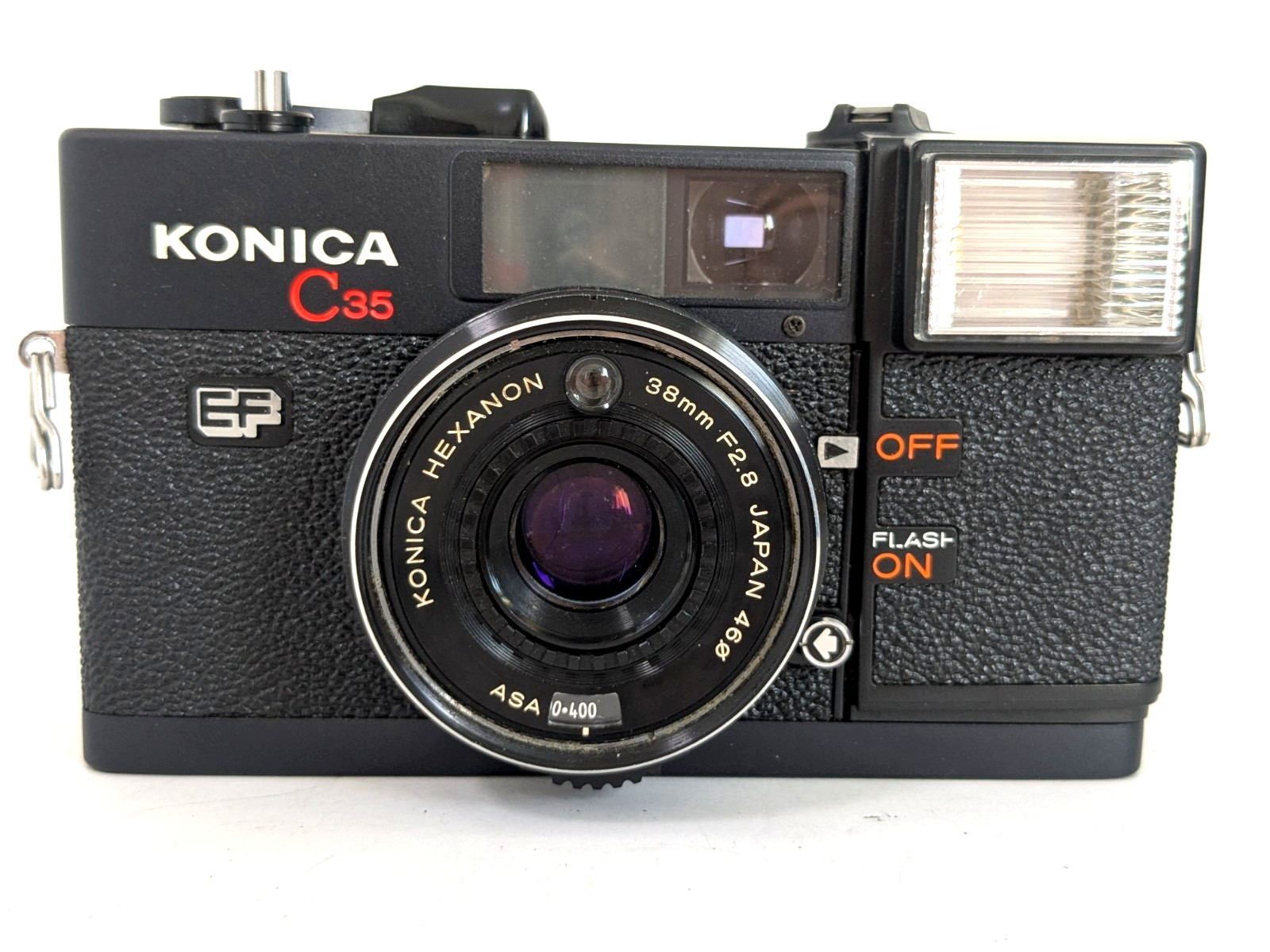
The Konica C35 EF is a landmark 35mm compact point-and-shoot camera renowned for being the world’s first 35mm camera with a built-in electronic flash. Released in 1975, it marked a pivotal moment in consumer photography by integrating flash technology directly into the camera body, eliminating the need for external flash units for casual photographers.
Overview
The Konica C35 EF was introduced during a transformative period in camera design, when Japanese manufacturers were rapidly advancing automation and miniaturization in consumer photography. Aimed squarely at the amateur and snapshot market, the C35 EF combined ease of use with innovative engineering. It was part of Konica’s C35 series, a line of compact, fixed-lens 35mm cameras designed for simplicity and reliability. What set the C35 EF apart was its integrated, pop-up electronic flash—powered by a self-contained rechargeable battery—making it the first of its kind in the world. This feature was revolutionary at a time when most compact cameras required external flash attachments or lacked flash synchronization altogether.
The camera featured a fixed 38mm f/2.8 Hexanon lens, a leaf shutter with speeds from 1/8 to 1/170 second, and a fully automatic exposure system with center-weighted metering. Focusing was achieved via scale focusing with preset distances (1.2m, 2m, and ∞), typical for compact cameras of the era. The C35 EF was marketed as a premium compact, offering advanced features in a sleek, metal-bodied design. It helped establish Konica as a leader in innovation within the point-and-shoot segment, bridging the gap between basic box cameras and more sophisticated rangefinders or SLRs.
Specifications
| Specification | Value |
| Type | Compact point-and-shoot |
| Film Format | 35mm |
| Years Produced | 1975–1980 |
| Lens Mount | Fixed lens (non-interchangeable) |
| Shutter | Electronically controlled leaf shutter, 1/8 to 1/170 sec |
| Metering | Center-weighted TTL (through-the-lens) CdS metering |
| Exposure Modes | Fully automatic (shutter-priority), no manual control |
| Viewfinder | Optical, fixed-focus, with brightline frame and flash-ready indicator |
| Dimensions | Approx. 130 x 75 x 50 mm; Weight: ~420 g (with battery) |
Key Features
- World’s first built-in electronic flash in a 35mm camera, eliminating reliance on external flash units.
- Rechargeable Ni-Cd battery pack (Konica BP-2) powered the flash and electronics, charged via a dedicated external charger (Konica BC-2).
- TTL center-weighted metering ensured accurate exposure under various lighting conditions.
- Fixed Hexanon 38mm f/2.8 lens—a high-quality, multi-coated lens known for sharpness and contrast.
- Automatic film loading and advance with motorized film transport, enhancing user convenience.
Historical Context
The Konica C35 EF was launched in 1975 at a time when consumer demand for easier, more automated photography was rising. Competitors like Olympus, Canon, and Minolta were introducing compact cameras, but none had successfully integrated a reliable electronic flash into the body. Konica’s innovation gave it a significant edge in the emerging point-and-shoot market. The C35 EF was developed in response to the growing popularity of indoor and low-light snapshot photography, particularly in home and social settings where flash was essential but cumbersome to use.
Konica leveraged its expertise in lens design (Hexanon optics) and electronic integration to position the C35 EF as a premium compact. It competed with models like the Olympus XA (later, in 1980) and the Minolta TC-1, though the C35 EF was bulkier due to its internal flash mechanism. Market reception was positive, especially in Japan and North America, where it was praised for its reliability and pioneering flash system. However, the reliance on a proprietary rechargeable battery pack was a limitation, as replacements are now difficult to source. Despite this, the C35 EF influenced future designs across the industry, with built-in flash becoming standard in compact cameras by the 1980s.
Collectibility & Value
The Konica C35 EF is a sought-after model among collectors of vintage Japanese cameras, particularly those interested in technological milestones. Its status as the first 35mm camera with a built-in flash gives it significant historical value. Units in working condition with original accessories (such as the BC-2 charger and BP-2 battery) command higher prices, typically ranging from $150 to $300 on the secondary market, depending on condition and functionality.
When purchasing a C35 EF today, collectors should verify that the flash still operates, as the internal capacitors and Ni-Cd battery often fail after decades of disuse. Corrosion in the battery compartment is common and can damage circuitry. The motorized film advance mechanism may also seize if the camera has been stored improperly. A functional shutter and accurate metering are essential for usability. Due to its age, finding a fully operational unit is increasingly rare, making well-preserved examples particularly valuable. The camera’s metal construction and solid build contribute to its longevity when maintained.
Similar Cameras
- Olympus XA (1980) – Compact 35mm rangefinder with aperture-priority metering, praised for its design and lens quality.
- Minolta TC-1 (1996) – High-end compact with 35mm f/3.5 G-Rokkor lens, advanced metering, and titanium body.
- Canon Sure Shot AF35M (1979) – Early autofocus compact with built-in flash, representing the next evolution in automation.
- Yashica T4 (1991) – Rugged compact with 35mm f/3.5 lens and advanced exposure controls.
- Konica C35 AF (1977) – Successor model with autofocus, showing Konica’s continued innovation in compacts.
Repair & Maintenance
The Konica C35 EF uses a proprietary Konica BP-2 Ni-Cd rechargeable battery pack (3V), charged via the Konica BC-2 wall charger. These batteries are no longer manufactured, and modern replacements are rare; some users retrofit with modern 3V lithium packs, though this requires modification and risks damaging the charging circuit. The flash capacitor is prone to failure and may need replacement by a technician experienced in vintage electronics.
Common issues include sticky shutter mechanisms due to dried lubricants, malfunctioning flash charging circuits, and degraded CdS cells leading to inaccurate metering. The motorized film advance system can also fail if the drive gears are worn or gummed up. Repair difficulty is moderate to high due to the camera’s dense internal layout and reliance on obsolete components. Servicing should be performed by specialists in vintage Japanese electronics. Regular use, proper storage, and periodic battery checks can extend the life of a C35 EF, preserving both functionality and collectible value.
eBay Listings



As an eBay Partner, we earn from qualifying purchases. This helps support our independent vintage technology research.