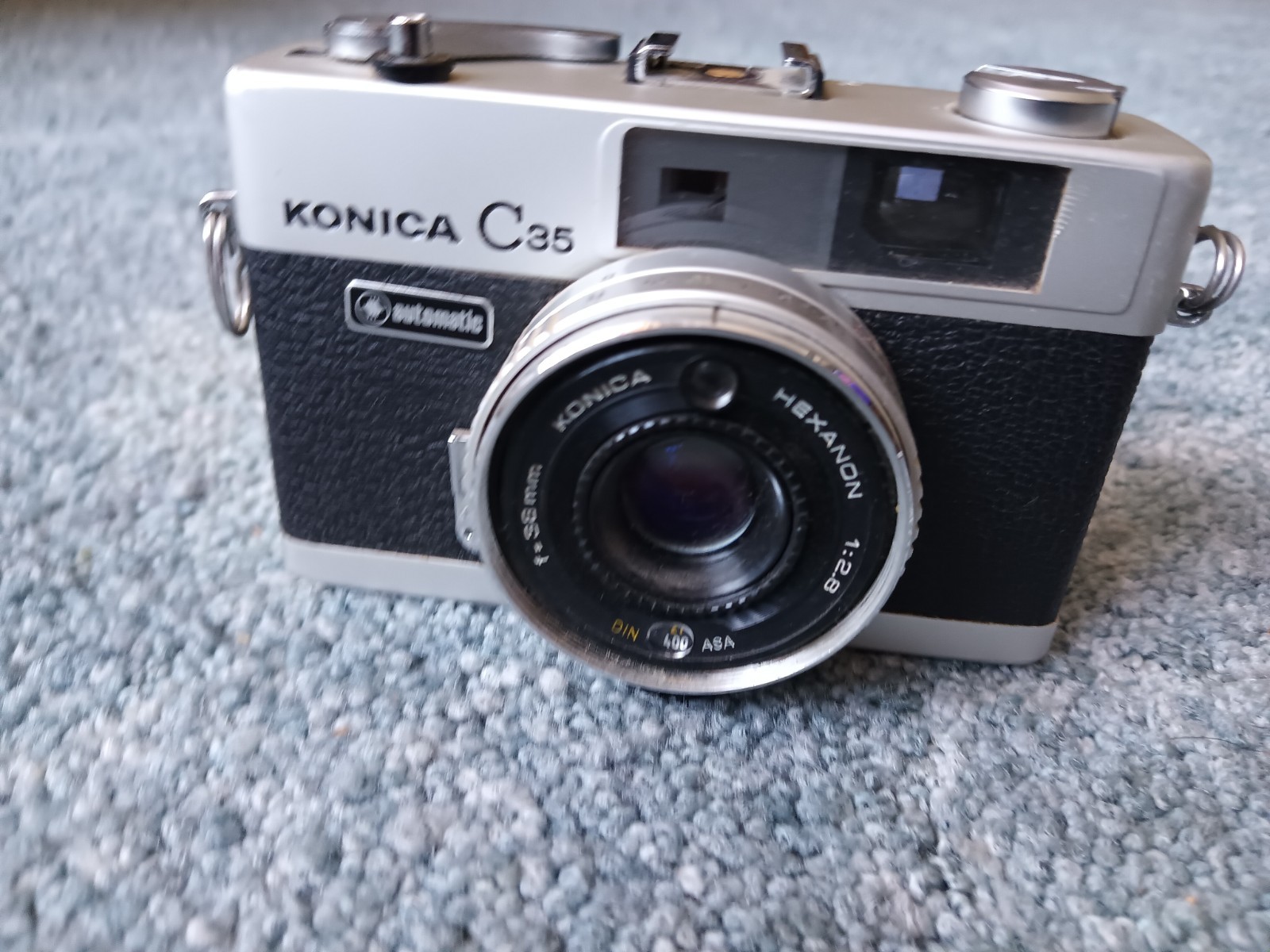
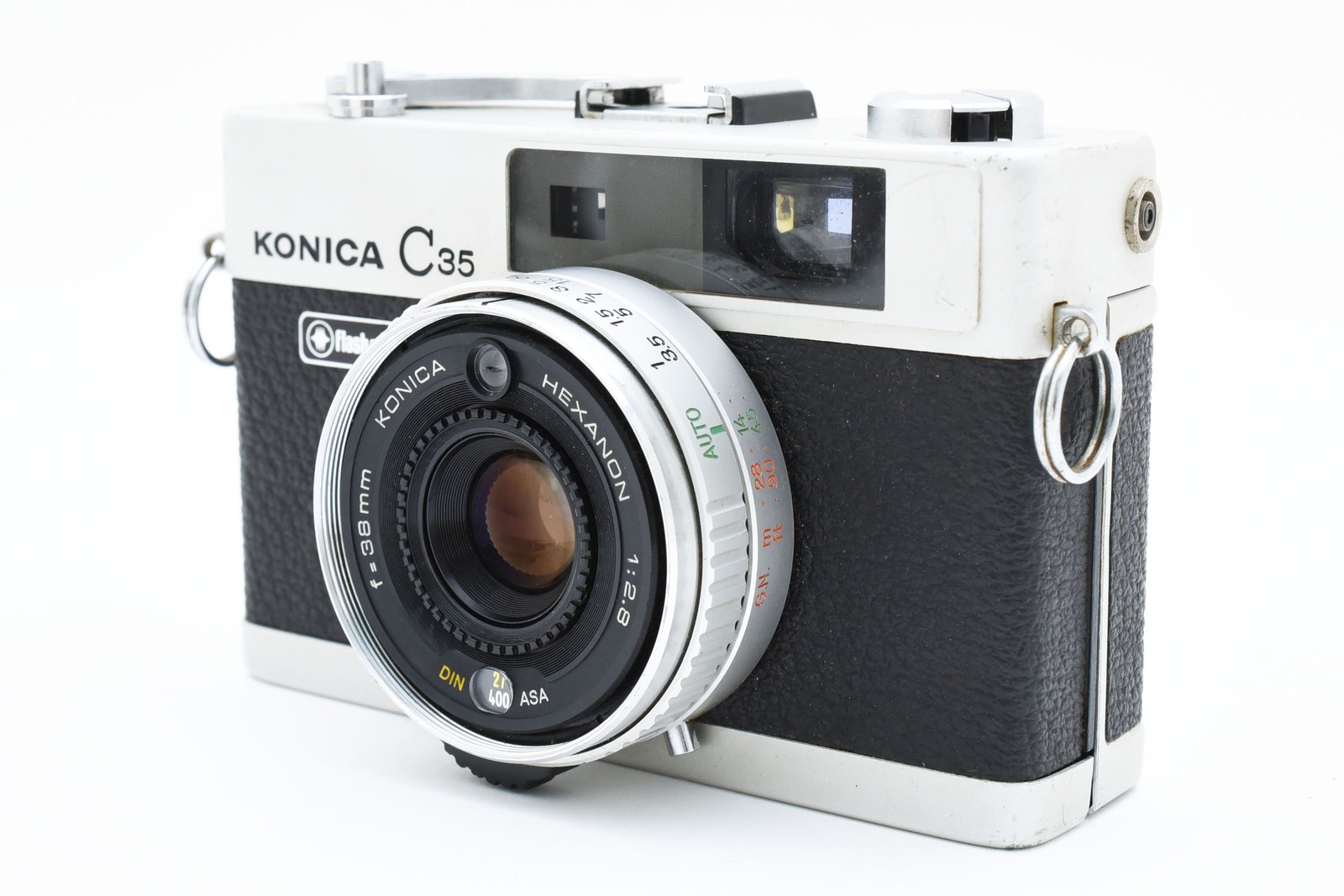
KONICA C35 AUTOMATIC
The Konica C35 Automatic is a compact, fixed-lens 35mm point-and-shoot camera introduced in 1969 as part of Konica’s push into the burgeoning automatic exposure compact market. Designed for ease of use and reliability, it features fully automatic exposure control, a sharp coated lens, and a compact metal-bodied design that exemplified Japanese engineering during the early era of consumer auto-exposure cameras.
Overview
Released in 1969, the Konica C35 Automatic was a pivotal model in Konica’s transition from professional and advanced amateur cameras to the rapidly expanding consumer compact market. It was the first in Konica’s C35 series, a line of compact 35mm cameras that would become one of the most successful in the company’s history, with over 10 million units sold across various iterations. The C35 Automatic was specifically engineered for novice photographers seeking high-quality results without the complexity of manual settings. Its sleek, all-metal body, combined with a well-regarded 40mm f/1.8 Hexanon lens, offered a balance of portability and optical performance uncommon in entry-level models of the era.
The camera was marketed as a "point-and-shoot" device, emphasizing its fully automatic exposure system. A selenium-cell exposure meter built into the lens barrel measured ambient light and automatically selected both aperture and shutter speed via a mechanical linkage—no batteries required. This was a significant advantage at the time, as many competing auto-exposure cameras relied on mercury batteries that were prone to failure and environmental concerns. The C35 Automatic’s mechanical automation system was both innovative and durable, contributing to its reputation for reliability. It was positioned as a premium compact, slightly more upscale than basic models from Olympus or Canon, and helped establish Konica as a leader in compact camera design throughout the 1970s.
Specifications
| Specification | Value |
| Type | Compact fixed-lens camera |
| Film Format | 35mm (135 cartridge) |
| Years Produced | 1969–1973 |
| Lens Mount | Fixed Hexanon 40mm f/1.8 lens (no interchangeable mount) |
| Shutter | Leaf shutter, mechanically timed; speeds from 1/4 sec to 1/500 sec (auto-selected) |
| Metering | Selenium-cell center-weighted metering (no battery required) |
| Exposure Modes | Fully automatic exposure only; manual override not available |
| Viewfinder | Optical direct-vision viewfinder with parallax-corrected framing lines |
| Dimensions | 125 × 70 × 45 mm; weight: approx. 480 g (with battery, though battery not required for metering) |
Key Features
- Fully automatic exposure system using a selenium-cell meter that requires no external power source, enabling reliable operation without batteries.
- Konica Hexanon 40mm f/1.8 coated lens, a high-quality fixed lens known for sharpness and low light performance, rare in compact cameras of this class.
- Mechanical shutter automation with speeds from 1/4 to 1/500 second, selected automatically based on scene brightness.
- Compact metal body with intuitive controls: simple film advance lever, manual rewind crank, and automatic film loading detection.
- Parallax-corrected viewfinder with brightline framelines for improved composition accuracy at close distances.
Historical Context
The Konica C35 Automatic was launched at a time of rapid innovation in consumer photography. The late 1960s saw a shift from manual, rangefinder-based systems to automated, user-friendly designs aimed at the growing amateur market. Konica, already respected for its rangefinders like the Konica II and Auto S series, recognized the potential in compact automation and responded with the C35 Automatic. It was one of the earliest fully automatic 35mm cameras available without requiring batteries for exposure metering—a key differentiator in an era when mercury cells were common but problematic.
Competitors at the time included the Olympus 35SP, Canonet QL17, and Minolta Hi-Matic series, though these were typically larger, more complex, and often required batteries. The C35 Automatic stood out by offering simplicity and reliability in a smaller form factor. It was particularly popular in Japan and North America, where it was praised in consumer magazines for its ease of use and consistent results. Its success laid the foundation for the long-running C35 series, which evolved through multiple iterations including the C35 EF (with electronic flash), C35 MD, and later models with electronic shutters.
Collectibility & Value
Today, the Konica C35 Automatic is a sought-after model among collectors of vintage compact cameras, particularly those interested in the evolution of auto-exposure technology. While not as rare as some limited-production rangefinders, original, fully functional units in good cosmetic condition can fetch $100–$200 on the secondary market, with mint examples in boxed condition occasionally exceeding $250. The camera’s all-metal construction and mechanical reliability contribute to its longevity, but functional issues can arise from dried lubricants in the shutter mechanism or degraded light seals.
When purchasing a C35 Automatic, collectors should verify that the selenium meter is still responsive (signs of failure include faded or cracked cells around the lens barrel) and that the shutter fires cleanly at all speeds. The film advance and rewind mechanisms should operate smoothly, and the viewfinder should be free of fungus or haze. Because the camera lacks a battery-dependent meter, it remains functional even decades later—unlike many electronic compacts of the 1970s and 1980s. Its historical significance as the progenitor of the C35 line and its role in popularizing battery-free automation make it a valuable piece of photographic history.
Similar Cameras
- Olympus 35RC – Compact 35mm rangefinder with aperture-priority automation and high-quality D.Zuiko lens.
- Canon Canonet QL17 GIII – Rangefinder with fast f/1.7 lens and semi-automatic exposure, requiring battery-powered metering.
- Minolta Hi-Matic 9 – Compact rangefinder with programmed autoexposure and CdS metering, introduced in 1969.
- Yashica Electro 35 GSN – Aperture-priority 35mm camera with electric shutter and large f/1.7 lens.
- Konica C35 AF – Later model (1977) in the same series, notable for being one of the first autofocus compact cameras.
Repair & Maintenance
The Konica C35 Automatic requires no batteries for metering or shutter operation, relying entirely on mechanical automation powered by the selenium cell’s output. This makes it highly reliable over time, though the selenium cells can degrade, leading to inaccurate exposure readings or complete meter failure. When servicing, technicians should check for "selenium rot"—a dark, powdery deterioration around the cell ring—which cannot be repaired but may still allow limited functionality in bright light.
Common issues include sluggish shutter speeds due to dried lubricants in the timing mechanism, sticky aperture blades, and worn film advance gears. A full CLA (Clean, Lubricate, Adjust) by a technician experienced in vintage compact cameras is recommended for heavily used units. Light seals should be replaced to prevent light leaks, and the film pressure plate should be inspected for flatness. Due to its mechanical simplicity and robust construction, the C35 Automatic is generally easier to repair than later electronic compacts, and many parts are interchangeable with later C35 models. Regular use and proper storage in a dry environment will ensure decades of reliable service.
eBay Listings

As an eBay Partner, we earn from qualifying purchases. This helps support our independent vintage technology research.