KONICA C35
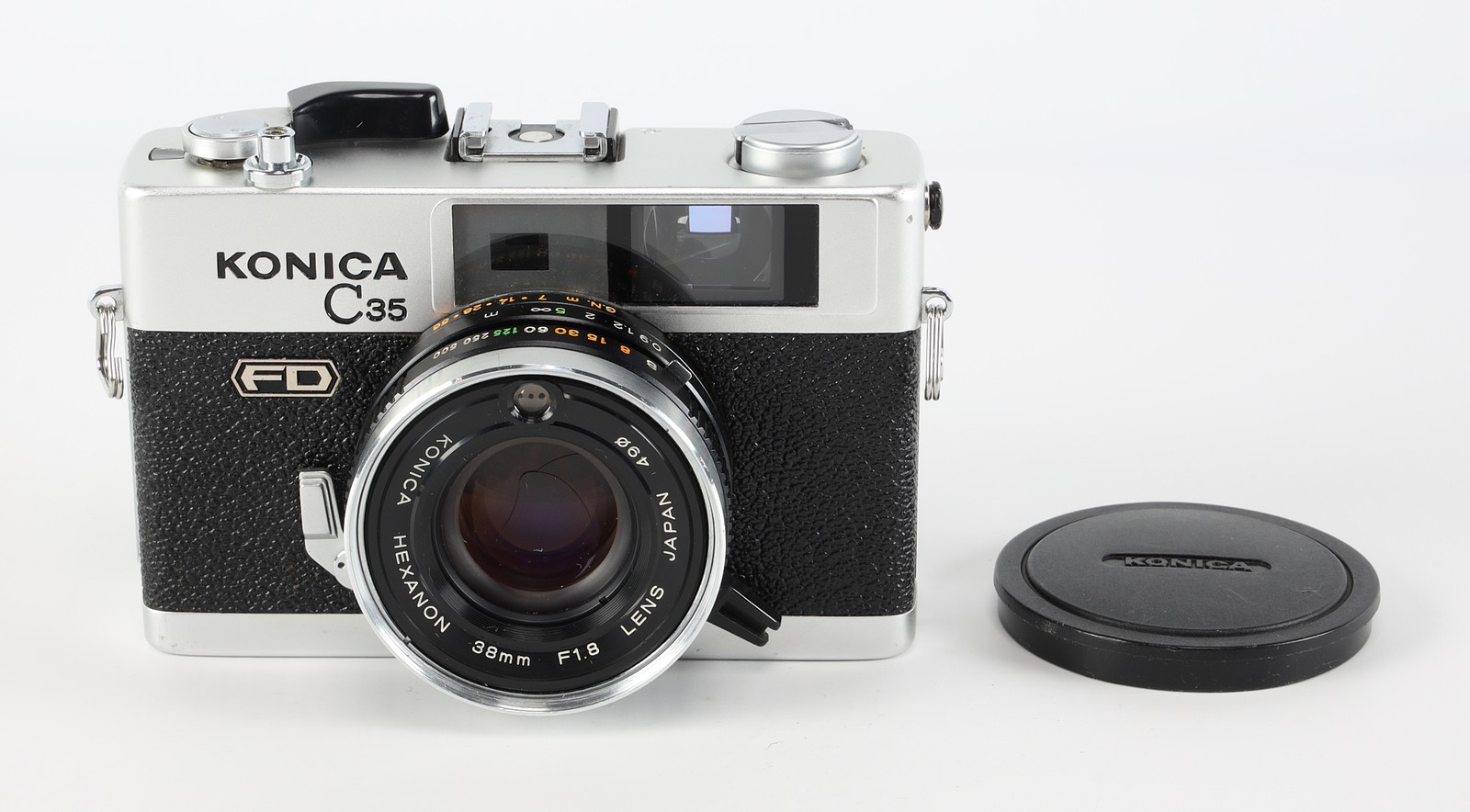
The Konica C35 is a compact 35mm viewfinder camera introduced in 1967 as part of Konica’s push into the growing point-and-shoot market. It combines a high-quality Hexanon lens with built-in CdS metering and aperture-priority autoexposure, making it one of the earliest compact cameras to offer sophisticated automation in a portable design.
Overview
Released in 1967, the Konica C35 marked a significant evolution in Konica’s product strategy, transitioning from traditional rangefinder and SLR designs toward user-friendly, fully integrated compact cameras aimed at amateur photographers. Marketed as an advanced compact for consumers who wanted professional-level image quality without the complexity of manual controls, the C35 was engineered to deliver reliable performance in a sleek, pocketable body. It was part of a broader trend in the late 1960s where Japanese manufacturers began integrating electronic metering and automation into small-format cameras, and Konica was among the pioneers in this space.
The C35 was notable for being one of the first compact 35mm cameras to feature a coupled selenium-cell light meter (later models used CdS) and aperture-priority autoexposure, allowing users to set the shutter speed manually while the camera automatically selected the correct aperture. This hybrid approach bridged the gap between fully manual operation and full automation, appealing to both novice and intermediate photographers. The inclusion of the 38mm f/2.8 Hexanon lens—a lens derived from Konica’s high-end rangefinder systems—ensured excellent optical performance, setting the C35 apart from many contemporaries that used lower-quality fixed lenses.
Over its production run from 1967 to 1973, the C35 achieved remarkable commercial success, with over 8 million units sold worldwide. Its popularity stemmed not only from its advanced features but also from its robust build quality, elegant design, and ease of use. The C35 series spawned numerous variants—including the C35A, C35AF, and C35 E—each refining the formula with improvements like flash synchronization, enhanced metering, and eventually auto-focus in later iterations. The C35 established Konica as a leader in compact camera innovation and laid the groundwork for future models like the C35 EF and the Hexar series.
Specifications
| Specification | Value |
| Type | Compact viewfinder camera |
| Film Format | 35mm (135 cartridge) |
| Years Produced | 1967–1973 |
| Lens Mount | Fixed lens (non-interchangeable) |
| Shutter | Leaf shutter, speeds 1/4 to 1/500 second + B |
| Lens | 38mm f/2.8 Hexanon coated 5-element lens |
| Aperture Range | f/2.8 to f/16 (automatic selection via aperture-priority AE) |
| Metering | Cadmium Sulfide (CdS) cell meter (early models used selenium) |
| Exposure Modes | Aperture-priority autoexposure; manual shutter speed selection |
| Viewfinder | Direct optical viewfinder with parallax-corrected framing lines |
| Focus | Scale focusing (manual), later variants introduced zone/active autofocus |
| Flash | Hot shoe and PC sync socket (on later models like C35A) |
| Battery | 1.35V mercury battery (PX625 or equivalent) for meter and shutter control |
| Dimensions | Approx. 135 x 75 x 55 mm |
| Weight | Approx. 450 g (with battery) |
Key Features
- 38mm f/2.8 Hexanon Lens: A high-performance, multi-coated lens derived from Konica’s rangefinder lineage, delivering sharp, contrast-rich images with minimal aberration.
- Aperture-Priority Autoexposure: One of the earliest compact cameras to offer semi-automatic exposure, using a CdS meter to select the correct aperture based on user-chosen shutter speed.
- Integrated CdS Metering: The light meter is fully coupled to the exposure system, enabling accurate readings under varied lighting conditions.
- Compact Metal Chassis: Built with a durable metal body and leatherette covering, combining portability with professional-grade construction.
- Manual Shutter Speed Selection: Offers shutter speeds from 1/4 to 1/500 sec plus Bulb mode, giving users control over motion capture while retaining automatic aperture.
Historical Context
The Konica C35 was launched at a pivotal moment in camera history, as the photography market shifted from manual, mechanical cameras toward automated, consumer-friendly designs. In the late 1960s, demand for easy-to-use cameras with built-in metering surged, driven by the rise of amateur photography and the expansion of 35mm film use. Konica responded by leveraging its expertise in lens design and metering technology to create a compact camera that offered both automation and optical excellence.
The C35 competed directly with models like the Minolta Hi-Matic series, the Canonet QL17, and the Olympus 35 series—all renowned for their lens quality and semi-automatic features. However, the C35 distinguished itself through its refined ergonomics, consistent build quality, and aggressive pricing. Its success was amplified by effective marketing and distribution, particularly in North America and Europe. The 8 million units sold during its production run underscore its widespread appeal and reliability. The C35 also served as a technological testbed for Konica, leading to innovations such as the C35 AF (1977), one of the world’s first autofocus 35mm cameras.
Collectibility & Value
Today, the Konica C35 is regarded as a classic example of late-1960s Japanese camera engineering and is sought after by collectors of vintage compact cameras. While not as rare as some limited-production rangefinders, well-preserved examples—especially those with clean lenses, functional meters, and original cases—are highly desirable. The value of a C35 typically ranges from $50 to $150 USD, depending on condition, model variant, and functionality. Early selenium-metered versions are less desirable due to the degradation of selenium cells over time, while later CdS models with replaceable batteries are more practical and thus more valuable.
When purchasing a Konica C35, collectors should inspect the lens for haze, fungus, or scratches, ensure the shutter fires at all speeds, and verify that the meter responds to light (though calibration may require a now-discontinued PX625 battery or modern substitute). Common issues include sticky aperture blades, worn shutter curtains, and degraded light seals. Because the camera uses a mercury battery (1.35V), using modern alkaline replacements without voltage regulation can lead to overexposure; solutions include using zinc-air batteries or adapting with step-down modules.
Similar Cameras
- Minolta Hi-Matic 7s – Similar aperture-priority 35mm compact with 45mm f/1.8 lens and CdS metering.
- Canon Canonet QL17 GIII – Iconic rangefinder-style compact with 40mm f/1.7 lens and full manual control.
- Olympus 35RC – Stylish, dual-knob compact with 42mm f/1.8 lens and manual exposure.
- Yashica Electro 35 GSN – Fully automatic 35mm rangefinder with 45mm f/1.7 lens and CdS metering.
- Ricoh 500G – Compact viewfinder camera with 40mm f/2 lens and aperture-priority AE.
Repair & Maintenance
The Konica C35 requires a 1.35V PX625 mercury battery for proper operation of its CdS meter and electronic shutter control. Since mercury batteries are no longer produced, users often substitute with modern alkaline PX625 batteries (1.5V), which can cause overexposure due to higher voltage. Recommended alternatives include WeinCell zinc-air batteries (1.35V) or using a step-down adapter with silver-oxide batteries. The shutter mechanism is electro-mechanical, relying on battery power for timing, so a dead battery results in non-functional shutter speeds.
Common maintenance issues include sluggish or inaccurate shutter speeds, often due to dried lubricants or capacitor degradation in the timing circuit. The aperture blades may also become sticky from old grease, requiring cleaning and relubrication. Repair difficulty is moderate: while the camera is well-built, accessing internal components requires disassembly of the front and top assemblies. Technicians familiar with vintage Japanese electronics and leaf shutters are best suited for servicing. Regular use, battery removal when not in storage, and occasional cleaning of contacts help preserve functionality.
eBay Listings

As an eBay Partner, we earn from qualifying purchases. This helps support our independent vintage technology research.