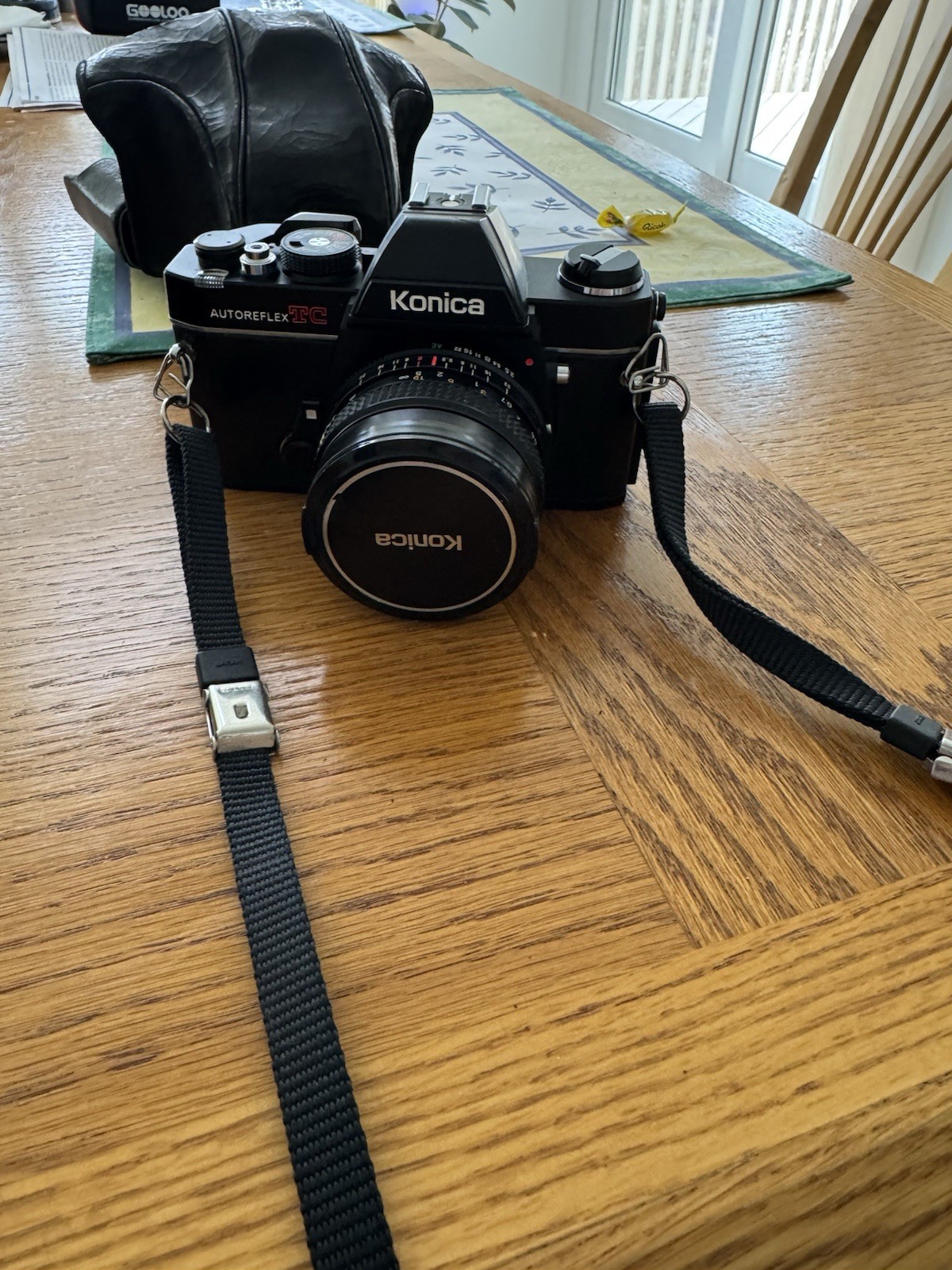
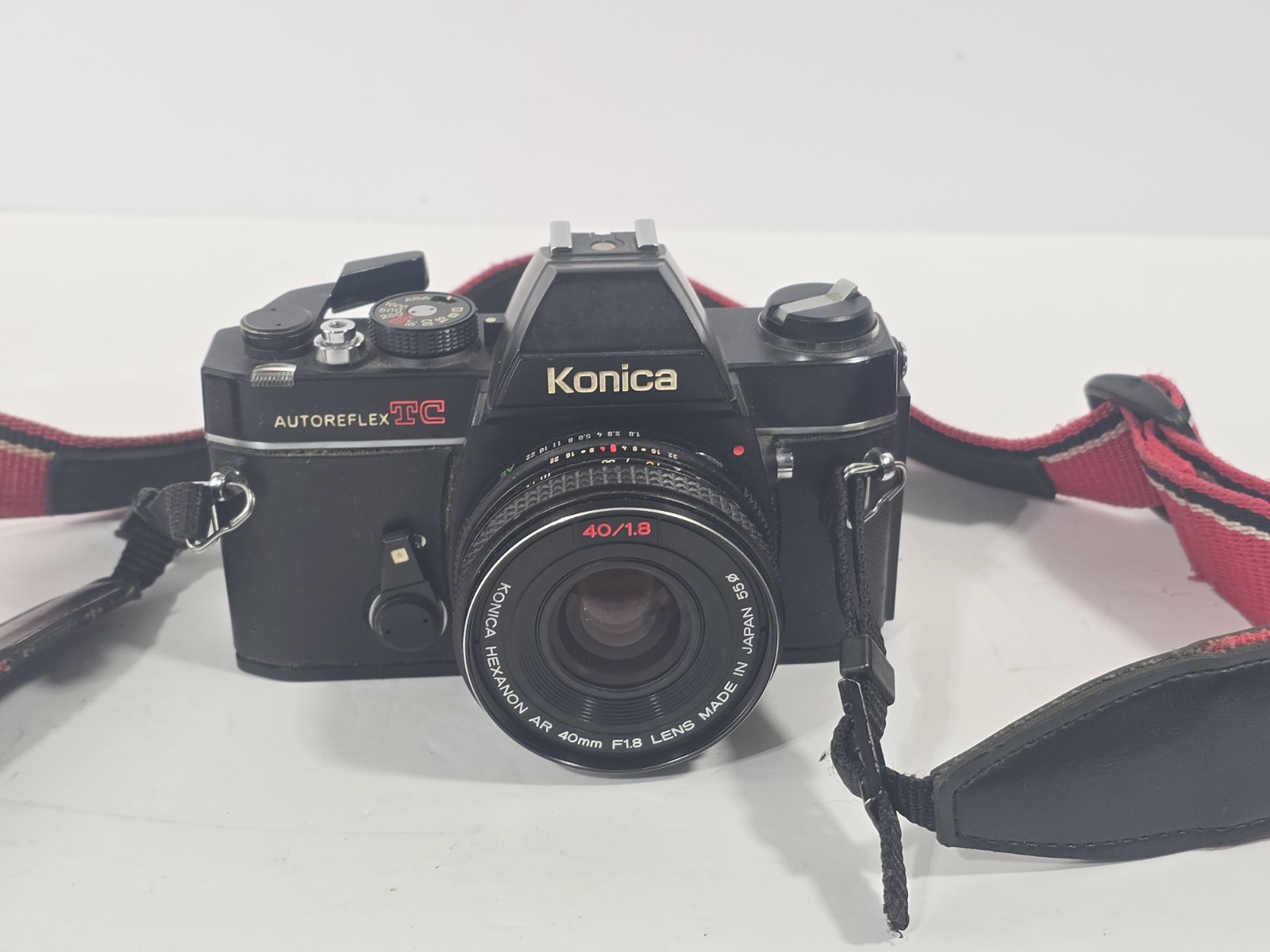
KONICA AUTOREFLEX TC
The Konica Autoreflex TC is a compact 35mm single-lens reflex (SLR) camera introduced in 1976 as a simplified, lightweight alternative within Konica’s Autoreflex series. Designed for amateur photographers seeking automatic exposure functionality in a manageable form factor, the TC features aperture-priority electronic metering and a robust yet minimalist mechanical design.
Overview
Released in 1976, the Konica Autoreflex TC was positioned as an entry-level model in Konica’s established Autoreflex SLR lineup, which had been evolving since the late 1960s. While earlier models like the Autoreflex T and T3 offered advanced manual controls and full aperture metering, the TC was engineered to reduce cost and size without sacrificing core functionality. It achieved this through a simplified body design, elimination of features such as mirror lock-up and depth-of-field preview, and a reliance on aperture-priority autoexposure with electronic shutter control. Despite its reduced feature set, the TC retained compatibility with Konica’s AR bayonet lens mount, allowing access to a wide range of high-quality Hexanon lenses.
The TC was marketed toward casual photographers and students who desired SLR image quality and interchangeable lenses but did not require professional-grade controls. Its compact dimensions—unusually small for an SLR of its era—were made possible by a vertically traveling Copal Square shutter and a streamlined internal layout. The camera was produced until 1982, coinciding with the decline of mechanical SLRs and the rise of more sophisticated electronic models from Japanese competitors like Canon, Minolta, and Pentax. As one of the final iterations of Konica’s 35mm SLR line, the Autoreflex TC represents the company’s effort to remain competitive in a rapidly modernizing market while maintaining optical excellence.
Specifications
| Specification | Value |
| Type | 35mm Single-Lens Reflex (SLR) |
| Film Format | 35mm (135) |
| Years Produced | 1976–1982 |
| Lens Mount | Konica AR Bayonet (Konica AR-mount) |
| Shutter | Vertical-travel metal Copal Square shutter; speeds 1 sec to 1/1000 sec, plus B (time) |
| Metering | Open-aperture TTL CdS metering, center-weighted |
| Exposure Modes | Aperture-priority automatic exposure only |
| Viewfinder | Fixed pentaprism with microprism collar and split-image rangefinder spot; 0.92x magnification, 92% coverage |
| Dimensions | 136 mm (W) × 80 mm (H) × 48 mm (D); weight: 510 g (body only, no battery or lens) |
Key Features
- Aperture-Priority Autoexposure: The camera automatically selects the correct shutter speed based on user-selected aperture and scene brightness, simplifying operation for novice users.
- Compact and Lightweight Body: At just 48 mm depth, the TC was among the smallest full-frame 35mm SLRs ever made, enhancing portability.
- TTL Center-Weighted Metering: Utilizes a CdS (Cadmium Sulfide) cell for accurate through-the-lens exposure measurement with open-aperture metering.
- Konica AR Lens Mount Compatibility: Supports all Konica AR-mount lenses, including the renowned Hexanon series, with full open-aperture metering on compatible lenses (marked "Auto").
- Electronic Shutter with Mechanical Backup: While shutter timing is electronically controlled, the shutter remains functional at 1/125 sec in the event of battery failure.
Historical Context
The Autoreflex TC was launched at a pivotal moment in SLR history, as the market shifted from fully mechanical cameras to electronically controlled systems. By the mid-1970s, manufacturers were increasingly integrating automation into SLRs to attract amateur photographers. Konica, while respected for its optical quality—particularly the Hexanon lens line—faced growing competition from companies like Minolta (with the XD-11/7) and Pentax (K1000), which offered more advanced or durable designs. The TC was Konica’s response: a no-frills, affordable SLR that retained the brand’s optical strengths while minimizing cost and size.
Unlike its predecessor, the Autoreflex T3, the TC omitted manual shutter speed selection and relied solely on aperture-priority automation. This placed it in direct competition with cameras like the Olympus OM-10 and Minolta X-300, though it lacked their manual exposure options. Despite its limitations, the TC was well-received for its build quality, compactness, and accurate metering. However, Konica’s decision to discontinue its SLR line in the early 1980s—eventually exiting the camera market altogether—limited long-term support and spare parts availability, affecting its legacy.
Collectibility & Value
Today, the Konica Autoreflex TC is regarded as a niche collectible, valued for its compact design, optical compatibility, and historical significance as one of Konica’s final SLRs. In good working condition, prices typically range from $75 to $150 USD, depending on included lens and cosmetic state. Models bundled with the 45mm f/1.8 or 50mm f/1.7 Hexanon lens command higher premiums due to their optical quality. Collectors appreciate the TC’s understated design and mechanical reliability, though its lack of manual exposure modes limits appeal compared to more versatile contemporaries.
When purchasing a used Autoreflex TC, buyers should verify the functionality of the shutter across all speeds, check for accurate metering (which relies on a single PX625 or equivalent 1.35V mercury battery, now obsolete), and inspect the viewfinder for haze or fungus. A common issue is degraded light seals, which can lead to light leaks; these should be replaced during servicing. The CdS meter cell may also degrade over time, resulting in inaccurate exposure readings. While repair parts are limited, the camera’s modular construction allows skilled technicians to service or recalibrate the shutter and metering system. Due to Konica’s exit from the camera industry, official support is nonexistent, making independent repair shops or enthusiast communities essential for maintenance.
Similar Cameras
- Olympus OM-10 – Aperture-priority SLR with compact design and TTL metering, introduced in 1979.
- Minolta X-300 – Entry-level SLR with manual and aperture-priority modes, produced from 1984.
- Pentax ME – Compact aperture-priority SLR (1976) with LED shutter speed display in viewfinder.
- Yashica FR-I – Simplified SLR with AR-mount compatibility and aperture-priority automation.
- Canon AE-1 – Highly popular aperture-priority SLR (1976) with electronic shutter and extensive lens support.
Repair & Maintenance
The Konica Autoreflex TC operates on a single 1.35V mercury PX625 battery (now obsolete), though modern substitutes such as WeinCell MRB625 (1.35V zinc-air) or adapters for 1.5V SR625SW batteries can be used with exposure compensation. Battery corrosion in the compartment is a common issue in unattended units and should be cleaned carefully. The electronically timed Copal Square shutter is generally reliable but may require recalibration if speeds become inaccurate. The CdS meter cell, located in the prism housing, is prone to aging and may require replacement or recalibration using a known-light-source reference. Light seals should be replaced every 10–15 years to prevent light leaks. While repair parts are not widely available from Konica (which ceased camera production in 2006), third-party technicians and enthusiast forums often provide service support and donor parts. Regular use, proper storage, and periodic CLA (Clean, Lubricate, Adjust) servicing are recommended to maintain long-term functionality.
eBay Listings


As an eBay Partner, we earn from qualifying purchases. This helps support our independent vintage technology research.
Related Models
- Konica Autoreflex T (1968-1974)
- Konica Autoreflex T2 (1970-1973)
- Konica Autoreflex T3 (1973-1976)
- Alpa 6 (1948-1953)
- Agfa Agfaflex
- Agfa Ambiflex
- Agfa Easy
- Agfa Futura Af zoom
- Agfa Isoflash-Rapid C
- Agfa Mini