KONICA AUTOREFLEX T3
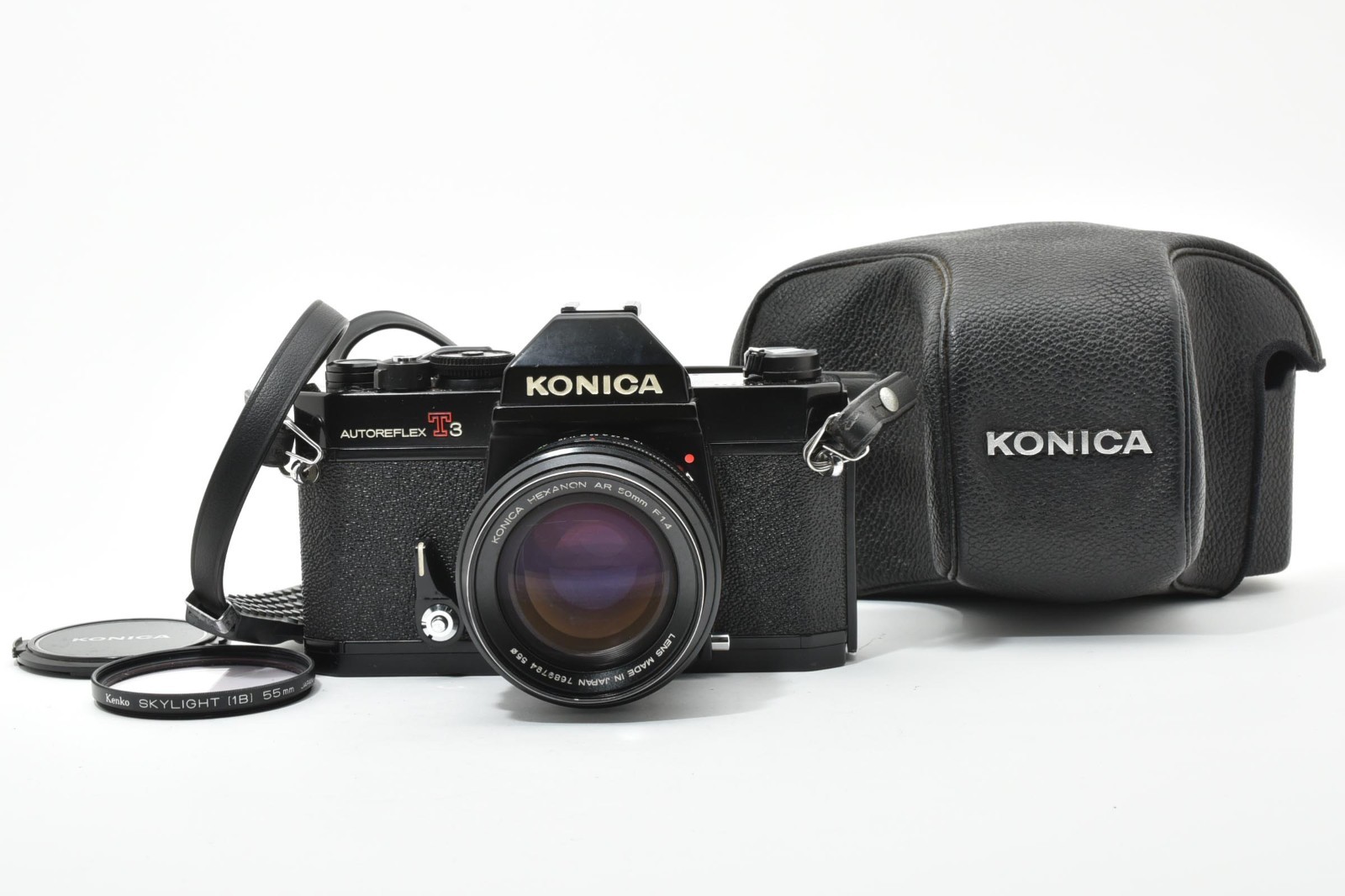
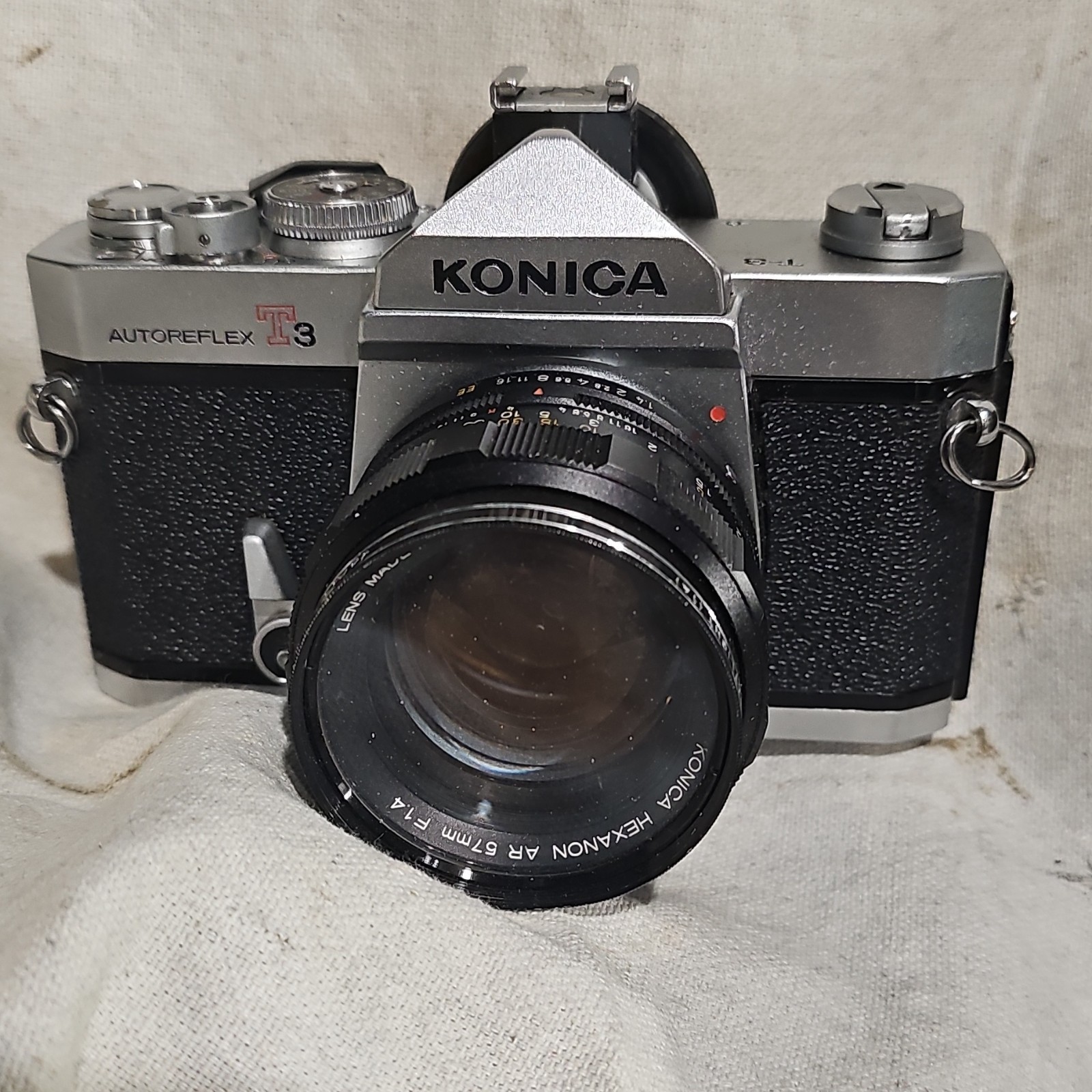
The Konica Autoreflex T3 is the flagship 35mm single-lens reflex (SLR) camera in Konica’s renowned Autoreflex series, introduced in 1973 as the culmination of the company’s mechanical and optical engineering prowess. Designed for professional and advanced amateur photographers, the T3 combines a robust all-metal chassis, precision metering, and a modular design with interchangeable viewfinders and focusing screens.
Overview
Released in 1973, the Konica Autoreflex T3 represented the peak of Konica’s 35mm SLR development, succeeding the T and T2 models with significant refinements in build quality, metering accuracy, and user ergonomics. It was positioned as a professional-grade camera, targeting serious photographers who demanded reliability, precision, and compatibility with Konica’s high-performance Hexanon lens lineup. The T3 was manufactured until 1976 and stands as the final and most advanced model in the Autoreflex line before Konica gradually shifted focus toward compact cameras and later digital imaging.
One of the T3’s defining characteristics is its modular construction, allowing users to swap viewfinders and focusing screens—a rare feature among Japanese SLRs of the era. This flexibility enabled customization for different shooting scenarios, such as sports (with the high-magnification finder) or general photography (with the standard pentaprism). The camera features a vertically traveling, focal-plane cloth shutter with speeds from 1 second to 1/1000 second, plus Bulb, and offers full-aperture TTL (through-the-lens) open-aperture metering using a CdS (cadmium sulfide) cell. Metering is center-weighted and coupled to the aperture ring, enabling accurate exposure readings without stopping down.
The T3 retains the robust all-metal construction typical of high-end 1970s SLRs, with a die-cast aluminum chassis and precision-machined components. It uses the Konica AR bayonet mount, which supports automatic diaphragm operation and full-aperture metering with compatible Hexanon lenses. The camera’s design emphasizes mechanical reliability, with minimal dependence on electronics—only the meter requires a battery (one 1.35V mercury PX625 or equivalent). Despite its mechanical nature, the T3 integrates advanced features such as a self-timer, mirror lock-up (via the interchangeable finder), and a depth-of-field preview lever.
Specifications
| Specification | Value |
| Type | 35mm Single-Lens Reflex (SLR) |
| Film Format | 35mm (135 cartridge) |
| Years Produced | 1973–1976 |
| Lens Mount | Konica AR Bayonet Mount |
| Shutter | Vertical-travel cloth focal-plane; 1s – 1/1000s + B |
| Metering | TTL full-aperture center-weighted CdS metering |
| Exposure Modes | Manual exposure with stop-down metering option |
| Viewfinder | Interchangeable pentaprism or waist-level finder; 0.92x magnification (50mm @ ∞) |
| Dimensions | 140 × 93 × 55 mm; ~710 g (body only, no battery) |
Key Features
- Interchangeable Viewfinders: Supports a removable pentaprism, high-magnification finder (2.3x), and waist-level finder, enabling versatile shooting configurations.
- TTL Full-Aperture Metering: Utilizes a CdS cell for accurate center-weighted exposure readings without stopping down the lens.
- Mirror Lock-Up: Available via the optional high-magnification finder, reducing vibration for long exposures and macro work.
- Robust Mechanical Construction: All-metal body with minimal reliance on electronics, ensuring long-term reliability.
- Konica Hexanon Lens Compatibility: Works with a wide range of high-quality AR-mount lenses, including fast primes and zooms.
Historical Context
The Autoreflex T3 was launched at a pivotal time in SLR development, when Japanese manufacturers were rapidly advancing automation and electronic integration. Competitors such as Nikon (F2), Canon (F-1), and Minolta (SRT-101) dominated the professional market, but Konica carved a niche with its precision engineering and optical excellence. The T3 was designed to compete directly with the Nikon F2 in terms of build quality and modularity, though it remained less widely adopted outside Japan and Europe.
Despite its technical merits, the T3 did not achieve the same level of international market penetration as its rivals. Konica’s limited global marketing presence and the dominance of Nikon and Canon in professional circles hindered widespread adoption. However, the T3 earned a loyal following among photographers who appreciated its compact size, smooth operation, and the exceptional sharpness of Hexanon lenses. The camera’s release also coincided with the transition toward aperture-priority and program autoexposure systems, making the T3 one of the last high-end fully mechanical manual SLRs from a major Japanese manufacturer.
Collectibility & Value
Today, the Konica Autoreflex T3 is a sought-after model among film photography enthusiasts and collectors, particularly those interested in vintage Japanese SLRs with professional-grade build and optical quality. Its rarity, especially outside Japan, contributes to its appeal. Well-maintained examples with original accessories—such as the high-magnification finder, mirror lock-up mechanism, or original case—can command prices between $400 and $700 on the secondary market, depending on condition and completeness.
When purchasing a T3, collectors should verify the functionality of the shutter across all speeds, the accuracy of the meter (noting that original PX625 batteries are obsolete and modern replacements may affect calibration), and the condition of the film transport and rewind mechanism. Common issues include degraded light seals, stiff shutter curtains, and CdS cell fatigue leading to inaccurate metering. While repair parts are limited, the T3’s mechanical simplicity makes it relatively serviceable by experienced technicians familiar with vintage SLRs.
Similar Cameras
- Nikon F2 Photomic – Professional SLR with interchangeable finders and prisms, similar build quality and target market.
- Canon F-1 – Rugged, modular SLR with interchangeable viewfinders and a strong lens ecosystem.
- Pentax LX – High-end manual SLR with modular design and exceptional build, released slightly later (1980).
- Minolta SRT-102 – Advanced SRT model with TTL metering and robust construction, though less modular than the T3.
- Topcon RE Super – Japanese professional SLR with interchangeable finders and high-quality lenses, known for optical excellence.
Repair & Maintenance
The Konica Autoreflex T3 uses a single 1.35V mercury battery (PX625) to power its CdS meter. Modern equivalents such as alkaline or silver oxide (SR44) batteries can be used, but may require adjustment for voltage differences (1.5V vs 1.35V), potentially affecting meter accuracy. Adapters or circuit modifications are sometimes employed to maintain correct exposure readings.
Mechanically, the T3 is durable but requires periodic CLA (clean, lubricate, adjust) service if stored improperly or used frequently. Common issues include sticky shutter blades at slow speeds, worn foam light seals (which should be replaced to prevent acid damage), and degraded mirror damping. The interchangeable finder system is generally reliable but can develop alignment issues if removed frequently. Due to the camera’s age, original repair parts are scarce, but its mechanical design allows for improvisation by skilled technicians. Overall, the T3 is considered repairable with proper expertise, though sourcing original accessories like finders and screens may be challenging.
eBay Listings


As an eBay Partner, we earn from qualifying purchases. This helps support our independent vintage technology research.
Service Manuals & Schematics
- Manual (1973) — archive.org
Related Models
- Konica Autoreflex T (1968-1974)
- Konica Autoreflex T2 (1970-1973)
- Konica Autoreflex TC (1976-1982)
- Alpa 6 (1948-1953)
- Agfa Agfaflex
- Agfa Ambiflex
- Agfa Easy
- Agfa Futura Af zoom
- Agfa Isoflash-Rapid C
- Agfa Mini