KONICA AUTOREFLEX T2
The Konica Autoreflex T2 is a 35mm single-lens reflex (SLR) camera introduced in 1970 as an updated version of the original Autoreflex T. It represents a refinement of Konica’s professional-grade SLR system, offering improved metering, enhanced ergonomics, and robust mechanical reliability for both amateur and professional photographers.
Overview
Released in 1970, the Konica Autoreflex T2 was positioned as a high-end 35mm SLR within Konica’s expanding system camera lineup. It succeeded the Autoreflex T (1968) and served as a bridge to the later Autoreflex T3/T3N models. Designed for serious photographers seeking precision and modularity, the T2 combined fully mechanical operation with integrated through-the-lens (TTL) center-weighted metering. It was marketed primarily to advanced amateurs and photojournalists who valued reliability, lens interchangeability, and manual control.
The Autoreflex T2 retained the core mechanical shutter and aperture-priority autoexposure functionality of its predecessor but introduced several refinements. Most notably, it featured a redesigned metering system with a silicon photodiode (SPD) cell, replacing the CdS cell used in earlier models. This provided faster response times, improved low-light sensitivity, and greater long-term reliability. The camera also included a hot shoe with TTL flash synchronization, a self-timer lever relocated to the front of the prism housing, and minor ergonomic updates to the film advance lever and shutter speed dial.
Konica’s Autoreflex series was central to the company’s strategy to compete with Japanese SLR leaders like Nikon, Canon, and Pentax in the late 1960s and early 1970s. The T2, while not as widely exported as some competitors, was particularly popular in Europe and Japan and formed part of a comprehensive system that included motor drives, interchangeable viewfinders, and a wide range of Hexanon lenses. Its robust all-metal construction, smooth shutter operation, and precise build quality underscored Konica’s engineering rigor during this era.
Specifications
| Specification | Value |
| Type | 35mm Single-Lens Reflex (SLR) |
| Film Format | 35mm (135) |
| Years Produced | 1970–1973 |
| Lens Mount | Konica AR Bayonet Mount |
| Shutter | Horizontal-travel, cloth focal-plane shutter; speeds from 1 sec to 1/1000 sec, plus B (Bulb) |
| Metering | TTL, center-weighted silicon photodiode (SPD) metering |
| Exposure Modes | Aperture-priority automatic exposure, manual exposure |
| Viewfinder | Fixed pentaprism with microprism collar focusing aid, 0.92x magnification, ~95% coverage |
| Dimensions | 140 mm (W) × 93 mm (H) × 54 mm (D); weight approx. 650 g (body only, no battery) |
Key Features
- TTL Aperture-Priority AE: One of the earliest SLRs to offer reliable aperture-priority autoexposure with through-the-lens metering, allowing photographers to set the aperture while the camera selected the correct shutter speed.
- Silicon Photodiode (SPD) Metering: More responsive and durable than CdS cells, with instant response and no memory effect, improving metering accuracy in rapidly changing light.
- Fully Mechanical Shutter at 1/100 sec: Even without battery power, the camera retains a functional 1/100 sec shutter speed and Bulb mode, ensuring usability in case of battery failure.
- Interchangeable Focusing Screens: Part of Konica’s modular system, allowing users to swap screens for different focusing needs (e.g., split-image, grid).
- Hot Shoe with TTL Flash Sync: Enabled direct connection of flash units with automatic exposure control via the TTL metering system.
Historical Context
The Autoreflex T2 emerged during a pivotal period in SLR development, when Japanese manufacturers were rapidly advancing automation and metering technologies. Released in 1970, it competed directly with models like the Nikon F (with Photomic finder), Canon FTb, and Pentax ES. While many rivals still relied on CdS metering cells, Konica’s adoption of SPD technology in the T2 gave it a technical edge in responsiveness and reliability—particularly in low-light conditions where CdS cells often lagged.
Konica’s AR mount system, though not as widely adopted as the M42 screw mount or Canon’s FD, offered a competitive range of high-quality Hexanon lenses, including fast primes and zooms. The T2 was part of a broader ecosystem that included the motorized Autoreflex T (with motor drive), the professional T3, and accessories like data backs and prism levels. Despite its technical merits, the T2 did not achieve the same global market penetration as Pentax or Nikon models, partly due to Konica’s relatively limited international marketing and distribution network.
Nevertheless, the Autoreflex T2 is regarded by collectors and vintage camera enthusiasts as one of Konica’s finest SLRs—well-built, innovative, and representative of the company’s commitment to optical and mechanical excellence. Its role in advancing aperture-priority automation with TTL metering places it as a significant, if underappreciated, contributor to the evolution of the modern SLR.
Collectibility & Value
Today, the Konica Autoreflex T2 is considered a desirable vintage SLR among collectors, particularly those interested in Japanese engineering from the pre-electronic era. While not as rare as some limited-production models, original, fully functional T2 bodies in good cosmetic condition typically command prices between $150 and $300 on the secondary market, depending on included accessories, lens condition, and provenance.
When purchasing a T2, collectors should verify the functionality of the meter (which requires a 1.35V mercury battery or modern substitute with voltage adjustment), check for smooth shutter operation across all speeds, and inspect the mirror movement and film advance mechanism for wear. Common issues include stiff shutter speeds (due to dried lubricants), inaccurate metering (from aging SPD cells or circuit degradation), and light seals that have deteriorated—requiring replacement to prevent light leaks. The camera uses a 1.35V mercury PX625 battery (now obsolete), so users often employ zinc-air substitutes or voltage adapters with modern 1.5V batteries, which may require meter recalibration.
Due to its modular design, original accessories such as motor drives, data backs, and alternative focusing screens significantly increase collectible value. Lenses in the Hexanon series, especially the 52mm f/1.8 and 40mm f/1.8, are prized for their sharpness and smooth bokeh. Overall, the T2 is a solid investment for those seeking a historically significant, mechanically robust SLR with advanced metering for its time.
Similar Cameras
- Pentax ES (1971) – TTL aperture-priority SLR with CdS metering, M42 mount
- Canon FX (1964) and FTb (1971) – Early Canon SLRs with TTL metering
- Nikon F with DP-11/DP-12 Finder – Professional system camera with modular metering
- Minolta SRT-101 (1966) – Legendary SRT series with CLC metering
- Topcon RE Super (1963) – High-end Japanese SLR with TTL metering and excellent optics
Repair & Maintenance
The Autoreflex T2 operates mechanically at 1/100 sec and Bulb without batteries, but full metering and aperture-priority functionality require a 1.35V PX625 mercury battery. Since these are no longer manufactured, users typically substitute with WeinCell MRB625 (zinc-air) or use a modern alkaline PX625 with a voltage-reducing adapter. Failure to regulate voltage may result in overexposure due to meter inaccuracy.
Common maintenance issues include sluggish shutter speeds, which often stem from hardened lubricants in the shutter mechanism—requiring professional CLA (clean, lubricate, adjust). The SPD meter cell is generally reliable but can degrade over decades; replacement or recalibration may be needed. The self-timer and film advance lever are robust but should be checked for smooth operation. Light seals should be replaced every 10–15 years to prevent fogging or light leaks. Due to the camera’s mechanical complexity and age, repair should be entrusted to technicians experienced with vintage Japanese SLRs. Spare parts are limited but still available through specialized vintage camera suppliers.
eBay Listings


As an eBay Partner, we earn from qualifying purchases. This helps support our independent vintage technology research.
Related Models
- Konica Autoreflex T (1968-1974)
- Konica Autoreflex T3 (1973-1976)
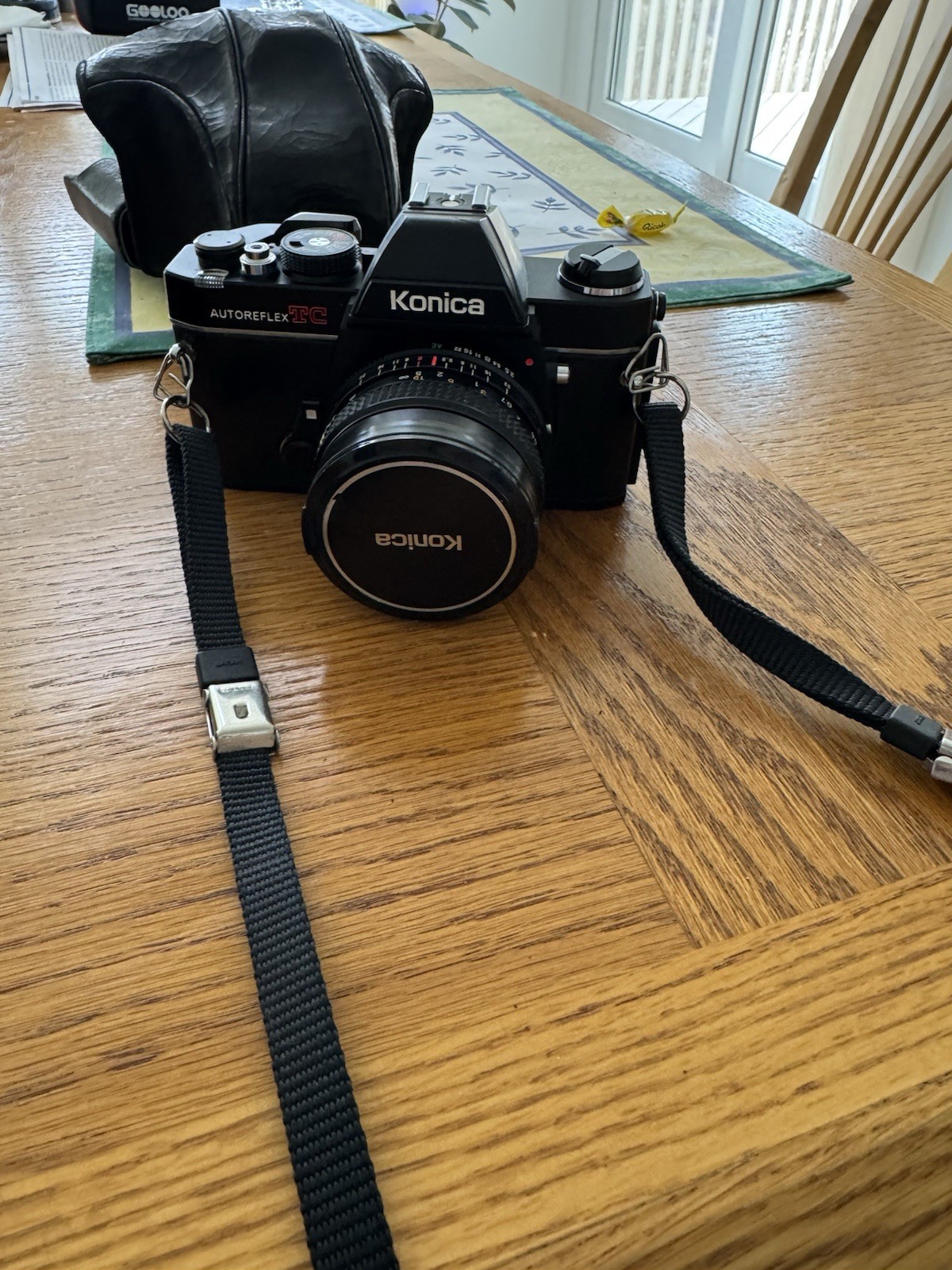
- Konica Autoreflex TC (1976-1982)
- Alpa 6 (1948-1953)
- Agfa Agfaflex
- Agfa Ambiflex
- Agfa Easy
- Agfa Futura Af zoom
- Agfa Isoflash-Rapid C
- Agfa Mini