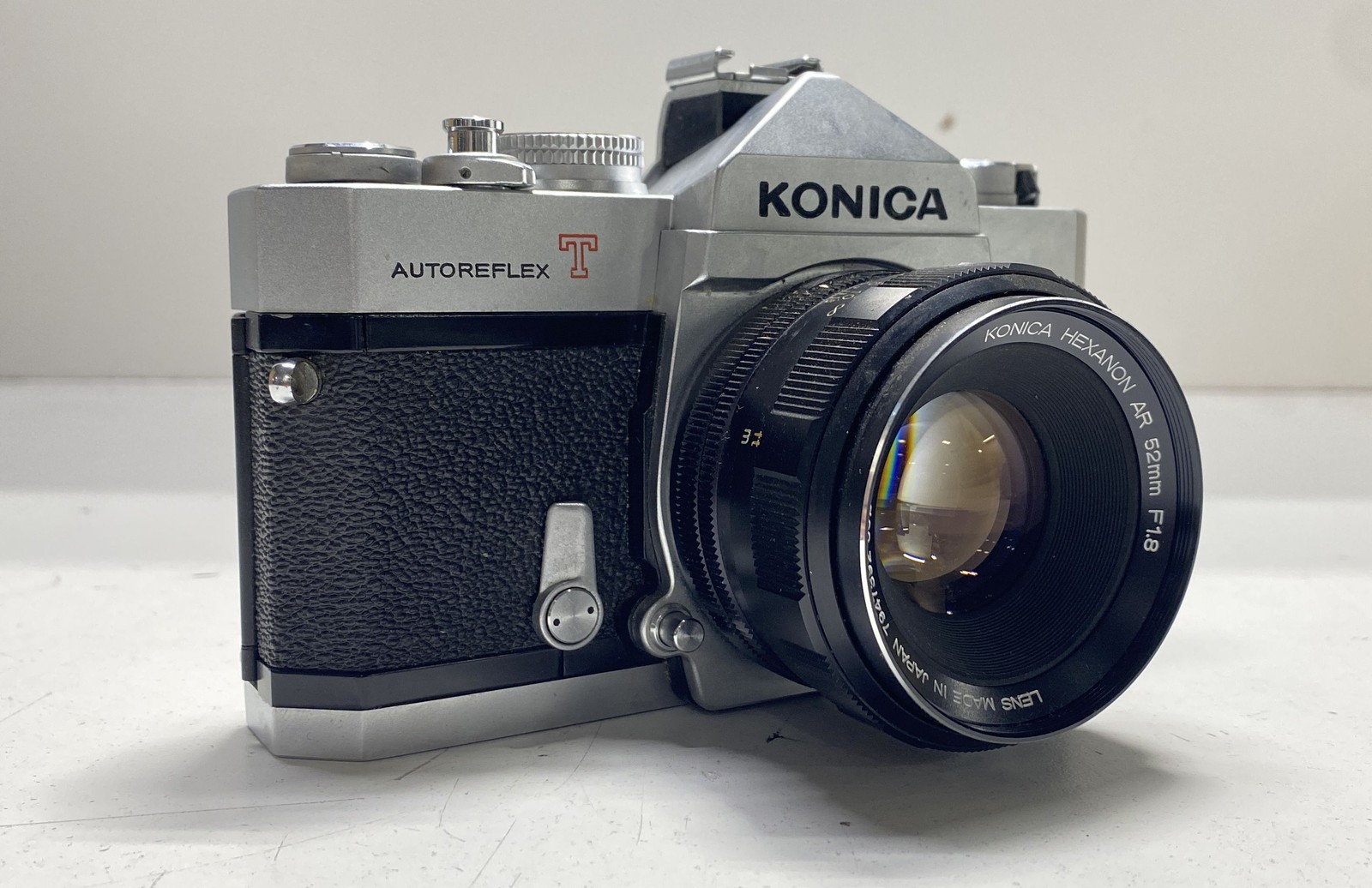
KONICA AUTOREFLEX T
The Konica Autoreflex T, introduced in 1968, was the world’s first through-the-lens (TTL) metered auto-exposure 35mm single-lens reflex (SLR) camera with a fully mechanical shutter and aperture-priority automatic exposure system. It marked a revolutionary step in SLR design, combining precision metering with user-friendly automation while maintaining full manual control, setting a new benchmark for professional and advanced amateur photographers.
Overview
The Konica Autoreflex T was developed during a period of rapid innovation in SLR technology, when manufacturers were transitioning from external light meters and manual exposure settings to integrated metering systems. Released in 1968, it was the first SLR to offer true TTL (through-the-lens) aperture-priority autoexposure, a feature that would become standard in later decades. Unlike earlier "semi-automatic" SLRs that required stop-down metering or external meter coupling, the Autoreflex T used a silicon photodiode cell located behind a semi-transparent pellicle mirror segment to measure light reflected off the main mirror, enabling real-time, open-aperture TTL metering. This allowed photographers to compose and focus at full aperture while receiving accurate exposure readings without stopping down.
Targeted at serious amateur and professional photographers, the Autoreflex T combined robust mechanical construction with cutting-edge electronics for its time. It featured a vertically traveling, focal-plane cloth shutter with speeds from 1 second to 1/1000 second, plus B and X-sync at 1/60 second. The camera used Konica’s proprietary AR bayonet mount, ensuring compatibility with the high-quality Hexanon series of lenses, which were renowned for their sharpness and build quality. Despite its advanced features, the Autoreflex T retained full mechanical functionality even without batteries, allowing shutter operation at all speeds when powered solely by mechanical means.
The Autoreflex T was a pivotal model in Konica’s transition from rangefinder and basic SLR systems to a modern, integrated SLR platform. It succeeded the original Autoreflex and preceded the Autoreflex T2, T3, and later TC models, establishing a lineage that would define Konica’s SLR offerings through the 1970s. Its blend of innovation, reliability, and optical excellence helped solidify Konica’s reputation as a serious contender in the global SLR market, particularly in Japan and Europe.
Specifications
| Specification | Value |
| Type | 35mm Single-Lens Reflex (SLR) |
| Film Format | 35mm (135 film) |
| Years Produced | 1968–1974 |
| Lens Mount | Konica AR Bayonet Mount |
| Shutter | Vertically-traveling focal-plane cloth shutter; 1 sec – 1/1000 sec, B, X-sync at 1/60 sec |
| Metering | TTL (through-the-lens) open-aperture metering using silicon photodiode |
| Exposure Modes | Aperture-priority autoexposure, manual exposure |
| Viewfinder | Fixed pentaprism eye-level viewfinder with microprism collar and split-image rangefinder spot; 92% coverage, 0.9x magnification |
| Dimensions | 140 mm (W) × 90 mm (H) × 55 mm (D); approx. 670 g (body only, no battery) |
Key Features
- World’s first TTL aperture-priority autoexposure SLR, enabling accurate exposure readings through the lens without stopping down.
- Open-aperture metering via a semi-transparent pellicle mirror segment, allowing continuous bright viewing and focusing.
- Dual exposure modes: aperture-priority AE and full manual control, with mechanical shutter backup.
- Konica AR bayonet mount for fast, secure lens attachment and compatibility with Hexanon lenses.
- Silicon photodiode metering cell offering improved sensitivity and longevity over earlier CdS cells.
Historical Context
The Konica Autoreflex T was introduced at a time when SLR cameras were rapidly evolving from mechanical tools into electronically assisted imaging systems. Prior to 1968, TTL metering existed in rudimentary forms—most notably in the Topcon RE Super (1963) and the Pentax Spotmatic (1964)—but these relied on stop-down metering, which darkened the viewfinder and required the photographer to manually close the lens aperture before taking a reading. The Autoreflex T eliminated this inconvenience by using a fixed, semi-transparent mirror segment that directed a portion of incoming light to a silicon photodiode, enabling continuous open-aperture metering. This innovation allowed photographers to maintain a bright viewfinder image while receiving real-time exposure feedback.
Konica’s achievement was significant not only technically but also competitively. At the time, Japanese SLR dominance was being contested by brands like Nikon, Canon, Pentax, and Minolta. While Nikon emphasized mechanical reliability with the F-series, and Canon was experimenting with electronic shutters, Konica carved a niche by prioritizing intelligent automation without sacrificing mechanical integrity. The Autoreflex T predated Minolta’s SR-T series (1966) with CLC metering and was years ahead of Canon’s AE-1 (1976) or Nikon’s Nikkormat EL (1972), which later adopted similar AE principles. Despite its innovation, the Autoreflex T did not achieve the same global market penetration as its rivals, partly due to Konica’s weaker international distribution network and branding compared to Canon or Nikon.
Collectibility & Value
Today, the Konica Autoreflex T is regarded as a historically significant camera and a prized item among collectors of vintage SLRs, particularly those interested in the evolution of autoexposure technology. Units in excellent working condition typically sell for $200–$400 USD, depending on shutter functionality, lens inclusion, and cosmetic state. Cameras paired with fast Hexanon lenses (such as the 52mm f/1.4 or 57mm f/1.2) command higher prices, especially if the lens coatings are intact and the glass is free of haze or fungus.
When purchasing an Autoreflex T, buyers should verify the functionality of the meter system, which relies on two PX625 (1.35V mercury) batteries or modern equivalents (with voltage adjustment). Many units suffer from degraded meter circuits or corroded battery compartments due to old mercury batteries leaking. The shutter should be tested across all speeds, as the mechanical linkage can stiffen over time. Additionally, the pellicle mirror segment—though fixed and not prone to movement—is sensitive to moisture and cleaning attempts; improper handling can cause delamination or reflectivity loss. Overall, the Autoreflex T is relatively durable, but its electronic components are aging, making functional examples increasingly rare.
Similar Cameras
- Pentax Spotmatic (1964) – Early TTL metering via stop-down CdS cell; manual exposure only.
- Minolta SR-T 101 (1966) – CLC dual-cell TTL metering with stop-down automation; fully mechanical.
- Topcon RE Super (1963) – One of the first with TTL metering, but required stop-down operation.
- Canon FX (1964) – Early Canon SLR with TTL meter, but not autoexposure.
- Nikkormat EL (1972) – Nikon’s first aperture-priority AE SLR, using a Copal Square shutter.
Repair & Maintenance
The Konica Autoreflex T uses two PX625 1.35V mercury batteries (or modern zinc-air or alkaline equivalents with exposure compensation) to power its TTL metering circuit. Due to the obsolescence of mercury cells, users often substitute 1.5V alkaline batteries, which can lead to overexposure unless compensated by -0.15 EV. The meter circuit is sensitive and may require recalibration if readings are inconsistent. Common issues include sticky shutters (especially at 1/30–1/125 sec), worn shutter curtains, and degraded foam light seals. The camera’s mechanical shutter remains functional without batteries, allowing manual shooting at all speeds. Repair difficulty is moderate: while the shutter mechanism is serviceable by experienced technicians, the integrated meter electronics are fragile and not easily replaced. Regular CLA (clean, lubricate, adjust) servicing is recommended for regular use.
eBay Listings



As an eBay Partner, we earn from qualifying purchases. This helps support our independent vintage technology research.
Service Manuals & Schematics
- Manual (1973) — archive.org
Related Models
- Konica Autoreflex T2 (1970-1973)
- Konica Autoreflex T3 (1973-1976)
- Konica Autoreflex TC (1976-1982)
- Alpa 6 (1948-1953)
- Agfa Agfaflex
- Agfa Ambiflex
- Agfa Easy
- Agfa Futura Af zoom
- Agfa Isoflash-Rapid C
- Agfa Mini