KODAK RETINA IIIC
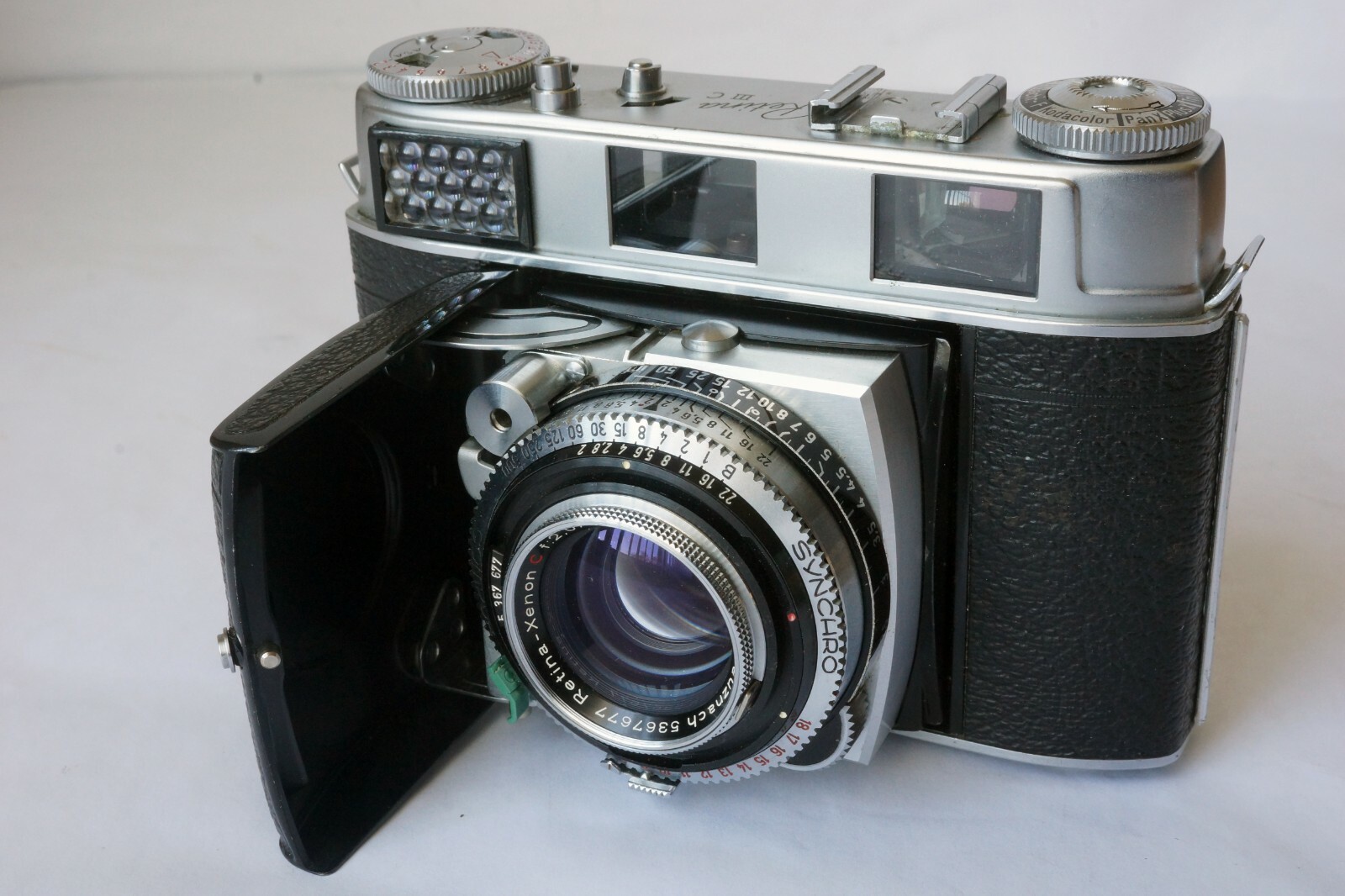
The Kodak Retina IIIc is a high-end 35mm rangefinder camera produced by Kodak in Germany under the Kodak A.G., Stuttgart division. Introduced in 1954, it represents one of the most advanced models in Kodak’s Retina line, combining precision engineering, a coupled selenium light meter, and interchangeable front lens elements in a compact folding body.
Overview
The Retina IIIc was developed during a period when German camera engineering was at its peak, and American companies like Kodak sought to compete in the premium 35mm rangefinder market dominated by Leica and Contax. Built in Kodak’s Stuttgart factory using advanced tooling and skilled craftsmanship, the IIIc was positioned as a professional-grade camera for serious photographers who demanded metering convenience without sacrificing optical quality. It succeeded the Retina IIc and added a built-in, fully coupled selenium-cell exposure meter, eliminating the need for handheld meters and improving exposure accuracy in variable lighting.
The IIIc shares the same robust folding chassis as its predecessors but features a redesigned top plate to accommodate the meter circuitry and a large, easy-to-read exposure dial visible in the viewfinder. The camera uses Kodak’s proprietary 135 film cartridges and advances film via a large, knurled knob with a built-in rewind crank. Its rangefinder patch is bright and well-illuminated, with a base length of approximately 70mm, enabling accurate focusing with fast lenses. The IIIc was available with either a Kodak Ektar 50mm f/3.5 or a Schneider Kreuznach Xenon 50mm f/2 lens, the latter marking a significant upgrade in speed and optical performance.
This model was part of Kodak’s broader Retina series, which began in 1934 and was notable for bringing high-quality 35mm photography to a broader audience. The IIIc, along with the nearly identical non-metered IIIa and the slightly earlier IIc, represented the final evolution of the Retina folding rangefinder line before Kodak shifted focus to fixed-lens rangefinders and eventually SLRs. Its combination of metering, interchangeable front elements, and compact folding design made it a favorite among photojournalists and traveling photographers in the mid-1950s.
Specifications
| Specification | Value |
| Type | Rangefinder |
| Film Format | 35mm (135 cartridge) |
| Years Produced | 1954–1960 |
| Lens Mount | Kodak Retina Interchangeable Front Lens Mount (bayonet-style for front elements) |
| Shutter | Compur-Rapid MXV leaf shutter with speeds from 1 sec to 1/500 sec, plus B; flash sync at all speeds via PC terminal |
| Metering | Coupled selenium-cell light meter (no battery required) |
| Exposure Modes | Manual only; meter aids shutter speed/aperture selection |
| Viewfinder | Combined optical viewfinder and brightline rangefinder with parallax correction; magnification ~0.7x |
| Dimensions | 135 x 70 x 45 mm (closed); weight ~580 g (with lens) |
Key Features
- Coupled Selenium Light Meter: The first Retina model with a built-in, fully coupled exposure meter that requires no battery, using selenium cells mounted around the lens to measure light and display recommended settings in the viewfinder.
- Interchangeable Front Elements: Allows use of supplementary wide-angle (e.g., 35mm) and telephoto (e.g., 85mm) lenses via front-mounted lens groups that attach to the main 50mm lens barrel.
- Precision Compur-Rapid Shutter: Offers reliable leaf shutter performance with flash synchronization at all speeds, ideal for studio and on-the-go flash work.
- High-Quality Optics: Available with either the sharp Kodak Ektar 50mm f/3.5 or the faster Schneider Xenon 50mm f/2, both renowned for excellent contrast and resolution.
- Compact Folding Design: The lens and shutter assembly retracts into the body for portability, protected by a hinged front cover with automatic on/off meter switch.
Historical Context
The Retina IIIc was launched in 1954 at a time when European manufacturers were pushing the boundaries of 35mm rangefinder technology. Competitors like Leica (with the M3, introduced in 1954) and Contax (whose G-series had ended but whose legacy remained strong) set the standard for rangefinder precision. Kodak, aiming to maintain its reputation for quality in the European market, leveraged its German engineering resources to produce a camera that combined American marketing reach with German craftsmanship. The IIIc was designed to appeal to advanced amateurs and professionals who wanted metering convenience without the bulk of an SLR.
Despite its advanced features, the IIIc faced stiff competition. Leica’s M3 offered superior lens interchangeability and a longer rangefinder base, while the IIIc’s system of interchangeable front elements was more limited. However, the IIIc’s built-in meter (absent on the M3 until much later) and lower price point gave it a niche. It was particularly popular in Europe and among U.S. photographers seeking a high-quality, compact camera for travel and documentary work. Production ended in 1957 as Kodak began shifting focus toward simpler, fixed-lens Retinas and later the Retina Reflex SLR line.
Collectibility & Value
Today, the Retina IIIc is a sought-after collector’s item, prized for its elegant design, historical significance, and mechanical sophistication. Well-maintained examples with clean meter cells and functioning shutters typically sell for $500–$900, with cameras equipped with the Schneider Xenon 50mm f/2 lens commanding higher prices, especially if accompanied by original cases, manuals, or accessories. Fully functional selenium meters are increasingly rare, as the cells degrade over time and cannot be easily replaced or recalibrated.
When purchasing a IIIc, collectors should inspect the meter’s needle movement under light, check for smooth film advance and shutter operation, and ensure the rangefinder alignment is accurate. Common issues include stiff or frozen shutters (often due to dried lubricants), hazy or separated lenses, and cracked leatherette. While repairable by specialists familiar with vintage German shutters, parts for the Compur-Rapid shutter and meter system are scarce. Cameras stored in dry, dark environments tend to fare best, and those with original packaging and documentation significantly enhance collectible value.
Similar Cameras
- Leica M3 (1954–1966) – The benchmark 35mm rangefinder with superior lens system and build quality.
- **** – Though later, shares the high-end rangefinder ethos.
- Canon P (1961) – A compact 35mm rangefinder with coupled meter and excellent optics.
- Nikon S3 (1958) – Professional-grade rangefinder with bright viewfinder and robust construction.
- Zeiss Ikon Contessa 35 (1957) – A more affordable German rangefinder with similar design philosophy.
Repair & Maintenance
The Retina IIIc requires no batteries for operation, as its selenium-cell meter generates power from light. However, these cells degrade over time, often resulting in a sluggish or non-functional meter needle—this is irreversible and cannot be restored. The Compur-Rapid shutter is generally reliable but benefits from a CLA (clean, lubricate, adjust) service every 10–15 years to prevent sticking or inaccurate speeds. Common shutter issues include slow 1-second timing and failure at high speeds due to hardened lubricants. The film advance mechanism is robust but may develop play in the film knob over decades of use. Rangefinder alignment can drift and requires specialized calibration tools. Due to the complexity of the coupled meter linkage and lens mount system, repairs should be handled by technicians experienced with vintage German rangefinders. helps maintain mechanical function, though care should be taken to avoid exposing the meter to strong light when not in use to minimize cell fatigue.
eBay Listings



As an eBay Partner, we earn from qualifying purchases. This helps support our independent vintage technology research.
Related Models
- Kodak Retina Automatic III (1960–1963)
- Kodak Retina II (1949-1956)
- Kodak Retina IIa (1951–1954)
- Kodak Retina IIc (1954–1957)
- Agfa Optima Sensor 1535
- Argus Argus A
- Argus Argus Autronic (1960)
- Argus Argus C-44R
- Argus Argus C
- Argus Argus C2