KODAK RETINA IIC
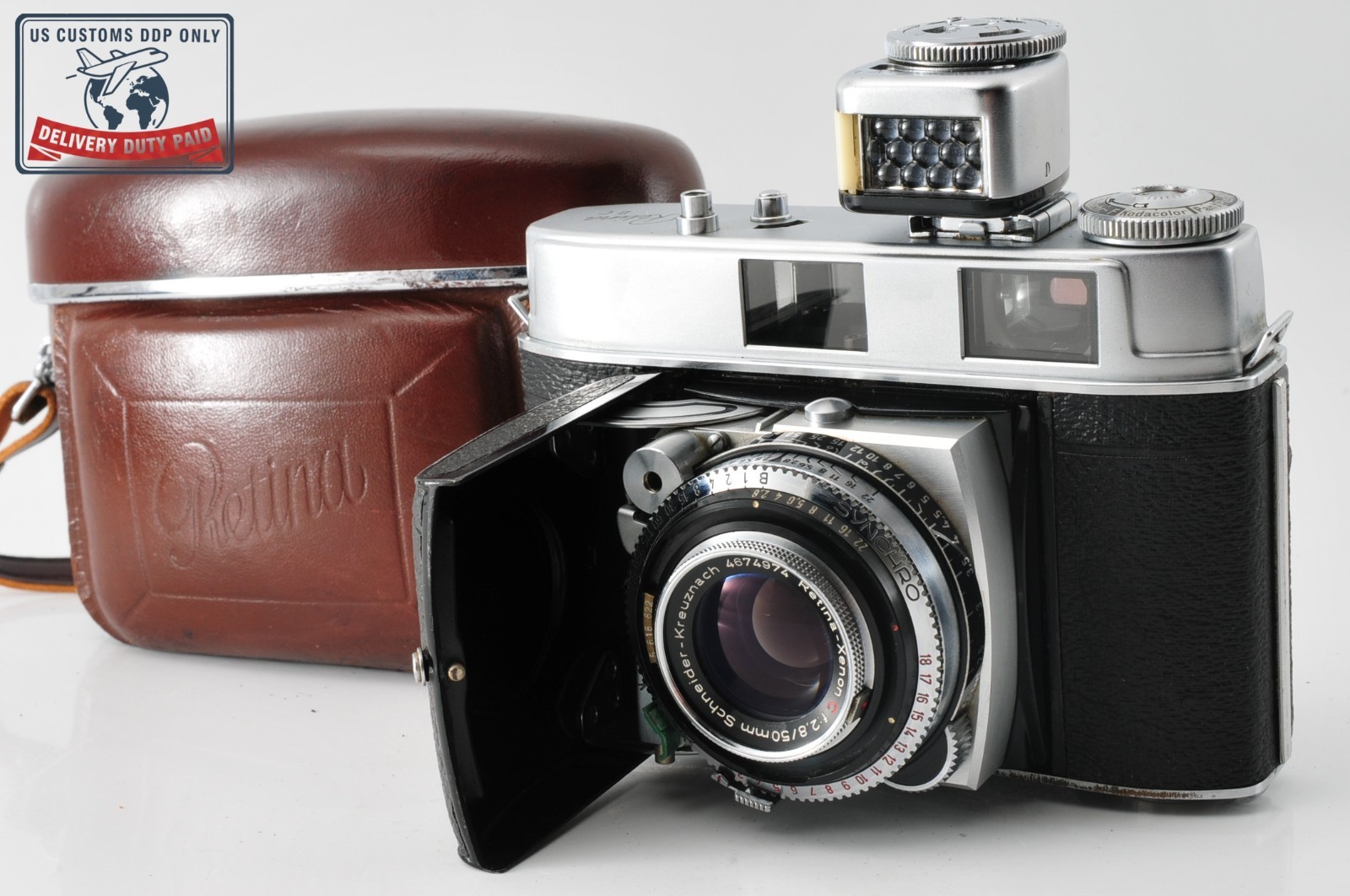
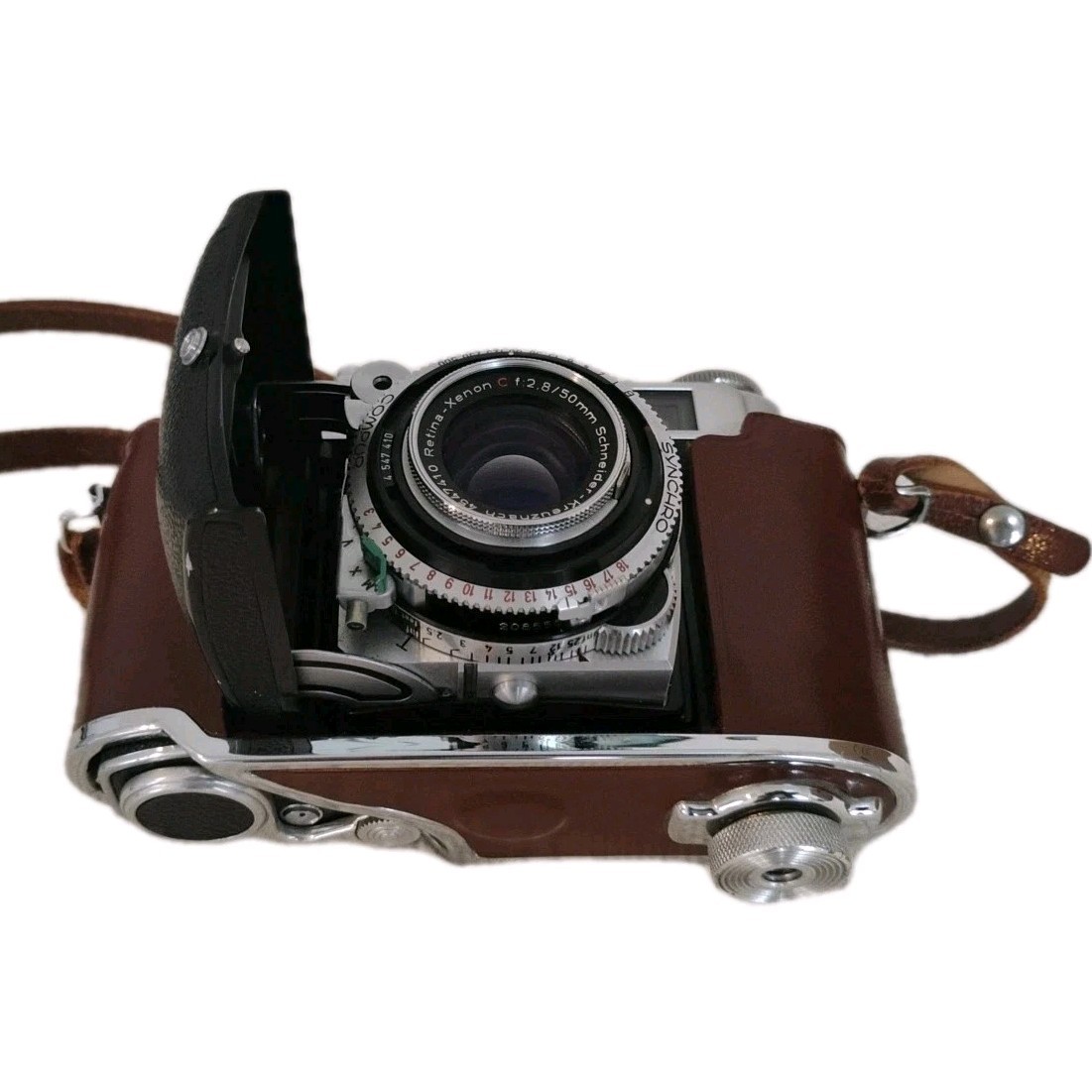
The Kodak Retina IIc is a 35mm rangefinder camera produced by Kodak AG in Stuttgart, West Germany, from 1954 to 1957. It represents the pinnacle of the Retina II series, distinguished by its interchangeable front lens elements, high-quality optics, and precision engineering, marking it as one of the most advanced 35mm rangefinders of its era.
Overview
Introduced in 1954, the Retina IIc was designed as a premium rangefinder camera targeting serious amateur and professional photographers who sought both portability and optical flexibility. It was part of Kodak’s renowned Retina line, which had established a reputation for German engineering and quality construction since the late 1930s. The IIc was the successor to the Retina II and IIb models, incorporating significant improvements in lens interchangeability and mechanical refinement. Unlike most 35mm rangefinders of the time—which featured fixed lenses—the Retina IIc introduced a unique system of interchangeable front lens elements, allowing users to switch between focal lengths without changing the entire lens assembly.
The camera was built around a robust die-cast aluminum chassis with a leatherette-covered body and featured a coupled rangefinder for precise manual focusing. It was equipped with a high-quality Schneider-Kreuznach Xenon 50mm f/2 lens as standard, with optional front elements available in 35mm (f/2.8) and 85mm (f/2) focal lengths. These front elements mounted via a bayonet system onto a shared rear optical group, maintaining rangefinder coupling and viewfinder framing across all three focal lengths. The viewfinder included automatic parallax correction and brightline frames for 35mm, 50mm, and 85mm, projected based on the selected lens element.
The Retina IIc was positioned as a high-end alternative to Leica and Contax rangefinders, offering comparable image quality and build at a more accessible price point. Its release coincided with a period of rapid innovation in 35mm photography, as compact cameras gained popularity among both professionals and enthusiasts. The IIc’s blend of modularity, precision optics, and user-friendly design made it a favorite among traveling photographers and photojournalists who needed versatility without sacrificing image quality.
Specifications
| Specification | Value |
| Type | Rangefinder |
| Film Format | 35mm (135 cartridge) |
| Years Produced | 1954–1957 |
| Lens Mount | Retina interchangeable front element bayonet (Schneider-Kreuznach system) |
| Standard Lens | Schneider-Kreuznach Xenon 50mm f/2 (7 elements in 4 groups) |
| Optional Front Elements | Retina-Xenar 35mm f/2.8 (convertible), Retina-Xenon 85mm f/2 |
| Aperture Range | f/2 to f/16 (50mm); f/2.8 to f/16 (35mm); f/2 to f/16 (85mm) |
| Shutter | Compur-Rapid shutter, horizontal cloth focal-plane |
| Shutter Speeds | B, 1–1/500 second (including 1/30 flash sync) |
| Metering | None (uncoupled selenium meter available as external accessory) |
| Exposure Modes | Manual only |
| Viewfinder | Combined optical viewfinder and coincident-image rangefinder with automatic parallax correction and brightline framelines |
| Focusing | Manual, via rangefinder-coupled focusing knob |
| Frame Count | 36 exposures (auto-indexing on loading) |
| Flash Sync | PC terminal, X-sync at 1/30s |
| Dimensions | 145 × 75 × 55 mm (W×H×D) |
| Weight | Approx. 750 g (with 50mm lens) |
Key Features
- Interchangeable front lens elements allowing use of 35mm, 50mm, and 85mm focal lengths with shared rear optics and automatic viewfinder frameline switching.
- Coupled rangefinder with high precision and bright, easily visible focusing patch for accurate manual focus.
- High-speed f/2 standard lens (Schneider Xenon 50mm) offering excellent low-light performance and shallow depth of field.
- Automatic film loading and frame counting via the Retina IIIc-style mechanism, reducing user error.
- Durable construction with a metal body, leather covering, and precision German-made Compur-Rapid shutter.
Historical Context
The Retina IIc was introduced during a transformative period in 35mm photography. In the early 1950s, the market was dominated by Leica and Contax rangefinders, which offered exceptional image quality but at high prices and with complex servicing requirements. Kodak, having acquired the Nagel camera works in Stuttgart in the 1930s, leveraged German engineering to produce high-quality cameras under the Retina brand, aiming to bridge the gap between professional performance and consumer accessibility.
The IIc was released one year after the non-interchangeable Retina IIb and was contemporaneous with the slightly more advanced Retina IIIc, which added a built-in selenium light meter. The IIc distinguished itself by offering lens interchangeability—a rare feature in 35mm rangefinders outside of the Leica screw-mount ecosystem—while maintaining a relatively compact form factor. Its modular lens system was innovative but limited in scope compared to full lens-swapping systems, as only front elements were changed. Nevertheless, it provided meaningful versatility for travel and reportage photography.
Despite its technical merits, the Retina IIc had a short production run of only three years, ending in 1957. This was due in part to the rising dominance of SLRs and Kodak’s strategic shift toward simpler, more mass-market cameras. Nevertheless, the IIc earned a strong reputation among photographers for its optical quality and mechanical reliability, and it remains a respected model among vintage camera collectors.
Collectibility & Value
The Kodak Retina IIc is a sought-after collectible, particularly in fully functional condition with all three front elements. Due to its limited production period and mechanical complexity, surviving examples in working order are relatively rare. Typical market values for a well-maintained IIc with the 50mm lens range from $600 to $900 USD; complete sets with 35mm and 85mm elements can command $1,200 to $1,800, especially if accompanied by original cases, manuals, or accessories.
Collectors prioritize cameras with smooth shutter operation, accurate rangefinder alignment, and clean, haze-free lenses. Common issues include stiff or inaccurate shutters (particularly at high speeds), lubricant degradation in the film transport mechanism, and misaligned rangefinder optics. The interchangeable lens system is generally reliable but can suffer from dust ingress or misregistration if the bayonet mount is damaged. Selenium meter versions are not applicable to the IIc (as it lacks built-in metering), so any added external meter should be considered an accessory.
When purchasing, it is advisable to verify that all framelines appear correctly in the viewfinder when switching focal lengths and that the rangefinder patch is bright and responsive. Servicing often requires specialized tools and knowledge, particularly for shutter calibration and rangefinder realignment, so professional evaluation is recommended before acquisition.
Similar Cameras
- Leica M3 (1954) – The benchmark 35mm rangefinder with full interchangeable lenses via M-mount; superior build and resale value but significantly higher cost.
- Contax G2 (1994) – A later rangefinder with interchangeable lenses, though electronically controlled; not directly comparable but shares the modularity ethos.
- Nikon S3 (1958) – A professional-grade rangefinder with excellent optics and robust construction, popular with photojournalists.
- Canon VT (1956) – A high-quality rangefinder with interchangeable lenses and bright viewfinder, aimed at advanced amateurs.
- Zeiss Ikon Ikoflex III (1957) – A TLR alternative with similar German engineering, though not a rangefinder.
Repair & Maintenance
The Retina IIc requires no batteries, as it is fully mechanical. Shutter operation, film advance, and rangefinder function are all manual. Common maintenance issues include sluggish shutter speeds due to dried lubricants, particularly in the Compur-Rapid shutter, which may require disassembly and cleaning by a qualified technician. The film advance mechanism can bind if not regularly serviced, and the rangefinder linkage may require calibration if the camera has been dropped or mishandled.
The interchangeable lens system is generally robust but should be kept clean and free of dust. The bayonet mount should engage smoothly; forced attachment can damage the alignment pins. Regular use is the best prevention against seizing, and storage in a dry, temperature-stable environment is recommended. Due to the scarcity of parts and specialized knowledge, repairs should be entrusted to technicians experienced with vintage German rangefinders. Full servicing typically includes shutter overhaul, rangefinder calibration, light sealing, and lubrication of the film transport system.
eBay Listings


As an eBay Partner, we earn from qualifying purchases. This helps support our independent vintage technology research.
Related Models
- Kodak Retina Automatic III (1960–1963)
- Kodak Retina II (1949-1956)
- Kodak Retina IIa (1951–1954)
- Kodak Retina IIIc (1954-1957)
- Agfa Optima Sensor 1535
- Argus Argus A
- Argus Argus Autronic (1960)
- Argus Argus C-44R
- Argus Argus C
- Argus Argus C2