Kodak K-100 (c. 1955–1973)
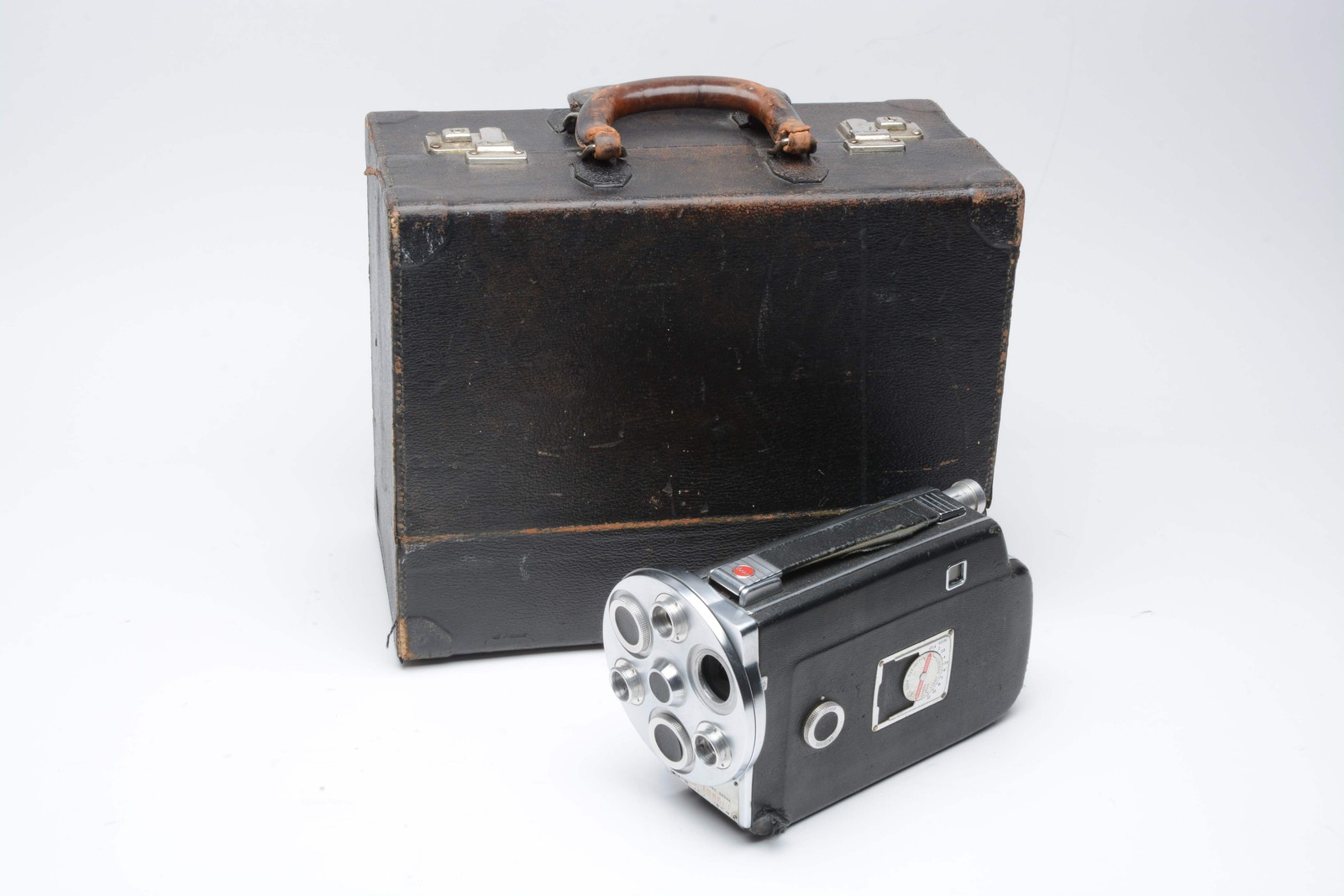
A 16mm non-reflex movie camera , available in single-lens and three-lens turret versions.
Overview
The Cine-Kodak K-100 is a 16mm motion picture camera made by Eastman Kodak Co., and followed in 1956 by a three-lens turret version. It is a spool-loading, non-reflex camera designed for precision filmmaking with interchangeable C-mount lenses ranging from 15mm to 152mm. The camera supports adjustable frame rates from 16 to 64 fps, typically operating at 24 frames per second. Two distinct models exist—the single-lens and the K-100 Turret—each serviced using specialized tools developed by Kodak. The K-100 Turret remained in production until 1973.
Notably, the Patterson–Gimlin film, a famous piece of controversial footage, was shot entirely using a Cine-Kodak K-100 camera. The viewfinder system uses an objective lens assembly with a reticle, and when equipped with a 25mm viewfinder lens, the subject appears at full size. The camera features both a motor drive shaft and a hand crank for operation.
Specifications
| Film Format | 16mm |
| Frame Rate | 16–64 fps (adjustable), typically 24 fps |
| Lens Mount | C-mount (lenses from 15mm to 152mm) |
| Viewfinder | Objective lens with reticle; subject appears full size with 25mm viewfinder lens |
| Dimensions (Turret Model) | 260 × 145 × 118 mm |
| Weight (Turret Model) | 2715 g |
| Operation | Motor drive shaft and hand crank |
| Reflex Type | Non-reflex |
Design
The K-100 uses a mechanical film transport system with a pull-down claw, sprocket, and pressure pad, and includes an aperture plate and stop cam for frame registration. The viewfinder optics can be adjusted to match the taking lens. The camera requires specific alignment tools, including gauge #906 for claw protrusion, #910 and #911 for take-up torque, and #916 precision frame line gauge used at the Rochester facility. The turret version features a three-lens rotating mount, allowing quick lens changes without removing the camera from the tripod.
Context
It may have been the last camera introduced in the Ciné-Kodak series. The repair bulletin ASRI #13 (1955) centralized service through Kodak’s Apparatus Service Department in Rochester, emphasizing its technical complexity and professional role. The camera was supplied with a field case and supported with dedicated tools and spare parts distributed across domestic divisions.
Market
Current market prices for the K-100 Turret model include listings at $750 USD and £599.95, indicating active collector interest. Known issues include speeds out of adjustment, claw engagement problems, film scratches from the notch mechanism, and misaligned frame lines—often due to improper film loading or lack of lubrication. The claw protrusion, take-up torque, and finder alignment require specialized gauges for accurate repair, reflecting its precision engineering.
eBay Listings


As an eBay Partner, we earn from qualifying purchases. This helps support our independent vintage technology research.