KODAK INSTAMATIC 814
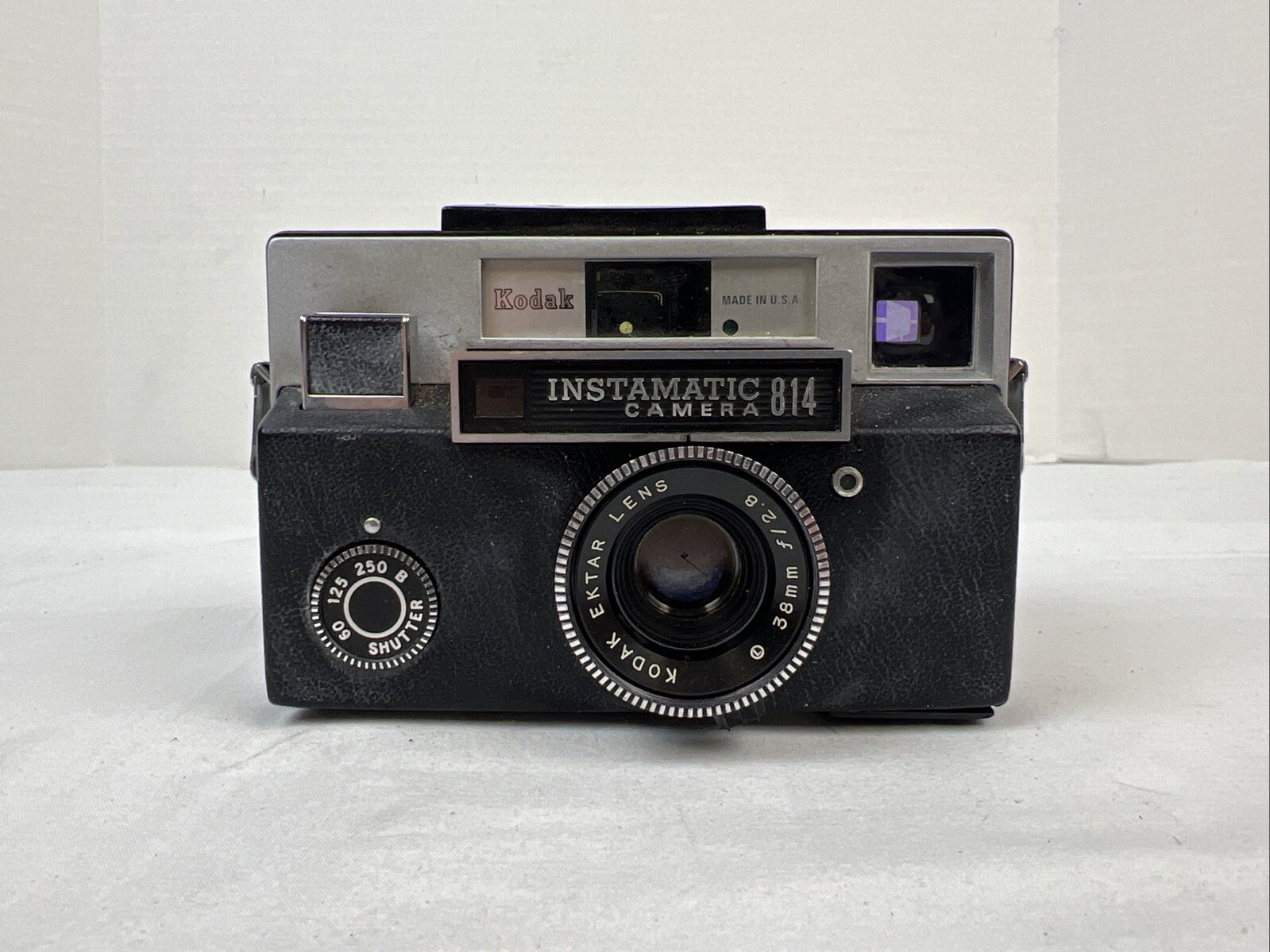
The Kodak Instamatic 814 is a premium 126 cartridge film camera released in 1968 as part of Kodak’s high-end Instamatic series. Distinguished by its high-quality Carl Zeiss Tessar lens and fully automatic exposure system, the 814 was engineered to deliver superior image quality within the constraints of the 126 cartridge format, targeting amateur photographers seeking convenience without sacrificing optical performance.
Overview
Introduced during the peak of the Instamatic line’s popularity, the Kodak Instamatic 814 represented the pinnacle of Kodak’s compact cartridge-based camera design. Launched between 1968 and 1970, the 814 was positioned as a premium alternative to the more common plastic-bodied Instamatics like the 100 or 200 models. It featured a robust metal body, precision German-made optics, and an advanced automatic exposure system, making it one of the most sophisticated 126-format cameras ever produced. The 814 was marketed toward serious amateur photographers who desired ease of use but were unwilling to compromise on lens quality.
The camera utilized Kodak’s proprietary 126 film cartridge system, introduced in 1963, which simplified film loading and standardized print sizes. While most Instamatics used lower-cost lenses and basic exposure controls, the 814 stood out with its Carl Zeiss Tessar 40mm f/2.8 lens—a rare inclusion of a European-designed lens in a mass-market American camera. This lens, manufactured under license by Kodak in Germany, offered exceptional sharpness and contrast for a fixed-lens compact. The 814 also featured a coupled selenium light meter and an automatic shutter-priority exposure system, eliminating the need for manual settings and making it ideal for point-and-shoot operation in a variety of lighting conditions.
Within Kodak’s Instamatic lineup, the 814 occupied the top tier, alongside the similar 813 and 815 models, which varied slightly in lens specification and market availability. The 814 was primarily sold in Europe and select international markets, with limited distribution in North America. Its production run was relatively short, ending around 1970 as Kodak shifted focus toward newer models and the declining interest in the 126 format. Despite its brief availability, the Instamatic 814 remains a sought-after model among collectors of vintage compact cameras due to its combination of optical excellence, build quality, and historical significance.
Specifications
| Specification | Value |
| Type | Compact viewfinder camera |
| Film Format | 126 cartridge (26x26mm square negative) |
| Years Produced | 1968–1970 |
| Lens Mount | Fixed Carl Zeiss Tessar 40mm f/2.8 (6-element, 4-group) |
| Shutter | Leaf shutter with speeds of 1/30, 1/60, 1/125, 1/250 sec; automatic selection via selenium meter |
| Aperture Range | f/2.8 to f/16 (automatic) |
| Metering | Selenium-cell exposure meter (no battery required), center-weighted |
| Exposure Modes | Fully automatic shutter-priority (no manual override) |
| Viewfinder | Optical direct-vision viewfinder with parallax correction marks |
| Focus | Fixed focus (optimized for 4 ft. to infinity) |
| Flash Support | Cold shoe and PC sync port; accepts flash cubes (Kodak Magicube compatible via adapter) |
| Dimensions | 130 × 75 × 55 mm (5.1 × 3.0 × 2.2 in) |
| Weight | Approx. 480 g (1.06 lb) with battery (none required for meter) |
| Power Source | None required for meter (selenium cell); shutter is mechanically operated |
Key Features
- Carl Zeiss Tessar 40mm f/2.8 lens: A high-resolution, multi-coated lens renowned for its sharpness and low aberration, rare in consumer compact cameras of the era.
- Fully automatic exposure system: Shutter-priority automation with no manual controls, enabling point-and-shoot simplicity while maintaining exposure accuracy.
- Selenium light meter: Integrated, battery-free metering system that degrades over time but requires no external power source.
- Metal construction: Die-cast metal body with leatherette covering, offering durability and a premium feel compared to plastic-bodied Instamatics.
- Flash synchronization: Supports both flash cubes and electronic flash via PC terminal, with automatic exposure adjustment for flash use.
Historical Context
The Kodak Instamatic 814 was released at a time when 35mm SLRs were gaining popularity among advanced amateurs, but the 126 cartridge format still dominated the consumer market due to its simplicity. Kodak introduced the 126 system in 1963 to make photography accessible to novices, and by the late 1960s, over 50 million Instamatic cameras had been sold worldwide. The 814 was part of a strategy to expand the line into higher-end segments, competing with premium compacts from European manufacturers like Zeiss Ikon and Braun.
Competitors to the Instamatic 814 included the Zeiss Ikon Super Ikonta 36 (though larger and more complex), the Braun Colorette, and the Ricoh 500 series. However, few rivals combined the 814’s blend of German optics, automatic exposure, and compact form. Despite its technical merits, the 814 faced challenges: the 126 format produced smaller negatives than 35mm, limiting enlargement potential, and the fixed-focus design restricted close-up capabilities. Additionally, the rise of 35mm point-and-shoot cameras in the 1970s eroded demand for cartridge systems. The 814 was discontinued by 1970, as Kodak streamlined its Instamatic line and shifted toward newer models like the X-15 series.
Collectibility & Value
Today, the Kodak Instamatic 814 is considered a collectible among vintage camera enthusiasts, particularly those interested in the evolution of automated photography and high-end compact designs. Its rarity, due to limited production and distribution, contributes to its desirability. In excellent working condition, with a clear lens and functional meter, the 814 typically commands prices between $150 and $300 on the secondary market, with mint, boxed examples occasionally exceeding $400.
Collectors should inspect the selenium meter for signs of deterioration—common issues include a darkened or cracked meter cell, which can impair exposure accuracy. While the camera does not require batteries for operation, a degraded meter may result in incorrect shutter speed selection. The lens should be free of fungus, haze, and scratches, and the shutter should fire crisply across all speeds. The film advance and frame counter mechanisms are generally reliable but may require cleaning after decades of disuse. Due to its metal construction, the 814 is less prone to the plastic degradation that affects other Instamatics, but the leatherette covering may peel over time.
Similar Cameras
- Kodak Instamatic 813 – Similar build and automation, but with a Kodak Ektanon 40mm f/2.8 lens instead of Zeiss Tessar.
- Braun Colorette 5 – German-made 126 camera with Zeiss Tessar lens and automatic exposure, comparable in quality and target market.
- Ricoh 500M – Japanese compact with 40mm f/2.8 lens, manual aperture selection, and match-needle metering.
- Ansco Cadet 126 – U.S.-market cartridge camera with fixed-focus lens, simpler mechanics, and lower price point.
- Agfa Select Rapid S – European 126 camera with automatic exposure and high-quality Agfa lens, direct competitor in the premium segment.
Repair & Maintenance
The Instamatic 814 requires no batteries for operation, as the selenium light meter generates its own current. However, selenium cells degrade over time, often resulting in overexposure due to reduced sensitivity. While replacement is not feasible, some collectors use external meters or expose based on sunny-16 estimates. The leaf shutter is mechanically actuated and generally reliable, but may require lubrication or cleaning if stiff. The film transport mechanism is simple and durable, though the frame counter reset may fail if not properly engaged during loading. Given the camera’s age, a CLA (clean, lubricate, adjust) by a technician experienced with vintage compacts is recommended for regular use. The fixed-focus design reduces alignment issues, but lens separation or internal haze should be checked before purchase.
eBay Listings


As an eBay Partner, we earn from qualifying purchases. This helps support our independent vintage technology research.
Related Models
- Kodak Instamatic 100 (1963-1966)
- Kodak Instamatic 104 (1963-1971)
- Kodak Retina Automatic I (1960-1963)
- Kodak Retina Automatic II (1960-1963)
- Kodak Retina I (1936–1950)
- Agfa Agfamatic 100
- Agfa Agfamatic 1000 pocket sensor
- Agfa Agfamatic 108
- Agfa Agfamatic 126
- Agfa Agfamatic 200