KODAK INSTAMATIC 104
The Kodak Instamatic 104 is a compact, consumer-grade point-and-shoot camera introduced in 1963 as part of Kodak’s revolutionary Instamatic series. Designed for ease of use and mass-market accessibility, it utilized the proprietary 126 film cartridge system, enabling quick, foolproof film loading and standardized exposure formats.
Overview
Launched at the dawn of the 1960s consumer photography boom, the Kodak Instamatic 104 was engineered to democratize photography for amateur users who previously found traditional 35mm cameras complex and intimidating. As part of the first wave of Instamatic models, the 104 targeted middle-class families seeking a reliable, user-friendly camera for home and vacation use. Its design emphasized simplicity: the 126 cartridge system eliminated the need for manual film threading, reducing loading errors and making it accessible even to first-time photographers. The camera was constructed primarily from durable black plastic with a metal shutter mechanism, reflecting Kodak’s shift toward cost-effective, high-volume production methods.
The Instamatic 104 featured a fixed-focus 44mm f/11 triplet lens, a selenium-cell exposure meter (used for ambient light assessment to guide manual aperture selection), and a built-in flash cube mount compatible with the then-new 4-socket flash cubes. Unlike later Instamatic models with fully automatic exposure, the 104 required users to manually set the aperture based on the meter’s recommendation—typically "Sunny" (f/16) or "Cloudy" (f/11)—via a dial on the lens barrel. This hybrid approach balanced automation with user control, serving as a transitional design between fully manual and fully automatic consumer cameras.
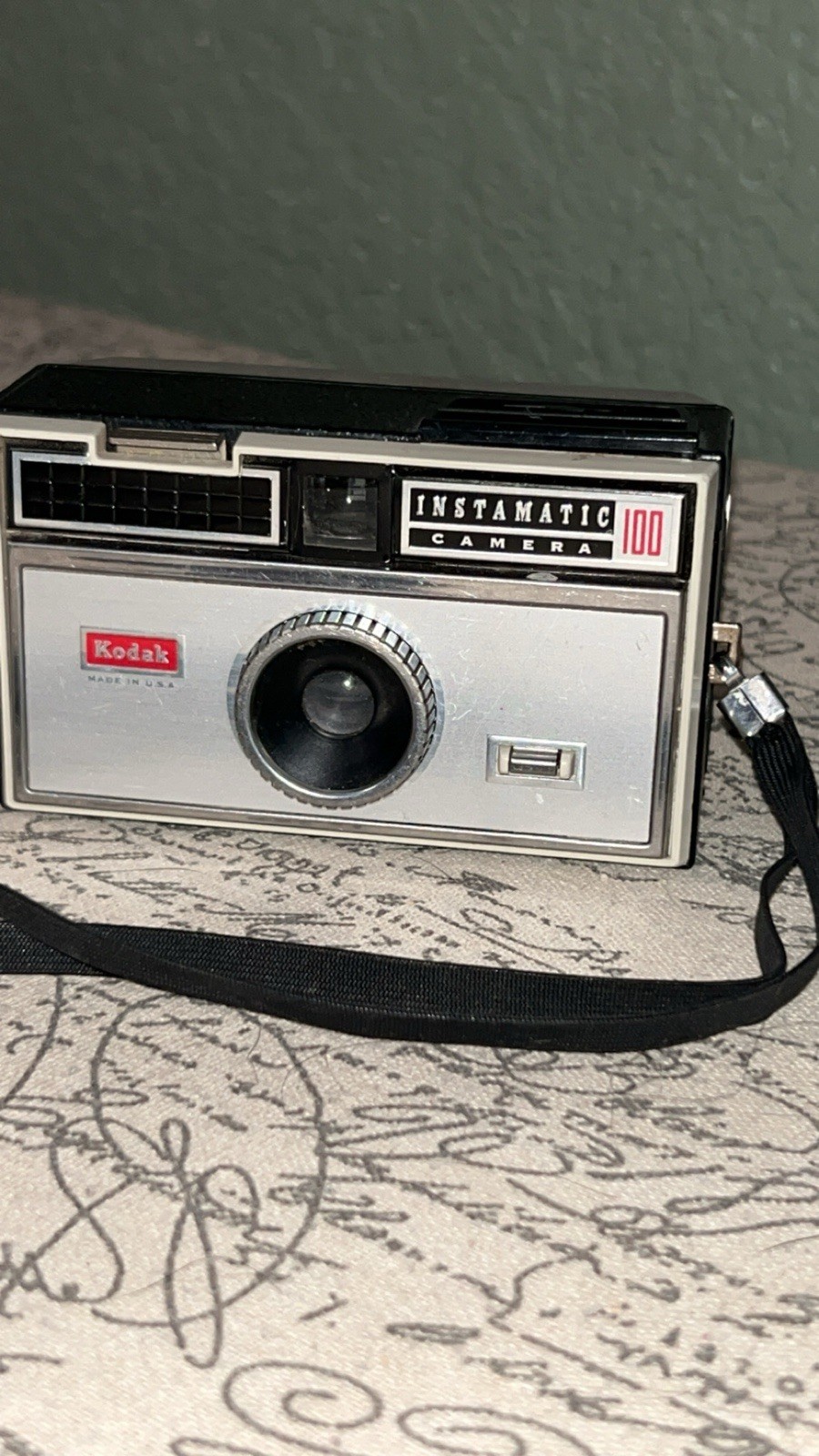
Within Kodak’s lineup, the Instamatic 104 occupied a mid-tier position—more advanced than the entry-level Instamatic 100 (which lacked a built-in flash) but less sophisticated than the premium Instamatic Reflex or later X-series models with electronic shutters. It was part of a broader strategy to dominate amateur photography by standardizing film format and simplifying camera operation. The 126 cartridge, introduced alongside the Instamatic series, became one of the most successful film formats of the 1960s and early 1970s, with over 50 million Instamatic cameras sold worldwide by 1970.
Specifications
| Specification | Value |
| Type | Fixed-lens compact camera |
| Film Format | 126 cartridge (26×26 mm square format, 12 exposures) |
| Years Produced | 1963–1971 |
| Lens Mount | Fixed 44mm f/11 Kodak Ektanon triplet lens |
| Shutter | Kodak Synchro-Compur leaf shutter; speeds of 1/30 sec (flash sync), 1/50 sec, and 1/100 sec |
| Metering | Selenium-cell exposure meter (no battery required) |
| Exposure Modes | Manual aperture selection based on meter guidance; no automatic exposure |
| Viewfinder | Optical direct-vision viewfinder with parallax correction marks |
| Dimensions | 120 mm (W) × 70 mm (H) × 50 mm (D); approximately 340 g (without film or flash) |
Key Features
- 126 Film Cartridge System: Enabled tool-free, foolproof film loading—users simply dropped the cartridge into the chamber and closed the back, with automatic film advance and sprocket engagement.
- Integrated Flash Cube Mount: Featured a top-mounted socket for 4-pin flash cubes (e.g., GE #5 or Kodak #3), with a flip-up reflector and manual cube rotation indicator.
- Selenium Light Meter: Provided battery-free exposure guidance via a needle pointer indicating recommended aperture settings ("Sunny" or "Cloudy").
- Simple Operation: Designed for point-and-shoot use with fixed focus (optimized for 4 ft. to infinity), manual shutter cocking via film advance lever, and frame counter.
- Durable Plastic Housing: Lightweight polystyrene body with metal shutter and film transport components, balancing cost and reliability.
Historical Context
The Instamatic 104 was released in 1963, during a period of rapid expansion in consumer photography. Kodak introduced the 126 film format to replace the cumbersome 127 and 620 roll films, standardizing a cartridge-based system that simplified film handling across brands. The Instamatic series, including the 104, was instrumental in popularizing snapshot photography, particularly in North America and Western Europe. Competitors such as Minolta (with the Minolta 16 series) and Argus offered compact cameras, but none matched Kodak’s ecosystem integration—film, processing, and camera design were all tightly controlled.
Market reception was overwhelmingly positive. The Instamatic 104 sold millions of units during its production run, benefiting from Kodak’s extensive retail network and advertising campaigns emphasizing ease of use. It was frequently sold as a gift camera during holidays and was commonly used for family events, vacations, and school functions. The camera’s reliance on flash cubes—newly commercialized in 1965—also aligned with the growing trend of indoor flash photography, making it a modern choice for its era.
Collectibility & Value
Today, the Kodak Instamatic 104 is a sought-after collectible among vintage camera enthusiasts, particularly those interested in mid-century consumer technology and the evolution of amateur photography. While not rare—due to high production volumes—well-preserved examples in working condition command moderate premiums. Typical market values range from $25 to $75 USD, depending on condition, completeness (including original strap, case, or flash cube), and mechanical functionality.
Collectors should inspect the selenium meter for fading or delamination, as degraded cells may still function but lose accuracy. Common issues include stiff or frozen shutters, worn film advance levers, and light seals deterioration (though the 126 cartridge has its own light-tight enclosure, reducing light leak risks). The flash cube socket may also suffer from oxidation or broken contacts. Because the camera uses no batteries for operation (except for optional flash units), it remains functional even after decades of storage, provided the mechanical components are lubricated and free of corrosion.
Similar Cameras
- Kodak Instamatic 100: Simpler variant without flash mount; otherwise identical.
- Kodak Instamatic 200: Higher-end model with automatic aperture selection.
- Minolta 16 QT: Subminiature 16mm camera for pocket use, targeting similar casual photographers.
- Ansco Instamatic 535: Rebadged version of the Instamatic 104 sold through General Aniline & Film Corporation.
- Braun Colorette 100: German-designed 126 camera with advanced styling and coupled metering.
Repair & Maintenance
The Instamatic 104 requires no batteries for shutter or meter operation—the selenium cell generates its own current. However, flash cubes require no external power but rely on proper contact in the socket. Common repair issues include sluggish shutters due to dried lubricant, which can often be remedied with careful cleaning and relubrication using light camera oil. The film advance mechanism is generally robust but may require alignment if the cartridge fails to advance properly. Replacement 126 cartridges can be hand-loaded using 35mm film and a darkroom, allowing modern use. Regular maintenance includes checking the viewfinder for haze, ensuring the lens is clean and scratch-free, and verifying that the film counter resets correctly. Due to its modular design and widespread availability of parts (via donor cameras), the Instamatic 104 is considered moderately easy to repair for experienced hobbyists.
eBay Listings


As an eBay Partner, we earn from qualifying purchases. This helps support our independent vintage technology research.
Related Models
- Kodak Instamatic 100 (1963-1966)
- Kodak Instamatic 814 (1968-1970)
- Kodak Retina Automatic I (1960-1963)
- Kodak Retina Automatic II (1960-1963)
- Kodak Retina I (1936–1950)
- Agfa Agfamatic 100
- Agfa Agfamatic 1000 pocket sensor
- Agfa Agfamatic 108
- Agfa Agfamatic 126
- Agfa Agfamatic 200