KODAK INSTAMATIC 100
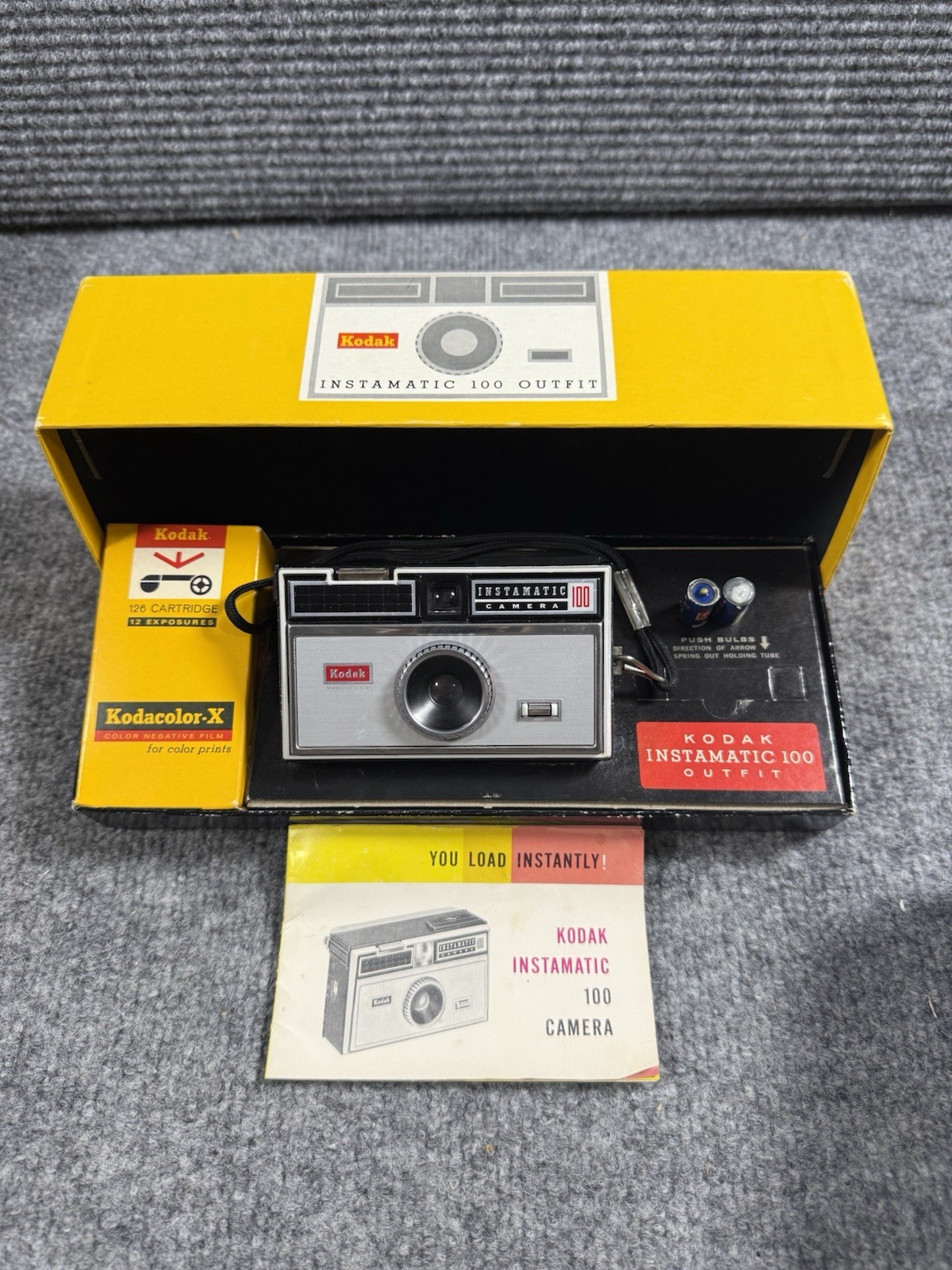
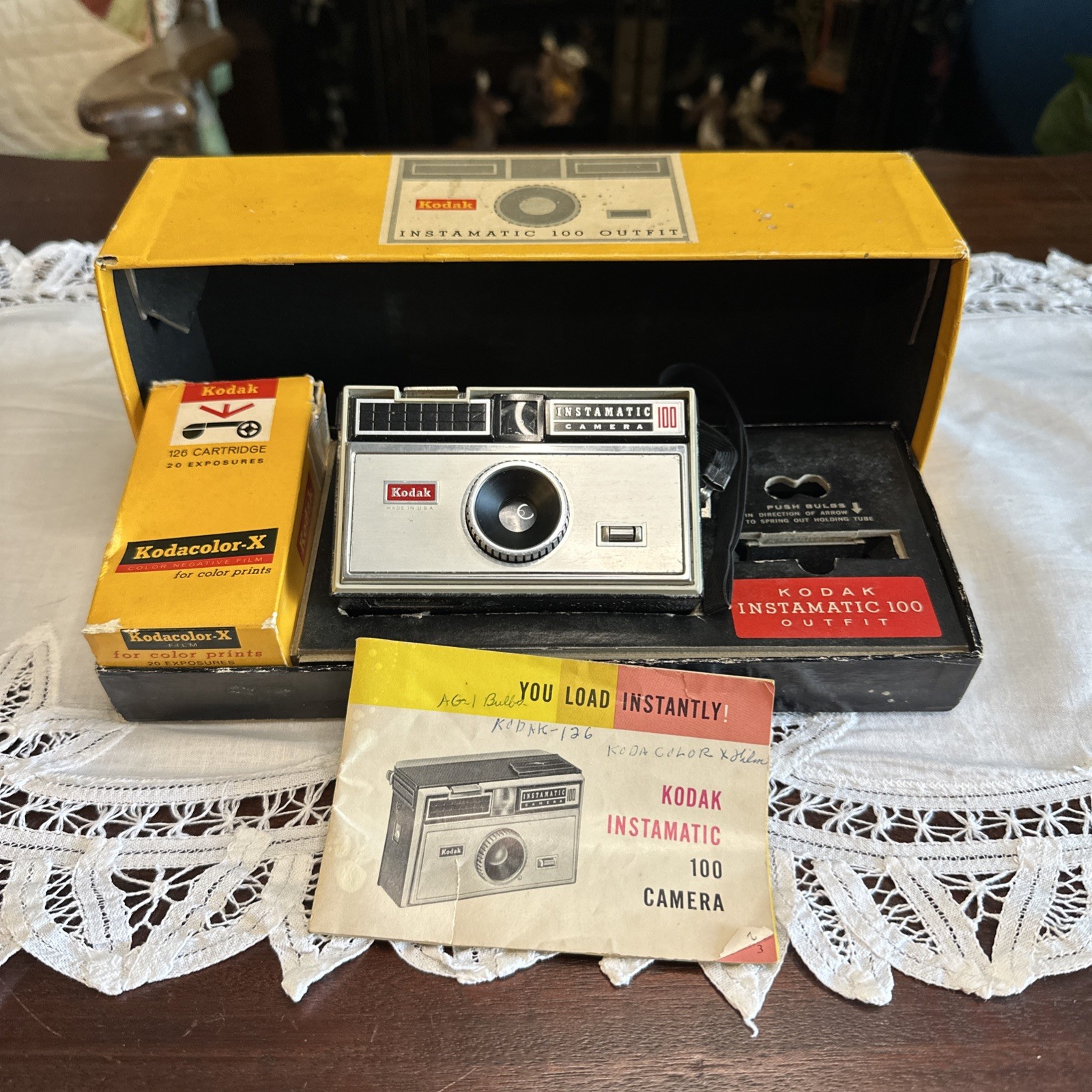
The Kodak Instamatic 100 is the inaugural model in Kodak’s revolutionary Instamatic series, introduced in 1963 as a pioneering compact camera designed to simplify 35mm-equivalent snapshot photography for the mass consumer market. Utilizing the newly developed 126 film cartridge system, the Instamatic 100 set a new standard for ease of use, film loading, and portability in amateur photography.
Overview
Launched in April 1963, the Kodak Instamatic 100 marked the debut of the Instamatic line, a family of cameras that would become one of the most successful consumer camera series in photographic history. Designed for the average family photographer, the Instamatic 100 eliminated the complexities of traditional film loading by introducing the Kodak 126 cartridge—a self-contained film cassette that dropped directly into the camera and ensured precise film positioning without manual threading. This innovation drastically reduced user error and made photography accessible to a broader, non-technical audience.
The camera was positioned as a premium compact model within Kodak’s consumer lineup, offering a fixed-focus 40mm f/2.8 Ektanon lens and a simple yet reliable leaf shutter system. It featured a coupled selenium light meter, a rarity in entry-level cameras at the time, enabling automatic exposure selection via aperture priority. The body was constructed from durable polystyrene plastic, available in black, red, and later white finishes, with a distinctive chrome-ringed lens and top-mounted film advance lever. As the first of its kind, the Instamatic 100 laid the foundation for over 50 million Instamatic cameras sold worldwide during the 1960s and 1970s.
Specifications
| Specification | Value |
| Type | Fixed-lens compact camera |
| Film Format | 126 cartridge (26×26 mm square negative) |
| Years Produced | 1963–1966 |
| Lens Mount | Fixed-integral Ektanon lens |
| Lens | 40mm f/2.8 Ektanon (3 elements in 3 groups) |
| Focus | Fixed focus (optimized for 4 ft. to infinity) |
| Shutter | Kodak Synchro-Compur leaf shutter, speeds: 1/30, 1/60, 1/125, 1/250 sec, B |
| Aperture Range | f/2.8 to f/16 (auto and manual selection) |
| Metering | Selenium-cell exposure meter (no battery required) |
| Exposure Modes | Aperture-priority automatic (via meter coupling), manual aperture override |
| Viewfinder | Direct optical framefinder with parallax correction marks |
| Flash Support | Cold shoe and PC sync terminal; accepts flash cubes (F-style) |
| Film Advance | Manual lever (single stroke per frame) |
| Frame Count | 12 or 24 exposures (depending on cartridge) |
| Dimensions | 125 mm (W) × 70 mm (H) × 50 mm (D) |
| Weight | Approx. 340 g (with film) |
Key Features
- Kodak 126 Film Cartridge System: The first consumer camera to use the drop-in 126 cartridge, enabling foolproof film loading and automatic film plane alignment.
- Selenium Light Meter: Self-powered meter with no batteries required, offering aperture-priority automation based on ambient light conditions.
- Fixed 40mm f/2.8 Ektanon Lens: Sharp, coated triplet lens optimized for snapshot use with a hyperfocal setting extending depth of field from 4 feet to infinity.
- Synchro-Compur Shutter: High-quality leaf shutter with flash synchronization and a full range of manual speeds from 1 sec (B) to 1/250 sec.
- Flash Cube Compatibility: Designed for use with Kodak’s 4-bulb M-series flash cubes, ideal for indoor family photography in low light.
Historical Context
The Instamatic 100 was released at a pivotal moment in consumer photography. In the early 1960s, 35mm cameras were becoming more common but still required technical knowledge for film loading, focusing, and exposure. Kodak sought to democratize photography by removing these barriers. The introduction of the 126 film format—packaged in a plastic cartridge with pre-aligned sprockets and a built-in backing paper—allowed users to load film in daylight and ensured consistent frame spacing and registration.
The Instamatic 100 competed with other simple box cameras like the Kodak Brownie Starlet and the Argus C3, but its integrated metering, superior lens, and modern design positioned it as a premium alternative. It also predated major competitors such as the Olympus Trip 35 (1967) and the later Instamatic rivals from Minolta and Canon. Market reception was overwhelmingly positive; within two years of its release, over 50,000 Instamatic cameras were sold monthly in the U.S. alone. The success of the Instamatic 100 prompted Kodak to rapidly expand the line with models like the Instamatic 20, 30, and 40, each offering incremental improvements or cost reductions.
Collectibility & Value
Today, the Kodak Instamatic 100 is a sought-after piece among collectors of mid-century consumer cameras, particularly those interested in the evolution of amateur photography. While not rare, fully functional examples in good cosmetic condition—especially in less common colors like white or with original accessories—can command prices between $75 and $150 on the secondary market. Cameras with working selenium meters are particularly prized, though many suffer from degraded meter cells due to age and exposure to moisture.
When purchasing an Instamatic 100, collectors should inspect the shutter operation across all speeds, check for lens fungus or separation (rare but possible), and verify that the film pressure plate is intact to ensure proper film flatness. The biggest challenge for use is sourcing 126 film, which Kodak discontinued in 2008. However, enthusiasts have developed methods to repackage 35mm film into 126 cartridges, allowing the camera to be used with proper modifications. Despite its age, the Instamatic 100 remains a functional and historically significant camera, representing a turning point in photographic accessibility.
Similar Cameras
- Ansco Instamatic 500 – A rebranded version of the Instamatic 100 sold through General Aniline & Film Corporation, nearly identical in design and function.
- Minolta Auto 110 Zoom – A later cartridge-based system (1976) using 110 film, featuring interchangeable lenses and automatic exposure.
- Kodak Brownie Starlet VI – A lower-end contemporary snapshot camera using 127 film, lacking metering and advanced shutter controls.
- Polaroid Swinger – A 1965 instant camera also using a proprietary cartridge system, aimed at the same youth and family market.
- Rollei A26 – A German-engineered 126 format camera with superior build quality and a Tessar lens, offering a more premium alternative.
Repair & Maintenance
The Instamatic 100 requires no batteries for operation—the selenium meter generates its own current—but prolonged exposure to humidity or direct sunlight can degrade the meter cell, rendering it inaccurate or non-functional. Shutter maintenance is critical; the Synchro-Compur mechanism may suffer from lubricant hardening after decades of disuse, leading to inconsistent speeds. A CLA (clean, lubricate, adjust) by a technician experienced in vintage leaf shutters is recommended for regular use.
The film advance mechanism is generally robust, but wear on the cartridge sprocket or pressure plate can cause frame spacing issues. Users should verify that the film counter resets properly and that the red window on the back aligns with the cartridge’s backing paper frame numbers. As with all 126 cameras, ensuring flat film plane alignment is essential for sharp images. Given the availability of reloaded 126 film, the Instamatic 100 remains a viable and enjoyable camera for experimental and nostalgic photography.
eBay Listings

As an eBay Partner, we earn from qualifying purchases. This helps support our independent vintage technology research.
Service Manuals, Schematics & Catalogs
- Catalog — archive.org
- Catalog (2001) — archive.org
- Catalog — archive.org
Related Models
- Kodak Instamatic 104 (1963-1971)
- Kodak Instamatic 814 (1968-1970)
- Kodak Retina Automatic I (1960-1963)
- Kodak Retina Automatic II (1960-1963)
- Kodak Retina I (1936–1950)
- Agfa Agfamatic 100
- Agfa Agfamatic 1000 pocket sensor
- Agfa Agfamatic 108
- Agfa Agfamatic 126
- Agfa Agfamatic 200