Kodak Ektasound 130 (1973–1977)
The first Super 8 camera that could record sound directly onto film — a bold leap for home movies, even if it’s now a museum piece.
Overview
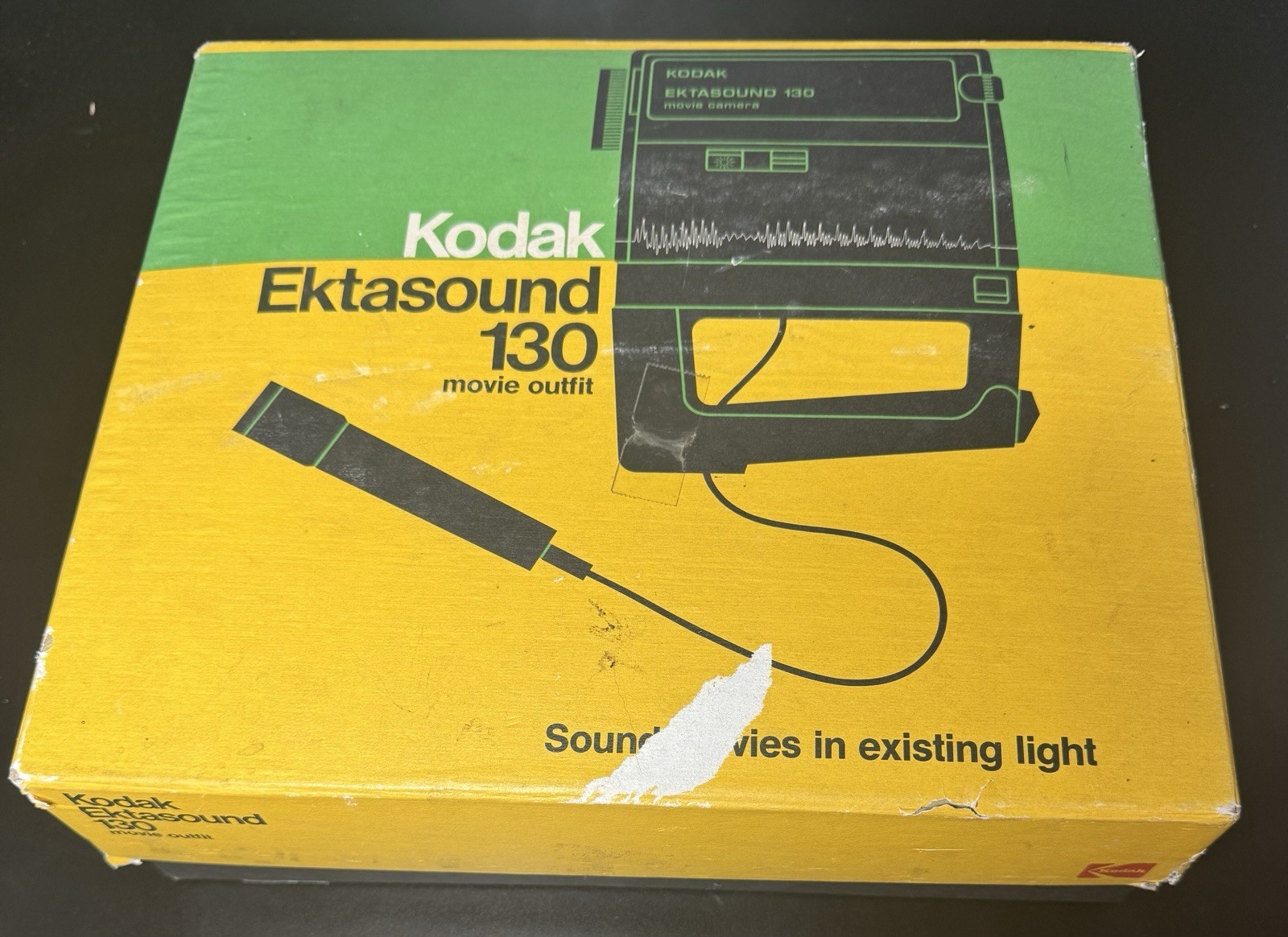
There’s a certain weight to holding the Kodak Ektasound 130 — not just the 1250 grams in your hands, but the historical heft. This wasn’t just another Super 8 camera. It was Kodak’s first attempt at bringing synchronized sound to the amateur filmmaker, a machine built to record audio directly onto magnetically striped Super 8 film while you shot. No separate recorder, no post-sync dance — just point, press record, and talk. That alone makes it a landmark, even if its practical life has long since expired. Introduced in 1974 and built in the USA, the Ektasound 130 was marketed as the future of home movies, a way to capture birthdays, holidays, and backyard dramas with actual dialogue. It didn’t just add a microphone jack; it rewired expectations. But like so many early experiments in consumer tech, it was built for a very specific film ecosystem that no longer exists. Today, it’s less a tool and more a time capsule — heavy, power-hungry, and tethered to a format that’s all but gone.
The camera’s design reflects its ambition. It’s chunky, with a fixed handle that doubles as a battery compartment, housing six AA cells for the motor and a separate 9V for the amplifier. The lens is a fixed 9mm Kodak Ektar f/1.2 — fast for its time, letting in serious light for indoor shooting, though focusing is fixed, meaning everything relies on depth of field. You compose through a non-reflex optical viewfinder with an adjustable eyepiece, which means what you see isn’t exactly what the lens sees — a parallax issue common in Super 8 but still a minor annoyance. Exposure is automatic, though not TTL (through-the-lens), so it’s guessing based on external light, not what’s actually hitting the film. There’s a manual override with sun and bulb icons for daylight and tungsten, plus a backlight control button to compensate for strong rear lighting — a thoughtful touch, even if it’s rudimentary by modern standards.
What sets the Ektasound 130 apart, though, is the sound system. It was the first camera designed to record sound simultaneously onto magnetically striped Super 8 Ektachrome film, a feature that must have felt like magic in 1974. The recording level is automatic, with two microphone input sockets offering Normal and Reduced sensitivity — a nod to varying sound environments. A mini jack sits just below the lens for the included microphone, and there’s even a phonograph input and auxiliary speaker jack, suggesting Kodak imagined users syncing home footage with records or external audio sources. The camera runs at 18 fps when using a sound cartridge, 20 fps in silent mode, with a 230-degree shutter angle — standard for smooth motion in the format. It uses a DC micromotor for drive, which was quieter and more consistent than spring-wound mechanisms, and includes a cable release socket for steady starts.
But all of this innovation came with strings attached. The camera depends on film stocks that are no longer produced or compatible. A 2006 article reviewing its viability with modern Kodak Super 8 film gave it a 6 out of ? (exact scale unclear), bluntly stating its useful life is finished when it comes to shooting Ektachrome 64T or 100D. Online, some users flatly call it “useless” for contemporary film use — not because it’s broken, but because the ecosystem it needs is gone. You can still power it on, test the motor, maybe even play back old cartridges if you have them, but shooting new film with synchronized sound? That ship has sailed.
Specifications
| Manufacturer | Eastman Kodak, made in USA |
| Production years | 1973–1977 |
| Lens | Kodak Ektar f/1.2, 9mm fixed focal length |
| Focusing | fixed |
| Viewfinder | non-reflex, adjustable eyepiece |
| Exposure | auto exposure control (not TTL); includes manual setting with sun (daylight) and bulb (tungsten) icons |
| Film speed | automatic for 25/40 and 100/160 ASA (daylight/tungsten) |
| Backlight control button | yes |
| CCA filter | built-in 85A filter with filter control switch |
| Shutter opening | 230 degrees |
| Filming speed | 18 fps (sound cartridge) and 20 fps (silent cartridge) |
| Sound | single system, magnetic recording on Super 8 film |
| Recording level control | auto |
| Microphone input | 2 sensitivity sockets (Normal and Reduced) |
| Cable release socket | yes |
| Film counter | yes |
| Handle | fixed, contains battery chamber |
| Camera drive | DC micromotor |
| Battery check button | yes |
| Power source | 6 x AA batteries, 1 x 9V for amplifier |
| Weight | 1250 g |
| Dimensions | 85 x 165 x 210 mm |
| Tripod socket | 1/4" |
| Film format | Super 8 |
Key Features
First single-system sound in Super 8
The Ektasound 130 wasn’t just adding sound — it was pioneering it. As the first camera designed to record audio directly onto magnetically striped Super 8 film, it eliminated the need for external recorders and post-production syncing. That was a big deal for home users who wanted to capture real conversations, not just silent pantomime. The system used Kodak’s own striped Ektachrome film, which had a magnetic strip along the edge for audio. The camera’s internal amplifier and auto level control handled the rest, making it as simple as plugging in a mic and pressing record. No more chasing sync with clapperboards or trying to match audio in editing — the sound was baked in, frame-accurate, and as close to professional filmmaking as a consumer could get in the mid-70s.
Microphone and auxiliary audio inputs
Kodak didn’t stop at basic mic input. The Ektasound 130 includes a mini jack for a microphone mounted just below the lens, but it also offers a phonograph input and an auxiliary speaker jack. This suggests a broader vision — one where users might play music from a record player into the camera while filming a dance, or monitor playback through an external speaker. It’s a level of connectivity that feels almost ahead of its time, even if most owners probably never used the phonograph input. The two sensitivity settings (Normal and Reduced) also show Kodak thinking about real-world conditions — loud environments like parties or parades wouldn’t overload the system, while quiet indoor scenes could still be captured clearly.
Non-TTL exposure with manual override
The exposure system is automatic, but not TTL — meaning it doesn’t meter through the lens, which can lead to inaccuracies, especially with filters or unusual lighting. Instead, it relies on an external light sensor, which works well enough in consistent conditions but can struggle with backlit scenes or mixed lighting. That’s where the backlight control button comes in, letting users compensate for strong rear lighting. The manual mode offers two settings — sun for daylight, bulb for tungsten — which is basic but functional. Film speed is automatically detected via a 1-pin ASA notching system, supporting 25/40 and 100/160 ASA films depending on lighting. It’s not precise by modern standards, but for point-and-shoot home movies, it got the job done.
Fixed lens with fast aperture
The 9mm Kodak Ektar f/1.2 lens is a standout. A maximum aperture of f/1.2 was extremely fast for a consumer Super 8 camera, allowing for usable indoor shooting without additional lighting. Since focusing is fixed, Kodak relied on depth of field to keep subjects in focus — fine for medium-distance shots, but close-ups could be blurry. The fixed focal length means no zoom, which might feel limiting today, but in 1974, most home cameras were fixed-lens anyway. The built-in 85A color correction filter, activated by a switch, helps balance color temperature when shooting under tungsten light, a thoughtful inclusion for indoor filming.
Historical Context
The introduction of the Super 8 format with lip-synchronized dialogue capability opened up the world of sound for the home movie-maker — and the Ektasound 130 was Kodak’s flagship for that shift. Before this, home movies were silent, relying on music or voiceover in playback. Being able to record sound directly onto the film changed the emotional impact of amateur footage. It wasn’t just about seeing your kid’s first steps — now you could hear their laughter too. The Ektasound 130 was positioned as the high-end solution for families who wanted the full experience. It shared its core design with the Ektasound 140, which was identical except for a zoom lens — suggesting Kodak offered a tiered lineup, with the 130 as the fixed-lens, possibly more affordable option.
Collectibility & Value
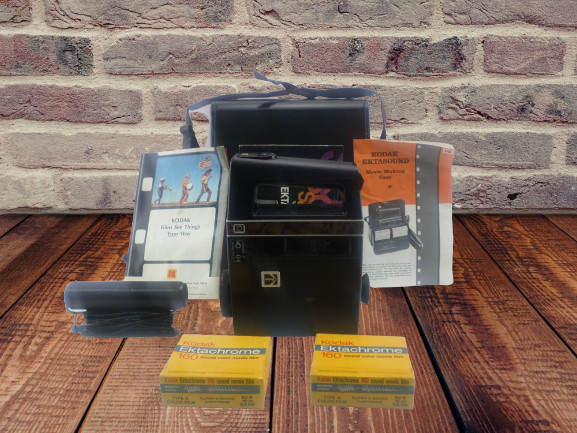
Today, the Ektasound 130 is a collector’s curiosity rather than a working tool. Its original price in England at introduction was £132 — a significant sum at the time — but current market value tells a different story. A complete in-box example was purchased for $20 USD, and one unit reportedly sold for just one dollar. An eBay Germany listing in November 2006 sold for EUR 9.37 plus EUR 7.00 shipping, suggesting even then it wasn’t highly valued. An untested unit with microphone listed on eBay for US $17.10 more recently, indicating it’s still trading in the under-$25 range for non-functional or untested gear. Given that a 2006 article declared its useful life finished for modern film stocks like Ektachrome 64T or 100D, and some online commentators call it “useless” for current use, it’s clear this camera is no longer viable for shooting. Collectors might value it for its historical significance as the first single-system sound Super 8 camera, but as a functional device, it’s largely obsolete.
eBay Listings


As an eBay Partner, we earn from qualifying purchases. This helps support our independent vintage technology research.
Related Models
- Kodak Brownie 8 (1951)
- Arriflex 16 BL (1965)
- Arriflex 16 SR (1975)
- Arriflex 16 ST (1952)
- Arriflex 35 BL (1972)
- Arriflex 35 IIC (1964)
- Beaulieu 4008 ZM II (1977)
- Beaulieu 5008 S (1976)
- Bell & Howell 134 (1940)
- Bell & Howell 2709 (1912)