KODAK BROWNIE FLASH
, designed to bring flash photography within reach of amateur photographers and families. As an evolution of the long-running Brownie series, it introduced built-in flash synchronization capabilities while retaining the simple, affordable design that made earlier models popular.
Overview
Introduced in 1955, the Kodak Brownie Flash was part of the final generation of the iconic Brownie line, which had been instrumental in democratizing photography since its debut in 1900. This model was specifically engineered to meet the growing consumer demand for indoor and low-light photography during the postwar era, when flashbulbs became widely accessible and affordable. Earlier Brownie models did not support flash, but there was no distinct model called the 'Brownie Flash.' Some later Brownie variants, such as the Brownie Hawkeye Flash (1950), included a flash contact for use with flashbulbs., allowing users to connect a flashgun via a PC sync socket—typically located near the lens or on the top plate—enabling properly exposed images in dimly lit environments.
Targeted at casual photographers and families, the Brownie Flash maintained the classic box camera form: lightweight, simple to operate, and priced for mass-market appeal. It used 620 film, a format unique to Kodak at the time, which was functionally similar to 120 film but with a thinner spool to allow for more compact camera designs. The camera featured a fixed-focus meniscus lens, a single-speed shutter, and a rotary dial for selecting aperture settings based on lighting conditions. Its design emphasized ease of use—load film, select lighting condition, aim, and shoot—making it suitable for casual snapshot photography.
Within Kodak’s product hierarchy, the Brownie Flash occupied the entry-level segment, positioned below more advanced models like the Brownie Starflash and the Hawkeye series. However, its inclusion of flash synchronization marked a notable upgrade over basic daylight-only Brownies, bridging the gap between rudimentary photography and more versatile amateur use. While not technologically sophisticated, the Brownie Flash reflected Kodak’s ongoing commitment to making photography accessible, even as more advanced cameras began to dominate the market.
Specifications
| Specification | Value |
| Type | Box Camera |
| Film Format | 620 film (12 exposures, 6×6 cm) |
| Years Produced | 1955–1960 |
| Lens Mount | Fixed meniscus lens (non-interchangeable) |
| Lens | Single-element meniscus lens, f/11–f/16 aperture range |
| Shutter | Simple rotary shutter, single speed (approximately 1/30 sec); no Bulb mode |
| Aperture Settings | f/11 (sunny), f/16 (cloudy), selected via dial on front |
| Focus | Fixed focus (typically set to ~8 feet to infinity) |
| Metering | None (zone exposure via scene lighting dial) |
| Exposure Modes | Manual selection via scene lighting dial (sunny/cloudy) |
| Viewfinder | Simple wire or optical frame viewfinder (top-mounted) |
| Flash Sync | |
| Film Advance | Manual knob wind (with red window for frame numbering) |
| Dimensions | Approx. 12 x 9 x 10 cm (varies slightly by body style) |
| Weight | |
| Construction | Molded plastic or Bakelite body with metal trim |
Key Features
- Integrated Flash Synchronization: One of the first entry-level Brownie models to include a flash contact (PC terminal or side sync), enabling use with external flashbulbs—typically AG-1 or M-2 types—via a flashgun.
- 620 Film Compatibility: Utilized the proprietary Kodak 620 roll film format, which was compact and widely available at the time, allowing for 12 square (6×6 cm) exposures per roll.
- Scene Lighting Dial: A rotating dial on the front allowed users to select between "Sunny" (f/11) and "Cloudy" (f/16) conditions, simplifying exposure decisions without a light meter.
- Simple Rotary Shutter: Operated via a spring-loaded lever; offered a single shutter speed (~1/30 sec) and a Bulb (B) mode for long exposures when the shutter remained open while the button was pressed.
- Top-Mounted Viewfinder: A basic wire or simple optical frame finder provided approximate framing, with parallax correction markings for close subjects.
Historical Context
The Kodak Brownie Flash was released during a transitional period in consumer photography, when flashbulbs were replacing flash powder and becoming standard accessories for home photographers. The mid-1950s saw a surge in indoor social events—birthday parties, holiday gatherings, and family dinners—being documented photographically, creating demand for cameras capable of reliable low-light performance. Kodak responded by upgrading the venerable Brownie line with flash capability, ensuring that even budget-conscious users could participate in this trend.
Competitors such as Argus, Ansco, and Universal offered similar box cameras with flash support, but Kodak’s brand recognition and extensive film sales network gave it a significant edge. The Brownie Flash was marketed as a natural upgrade from earlier daylight-only models, often bundled with flashbulbs or sold alongside Kodak’s own flashguns. Despite its simplicity, it was well-received for its reliability and ease of use. However, by the late 1950s, more advanced models with better lenses, built-in flash, and faster shutters—like the Brownie Starflash (1957)—began to overshadow it, leading to its discontinuation around 1960.
Collectibility & Value
Today, the Kodak Brownie Flash is a sought-after item among vintage camera collectors, particularly those interested in mid-century American design and the evolution of amateur photography. While not exceptionally rare, complete examples with intact flash contacts, functional shutters, and original finish command higher prices. Units with original boxes, instruction manuals, or accompanying flash accessories are especially desirable.
When purchasing a Brownie Flash, collectors should inspect the shutter mechanism for responsiveness, check the flash contact for corrosion or breakage, and verify that the film advance knob turns smoothly. Common issues include cracked plastic or Bakelite bodies (especially at stress points like corners and film ends), degraded light seals (though minimal in box cameras), and stuck or sluggish shutters due to dried lubricants. The red window on the back should be clear and unclouded to ensure accurate frame numbering. As with all 620 film cameras, users should be aware that 620 film is no longer manufactured, though it can be respooled from 120 film with careful modification.
Similar Cameras
- Ansco Shur Shot Flash Model – A contemporary box camera with flash sync and 620 film support, featuring a similar meniscus lens and scene dial.
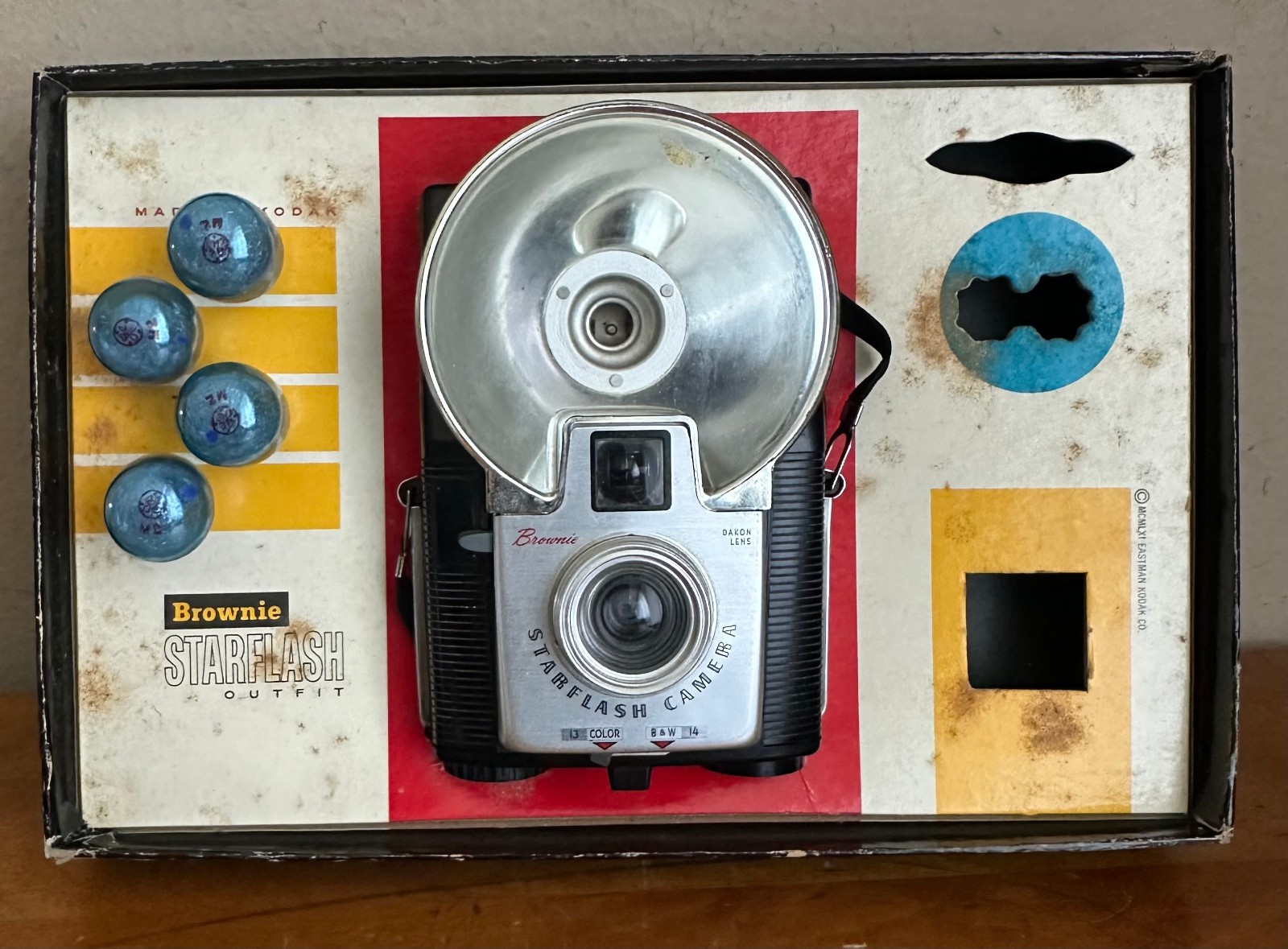
- Kodak Brownie Starflash – A more advanced 1957 successor with built-in flashgun and improved optics.
- Argus C3 "Brick" (with flash) – Though more complex, it competed in the amateur market with flash capability and 35mm film.
- Universal Mercury II – A compact 35mm camera with flash sync, targeting enthusiasts seeking portability and versatility.
- Kodak Hawkeye Flash Brownie – A later (1950s) plastic-bodied 620 camera with a molded plastic lens and built-in flash.
Repair & Maintenance
The Kodak Brownie Flash requires no batteries and operates entirely mechanically. The shutter is manually cocked via a lever and uses a simple spring mechanism. Common maintenance issues include sticky or non-firing shutters, often remedied by careful cleaning and lubrication with light camera oil. The flash contact terminal may suffer from oxidation; cleaning with isopropyl alcohol and a cotton swab typically restores functionality. Due to the use of 620 film, which is obsolete, users wishing to shoot film must respool 120 film onto 620 spools—a process requiring care to avoid light leaks or film damage. The red window should be checked for opacity, and if needed, can be replaced with a modern opaque film reminder system. Overall, the Brownie Flash is relatively easy to service for beginners, though replacement parts are not commercially available and must be sourced from donor cameras.
eBay Listings



As an eBay Partner, we earn from qualifying purchases. This helps support our independent vintage technology research.
Service Manuals, Schematics & Catalogs
- Catalog — archive.org
- Catalog (2001) — archive.org
- Catalog — archive.org