KIEV 60
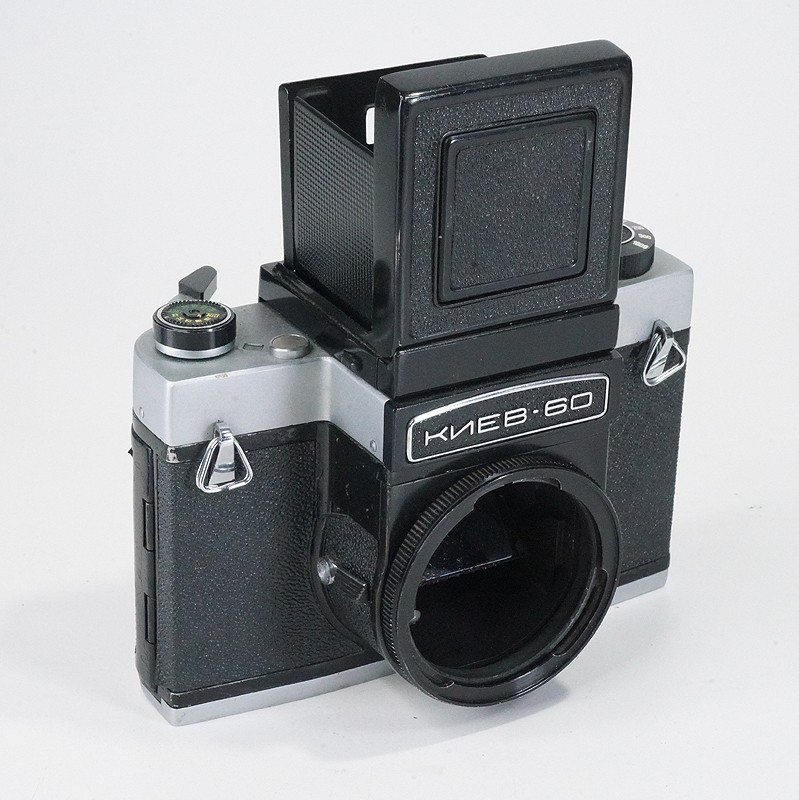
The Kiev 60 is a Soviet-built 6×6 cm medium format single-lens reflex (SLR) camera produced from 1984 to 1999 by the Arsenal Factory in Kyiv, Ukraine. Designed as a professional-grade system camera, it features a Pentacon Six lens mount, through-the-lens (TTL) metering, and modular construction, making it a versatile tool for studio, portrait, and landscape photography.
Overview
The Kiev 60 was developed as a modernized successor to the earlier Kiev 6 and Kiev 6S models, incorporating refinements in build quality, metering accuracy, and user ergonomics. Introduced during the final decade of the Soviet Union, the camera was intended to serve both domestic professional photographers and export markets seeking an affordable alternative to Western medium format systems like the Hasselblad 500 series and Bronica SQ. Unlike its predecessors, the Kiev 60 featured a fixed, integrated pentaprism housing with a TTL metering system, eliminating the need for external metering attachments and improving usability.
Built around the widely adopted Pentacon Six (also known as Praktica PL or East German 6×6) lens mount, the Kiev 60 offered compatibility with a broad range of manual focus lenses from Carl Zeiss Jena, Meyer-Optik, Schneider-Kreuznach, and others, in addition to Arsenal’s own Arsenal-brand optics. The camera utilized a focal-plane cloth shutter with speeds ranging from 1 second to 1/1000, plus Bulb mode, and supported flash synchronization at 1/60 second via PC terminal and hot shoe. Its modular design allowed for interchangeable film backs, viewfinders (though limited in practice), and focusing screens, although true system flexibility was constrained by inconsistent manufacturing tolerances and limited accessory availability outside the Eastern Bloc.
Despite its rugged metal construction and capable optical performance when paired with quality lenses, the Kiev 60 suffered from inconsistent quality control, a legacy of the Soviet industrial model. Units varied significantly in finish, mechanical precision, and light sealing, with later production models (post-1991) often exhibiting greater build inconsistencies due to economic instability following the dissolution of the USSR. Nevertheless, the Kiev 60 remains a notable example of Soviet engineering ambition in photographic technology, offering high-format capability at a fraction of the cost of Western counterparts.
Specifications
| Specification | Value |
| Type | Single-Lens Reflex (SLR) |
| Film Format | 6×6 cm (120 and 220 roll film) |
| Years Produced | 1984–1999 |
| Lens Mount | Pentacon Six (PSK) |
| Shutter | Vertically-traveling cloth focal-plane shutter; speeds 1–1/1000 sec + B |
| Metering | TTL open-aperture metering via CdS cell in pentaprism housing |
| Exposure Modes | Manual only (stop-down metering via preview lever) |
| Viewfinder | Fixed pentaprism with interchangeable focusing screens; 93% coverage, 0.85× magnification |
| Dimensions | 105 × 105 × 125 mm (W×H×D); weight: ~1,050 g (body only, no film back or battery) |
Key Features
- Pentacon Six Lens Mount: Enables use of a wide array of third-party and Soviet-made 6×6 lenses, enhancing system flexibility and lens choice.
- Integrated TTL Metering: Through-the-lens CdS metering with open-aperture composition and stop-down exposure confirmation via dedicated preview lever.
- Modular Film Backs: Interchangeable film magazines allow mid-roll film changes and support for both 120 and 220 film formats.
- Focal-Plane Shutter: Offers flash sync at all speeds up to 1/60 sec and high-speed capability to 1/1000 sec, uncommon in many medium format SLRs of the era.
- Interchangeable Focusing Screens: Multiple screen types available (matte, grid, microprism) for specialized focusing needs.
Historical Context
The Kiev 60 was released in 1984 during a period of stagnation in Soviet consumer electronics and photographic industries. It represented a belated modernization of the Kiev 6 series, which itself was a derivative of the East German KW (Praktisix) design from the 1950s. By the 1980s, Western medium format systems such as the Hasselblad 500ELX, Bronica SQ-A, and Mamiya RB67 dominated professional markets with superior reliability, precision engineering, and comprehensive accessory systems. The Kiev 60 attempted to compete on price and format equivalence rather than build quality or automation.
Despite its technical capabilities, the camera faced significant challenges in international markets due to its reputation for inconsistent assembly, light leaks, shutter timing inaccuracies, and unreliable film transport mechanisms. However, in regions where Western equipment was prohibitively expensive or inaccessible, the Kiev 60 found a niche among budget-conscious professionals and enthusiasts. Its release coincided with the final years of centralized Soviet manufacturing, and production continued into the 1990s under Ukrainian management after the USSR’s collapse, though with declining quality and supply chain reliability.
Collectibility & Value
Today, the Kiev 60 is regarded as a budget entry point into modular 6×6 SLR photography. In the used market, prices typically range from $150 to $400 USD depending on condition, included accessories, and film back availability. Fully functional units with clean viewfinders, accurate shutters, and light-tight film backs command higher prices. Collectors and users should inspect for common issues such as shutter curtain wear, light leaks around the film back seal, prism fogging, and inconsistent film advance.
Because of its mechanical nature and lack of electronic dependencies, the Kiev 60 can be a durable tool if properly maintained. However, original Kiev lenses (e.g., Volna-3, Arsenal 80mm f/2.0) vary in optical quality, and many users prefer pairing the body with Carl Zeiss Jena Biometar or Flektogon lenses for superior sharpness and contrast. The camera’s value lies more in its utility than in rarity—complete, well-functioning systems are uncommon but not rare, and repair parts are limited but available through specialist vendors and Eastern European surplus sources.
Similar Cameras
- Hasselblad 500C/M – Swedish-made 6×6 SLR with modular design, leaf shutter lenses, and superior build quality.
- Bronica SQ-Ai – Japanese 6×6 SLR with TTL metering, interchangeable backs, and robust mechanical construction.
- Pentacon Six TL – East German SLR with identical lens mount and similar format, but with a waist-level finder as standard.
- Mamiya RB67 Pro-S – Rotating back 6×7 SLR with focal-plane shutter and professional-grade modularity.
- Kiev 88 – Soviet-built 6×6 SLR with interchangeable backs and lenses, based on the Hasselblad design but with a different mount.
Repair & Maintenance
The Kiev 60 uses a single 1.35V mercury battery (PX625 or equivalent; modern substitutes include Wein Cell or 1.4V hearing aid batteries with exposure compensation) for its CdS meter. The camera functions mechanically without battery power, but metering is disabled. Common maintenance issues include degraded light seals (which should be replaced every 10–15 years), sticky shutter curtains, and misaligned film pressure plates. Shutter timing often requires calibration, especially in older units, and the film advance mechanism may develop play over time.
Repair is considered moderately difficult due to limited official support and proprietary components, though a community of enthusiasts and specialized technicians in Eastern Europe and North America provide servicing. Cleaning the pentaprism and mirror assembly requires care to avoid coating damage. Lubrication of the focal-plane shutter and film transport should only be performed by experienced technicians, as improper servicing can lead to curtain tears or frame spacing errors. Regular cleaning, light seal replacement, and periodic CLA (clean, lubricate, adjust) are recommended for sustained reliable operation.
eBay Listings



As an eBay Partner, we earn from qualifying purchases. This helps support our independent vintage technology research.
Service Manuals & Schematics
- Manual (1989) — archive.org
Related Models
- Kiev 10 (1965-1972)
- Kiev 88 (1980-1999)
- Alpa 6 (1948-1953)
- Agfa Agfaflex
- Agfa Ambiflex
- Agfa Easy
- Agfa Futura Af zoom
- Agfa Isoflash-Rapid C
- Agfa Mini
- Agfa Registrierkamera