KIEV 4M
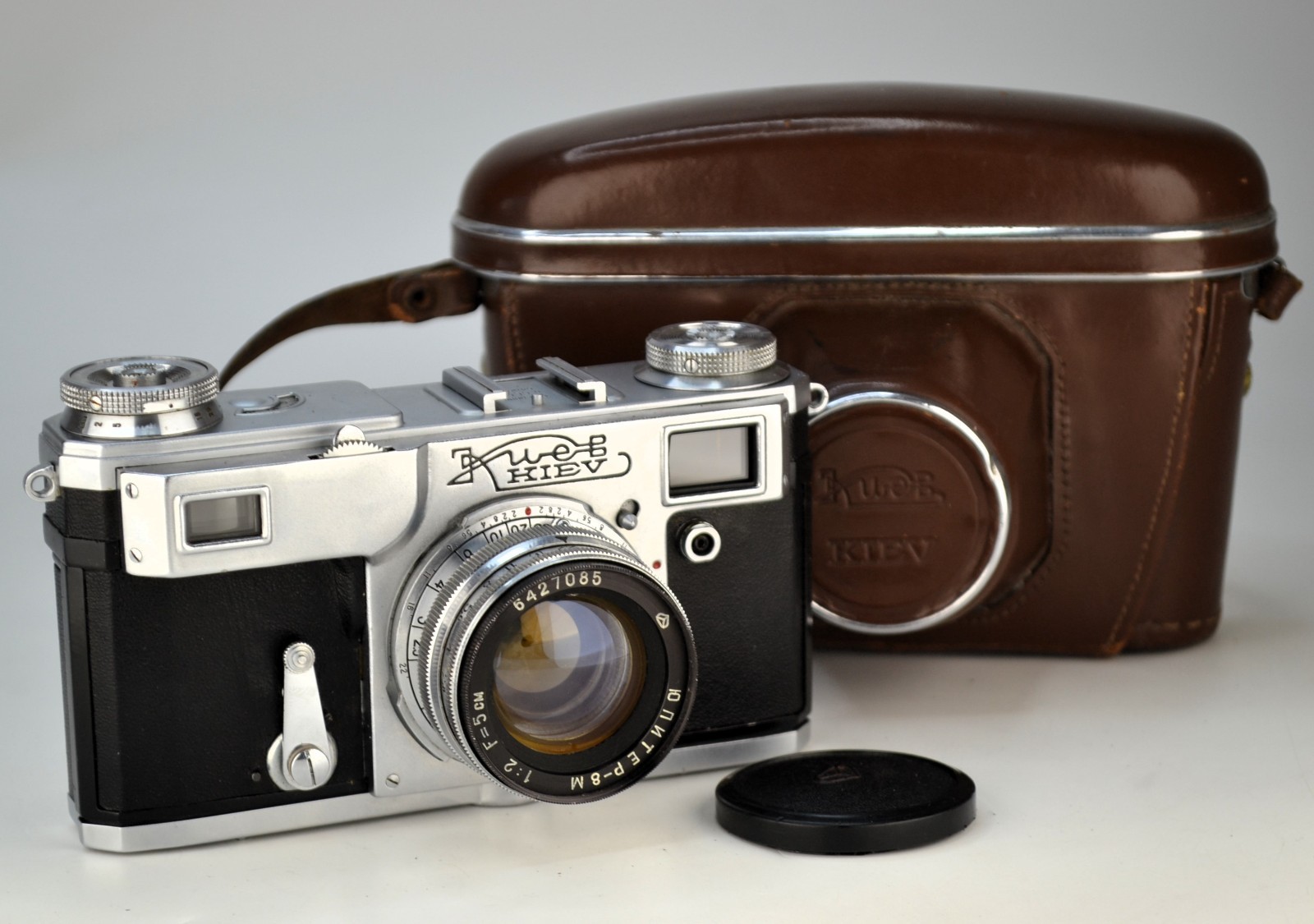
The Kiev 4M is a 35mm rangefinder camera produced by the Arsenal Factory in Kyiv, Ukraine (then part of the Soviet Union), from 1977 to 1985. As a modernized iteration of the long-running Kiev 4 series, the 4M introduced practical improvements such as a built-in hot shoe for flash synchronization and minor ergonomic refinements, while retaining the core mechanical design and lens mount compatibility of its predecessors.
Overview
The Kiev 4M represents the final major evolution of the Soviet-era Kiev rangefinder line, which traces its lineage back to the pre-World War II Contax II and postwar East German Zeiss Ikon designs. Manufactured at the Arsenal State Arsenal Plant in Kyiv, the 4M was developed during a period when Soviet camera engineering was increasingly diverging from its original German inspirations due to tooling limitations, material constraints, and shifting design priorities. The 4M was intended for both amateur and semi-professional photographers in the Eastern Bloc, offering manual control over exposure and a robust metal chassis with leatherette covering.
This model retained the distinctive top-mounted rangefinder window, central shutter speed dial, and interchangeable lens system via the M39 screw mount (with an integrated bayonet variant for specific lenses). The most visible update over the earlier Kiev 4A was the addition of a standard ISO 518 hot shoe on the pentaprism housing, enabling direct use of modern flash units without requiring a PC sync cable. Despite these updates, the camera remained fully mechanical, with a cloth focal-plane shutter and manual film advance via a lever on the upper right shoulder. The 4M continued to use the same 1:1 viewfinder with superimposed rangefinder patch and frame lines for 50mm and 85mm lenses, with parallax correction marks.
The Kiev 4M occupied a niche position in the Soviet camera hierarchy, positioned above the simpler Zorki and FED rangefinders but below the more advanced (and rare) Kiev 5. It was primarily marketed to photographers who required interchangeable lenses and precise focusing for portrait, street, and documentary work. While it lacked through-the-lens metering or aperture-priority automation found in contemporary Japanese rangefinders, its build quality—when properly assembled—could rival that of early Leica screw-mount models.
Specifications
| Specification | Value |
| Type | Rangefinder |
| Film Format | 35mm (135 cartridge) |
| Years Produced | 1977–1985 |
| Lens Mount | M39 screw mount (Leica Thread Mount compatible), with internal bayonet for Industar-50-2 and Helios-44-2 |
| Shutter | Vertically-traveling cloth focal-plane shutter; speeds 1–1/1000 sec, B, X-sync at 1/30 sec |
| Metering | None (uncoupled selenium cell light meter on top plate, model-dependent) |
| Exposure Modes | Manual only |
| Viewfinder | Combined optical viewfinder and rangefinder with 50mm/85mm frame lines, parallax correction |
| Dimensions | 150 × 85 × 55 mm; ~750 g (body only, no lens) |
Key Features
- Integrated ISO 518 hot shoe for direct flash attachment, a significant usability upgrade over earlier models reliant on PC sync cables.
- Mechanical focal-plane shutter with full speed range from 1 second to 1/1000 sec, allowing high-speed photography in bright conditions.
- Interchangeable M39 lenses, including native Soviet optics like the Jupiter-8, Jupiter-9, Industar-50, and Helios-44 series.
- Dual top-plate controls: shutter speed dial on the front, film rewind knob and accessory shoe on the rear, maintaining classic Contax-style layout.
- Selenium light meter (on some variants): self-powered meter with needle visible in the viewfinder, though not coupled to aperture or shutter—requiring manual transfer of readings.
Historical Context
The Kiev 4M was introduced in 1977 as a response to growing demand for modernized features in Soviet rangefinders, particularly improved flash compatibility. Its development occurred during a period of stagnation in Soviet consumer electronics, where innovation was limited by centralized planning and outdated manufacturing infrastructure. Despite these challenges, the 4M represented a modest but meaningful step forward from the Kiev 4 and 4A models, which had been in production since the 1960s.
In the global market, the 4M faced competition from Japanese rangefinders such as the Canon Canonet QL17 series, Minolta CLE, and Nikon SP (though the latter was already discontinued). However, due to limited export and inconsistent quality control, the Kiev 4M never achieved significant international recognition. Domestically, it was regarded as a premium camera, often reserved for state-employed photographers or available through specialized trade outlets (such as Beryozka stores for hard currency purchases). Production ceased around 1985, as Arsenal shifted focus toward the Kiev Automat and later medium format Salyut and 88 models.
Collectibility & Value
Today, the Kiev 4M is a sought-after model among collectors of Soviet and Eastern Bloc cameras, particularly those interested in Cold War-era technology or mechanical rangefinders. While not as rare as the Kiev 5 or early FED prototypes, well-functioning examples in good condition are increasingly difficult to find due to age-related deterioration and inconsistent original build quality. Prices for a working Kiev 4M typically range from $150 to $300 USD, depending on lens inclusion, cosmetic condition, and shutter accuracy.
When purchasing a Kiev 4M, buyers should inspect several critical areas: the shutter's consistency across all speeds (especially 1/1000 sec, which often fails due to weak springs), the rangefinder alignment (prone to misalignment from impact), and the condition of the leatherette and sealing around the film door. Light leaks are common in aged examples. Additionally, the selenium light meter, if present, is likely degraded and non-functional after decades of exposure, though it does not affect mechanical operation. Lubricant hardening and corrosion are frequent issues, necessitating professional CLA (clean, lubricate, adjust) service for reliable use.
Similar Cameras
- Leica M3 (1954–1966) – The gold standard for M39/Leica Thread Mount rangefinders; superior build and optics but significantly more expensive.
- FED 5 (1974–1994) – Soviet-made rangefinder based on Leica II design; simpler, fixed 50mm lens, lower cost.
- Zorki 4 (1956–1973) – Earlier Soviet Leica copy with M39 mount; less refined than the Kiev 4M but more widely exported.
- Canon Canonet QL17 G-III (1972–1982) – Japanese rangefinder with automatic exposure and high-quality 40mm f/1.7 lens; far more user-friendly.
- Nikon SP (1957–1962) – High-end Japanese rangefinder with interchangeable viewfinder and multiple frame lines; contemporary in spirit but vastly more advanced.
Repair & Maintenance
The Kiev 4M requires no batteries for mechanical operation, making it fully functional without power. However, the selenium-cell light meter (if equipped) operates without batteries but degrades over time due to oxidation, rendering it inaccurate or non-functional—replacement with a modern CdS meter is possible but requires modification. Common mechanical issues include sticky shutter curtains, inaccurate timing at high speeds, and misaligned rangefinder mechanisms due to chassis warping or impact. Repair difficulty is moderate to high due to tight internal tolerances and limited availability of spare parts outside Eastern Europe. Lubrication with modern synthetic oils is recommended during servicing to prevent gumming. Users are advised to store the camera with the shutter uncocked and the light meter shield closed (if present) to prolong longevity.
eBay Listings


As an eBay Partner, we earn from qualifying purchases. This helps support our independent vintage technology research.
Related Models
- Kiev 4 (1957–1979)
- Kiev 4A (1957–1980)
- Agfa Optima Sensor 1535
- Argus Argus A
- Argus Argus Autronic (1960)
- Argus Argus C-44R
- Argus Argus C
- Argus Argus C2
- Argus Argus C3 (1939-1966)
- Argus Argus C44R