KIEV 4A
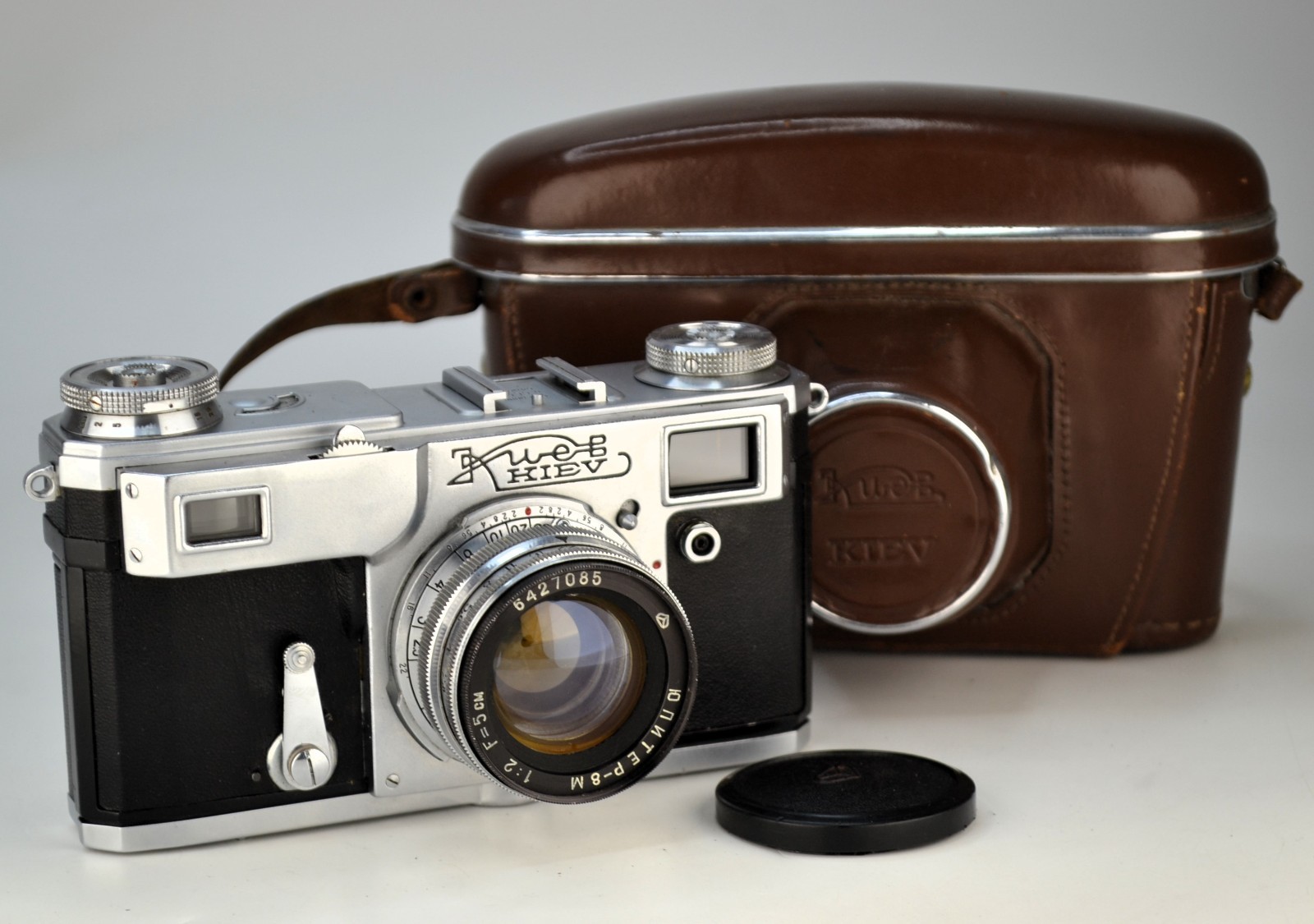
The Kiev 4A is a 35mm rangefinder camera produced by the Arsenal Factory in Kyiv, Ukraine (then part of the Soviet Union), serving as a simplified, meterless variant of the Kiev 4. Introduced in 1957 and manufactured until 1980, the 4A was designed for reliability and mechanical simplicity, making it a favorite among photographers seeking a robust rangefinder without the complexity or fragility of a built-in exposure meter.
Overview
The Kiev 4A emerged as a direct evolution of the Kiev 4, which itself was a Soviet adaptation of the pre-war Contax IIa design. However, unlike its predecessor, the Kiev 4A eliminated the selenium light meter system that had proven prone to failure and degradation over time. This removal significantly improved the camera’s long-term reliability and reduced production costs, making the 4A a more durable and accessible option for both amateur and professional photographers within the Eastern Bloc. The camera retained the full mechanical operation, focal-plane shutter, and rangefinder-coupled focusing system that defined its lineage.
Manufactured at the Arsenal State Plant in Kyiv, the Kiev 4A was part of a broader Soviet effort to produce high-quality optical and mechanical equipment based on captured German engineering principles. While not an exact copy, the Kiev 4A's design closely follows the Contax II/III architecture, featuring a top-mounted rangefinder patch, a combined viewfinder and rangefinder optical system, and a vertical-travel metal focal-plane shutter. The camera was marketed toward serious photographers who valued precision engineering and manual control, particularly in scientific, journalistic, and artistic fields where meterless operation was acceptable or even preferred.
Despite its mechanical sophistication, the Kiev 4A suffered from inconsistent quality control typical of Soviet-era mass production. Build quality could vary significantly between units, with some examples exhibiting excellent craftsmanship and others showing misalignments, rough shutter operation, or rangefinder inaccuracies. Nevertheless, the 4A remains one of the most mechanically advanced rangefinders ever produced in the Eastern Bloc and is considered the most refined model in the Kiev rangefinder series before the line transitioned to the fully meterless Kiev 4M and 4AM variants.
Specifications
| Specification | Value |
| Type | Rangefinder |
| Film Format | 35mm |
| Years Produced | 1957–1980 |
| Lens Mount | Contax rangefinder screw mount (M39×1) |
| Shutter | Vertical-travel metal focal-plane shutter, speeds 1–1/1000 sec, B, X-sync at 1/30 sec |
| Metering | None (meterless) |
| Exposure Modes | Manual only |
| Viewfinder | Combined optical viewfinder and coincident-image rangefinder |
| Dimensions | Approx. 150 × 85 × 55 mm; Weight: ~750 g (body only) |
Key Features
- Meterless design: Eliminates the unreliable selenium meter of the Kiev 4, improving long-term durability and reducing weight.
- High-speed shutter: Capable of 1/1000 sec, rare among screw-mount rangefinders and inherited from the Contax IIa design.
- Interchangeable lenses: Uses the M39 screw mount compatible with a range of Soviet and pre-war Zeiss lenses, including Helios-44, Jupiter-8, and Sonnar types.
- Flash synchronization: X and M contacts in the accessory shoe, with a PC sync socket and 1/30 sec flash sync speed.
- Self-timer and multiple exposure capability: Includes a mechanical self-timer and a frame counter that can be reset for multiple exposures.
Historical Context
The Kiev 4A was introduced in 1957 as a response to the shortcomings of the original Kiev 4, particularly the degradation of its selenium exposure meter, which could fail or become inaccurate over time due to age, moisture, or physical damage. By removing the meter, Arsenal simplified the top plate mechanism and improved reliability, resulting in a camera better suited for harsh environments and long-term use. The 4A was produced alongside the metered Kiev 4 for several years before eventually supplanting it in the lineup.
During the Cold War, the Kiev 4A served as one of the few domestically produced high-end rangefinders available in the USSR and Eastern Europe. It competed indirectly with Western models like the Leica M3 and Contax G series, though it was mechanically more akin to the pre-war Contax II/III. While lacking the compactness of Leica’s rangefinder design, the Kiev 4A offered superior shutter speeds and a robust build, appealing to photographers who prioritized mechanical performance over portability. Its production spanned over two decades, reflecting both its utility and the slow pace of technological change in Soviet manufacturing.
Collectibility & Value
Today, the Kiev 4A is sought after by collectors and film photographers interested in Soviet-era optics and mechanical engineering. Units in good working condition typically sell for $150–$300 USD, depending on shutter functionality, rangefinder alignment, and included accessories. Fully functional examples with clean viewfinders and accurate meterless operation are increasingly rare, as many cameras suffer from fogged or deteriorated rangefinder optics, stiff shutters, or light leaks from degraded foam seals.
When purchasing a Kiev 4A, buyers should carefully inspect the shutter across all speeds (especially 1/500 and 1/1000 sec, which may fail due to worn shutter curtains or timing issues), test the rangefinder alignment, and check for film advance smoothness. Common issues include misaligned film pressure plates, worn film sprockets, and sticky self-timer mechanisms. Due to the lack of electronics, the camera requires no batteries and can be used indefinitely with proper maintenance. However, repair parts are scarce, and specialized knowledge is often required for servicing, making functional examples more valuable than cosmetic ones.
Similar Cameras
- Contax IIa (1950–1961) – The German-designed predecessor that directly influenced the Kiev 4A’s layout and mechanics.
- Leica M3 (1954–1966) – The benchmark 35mm rangefinder of the era, offering superior ergonomics and lens quality.
- Zorki 4 (1956–1973) – A more basic Soviet rangefinder based on the Leica II, less advanced but more reliable.
- FED 2/3/4 series – Ukrainian-built Leica copies with similar screw-mount compatibility but simpler construction.
- Nikon I, M, S series (1948–1959) – Early Japanese rangefinders with Contax-inspired designs and high build quality.
Repair & Maintenance
The Kiev 4A requires no batteries and operates entirely mechanically, making it ideal for long-term use without dependency on electronic components. However, regular maintenance is essential due to age-related wear. Common problems include degraded light seals (leading to light leaks), stiff or inaccurate shutter speeds, and misaligned rangefinder optics. The metal focal-plane shutter is complex and sensitive to improper handling; attempting adjustment without proper tools often leads to damage.
Cleaning the viewfinder and rangefinder prism is frequently necessary, as internal haze or fungus can obscure the image. Replacement foam seals and focusing screens are available from specialty camera repair shops, though original parts are scarce. Due to the precision engineering involved, full servicing should be performed by technicians experienced with Contax-style mechanisms. Lubrication must be applied sparingly, as excess oil can attract dust and gum up the shutter mechanism over time. With proper care, a Kiev 4A can remain functional for decades, serving as a testament to mid-century mechanical design.
eBay Listings



As an eBay Partner, we earn from qualifying purchases. This helps support our independent vintage technology research.
Related Models
- Kiev 4 (1957–1979)
- Kiev 4M (1977-1985)
- Agfa Optima Sensor 1535
- Argus Argus A
- Argus Argus Autronic (1960)
- Argus Argus C-44R
- Argus Argus C
- Argus Argus C2
- Argus Argus C3 (1939-1966)
- Argus Argus C44R