Kiev 3A (c. 1950s)
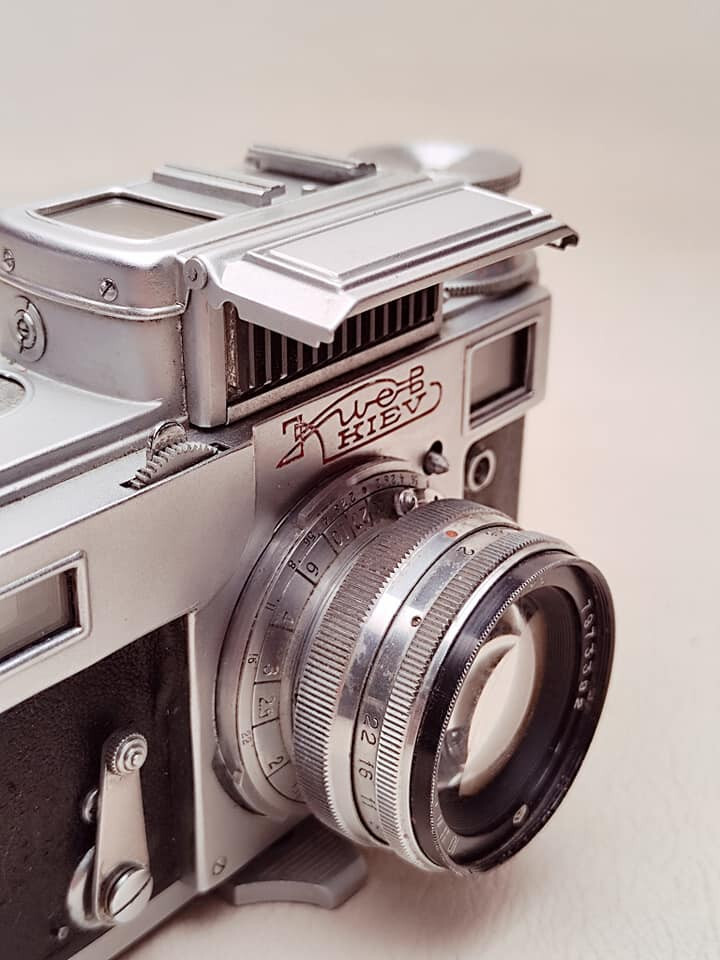
The Kiev 3A is a 35mm rangefinder camera from the Arsenal factory in Ukraine. It is one of the more direct Soviet descendants of the pre-war Zeiss Contax II. It uses the Contax/Kiev bayonet mount, so Contax-era lenses can be adapted. The body is die-cast metal with a chrome top plate. The standard lens is the collapsible Jupiter-8M 50mm f/2, which collectors generally praise for its sharpness.
It's fully manual - no meter, no automation. You get a coupled rangefinder with brightline frames in the combined viewfinder, a shutter with speeds from 1s to 1/1000s plus B, X-sync via a PC socket, a self-timer, and a single-stroke rapid wind lever. The rewind is a crank knob. Forum users report the Jupiter-8 is sharp and the rangefinder accurate. The finder is dim in low light.
Documentation on the 3A is thinner than on its siblings, and the record has gaps. Production years are given variously as 1953-1956 or 1956-1962, and no source settles it. Its place in the Kiev lineup is also muddled. Some sources place it below the Kiev 3 as a meterless variant with a simpler viewfinder, others call it essentially the same camera. What's clear is that it sits near the Kiev 4A, which adds a meter. No original price survives in the sources.
The usual Kiev-era caveats apply. The shutter can cap at high speeds after decades of storage. The rangefinder can fall out of alignment if someone's been inside. The Jupiter-8's cemented elements are prone to separation. A clean-lubricate-adjust is often needed. Prices have been creeping up. A clean user-grade example will typically run $150 - $350, with mint copies fetching $400 or more, per a 2023 collector forum discussion.
Known specs
- Lens: Jupiter-8M 50mm f/2, collapsible
- Mount: Contax/Kiev bayonet
- Shutter: 1s–1/1000s plus B, X-sync
- Viewfinder: Combined rangefinder/viewfinder, brightline frames
- Film: 35mm, 24×36mm frame; no built-in meter
- Extras: Self-timer, crank rewind, rapid wind lever
Beyond its listing in period equipment directories and a few collector discussions, almost nothing is recorded about the 3A's contemporary reception. Period classifieds in HiFI-Stereo (January 1991, p.131) show the broader electronics market of the era. The sources that exist are user manuals, repair guides, and forum posts.
eBay Listings



As an eBay Partner, we earn from qualifying purchases. This helps support our independent vintage technology research.