IHAGEE EXA IIA
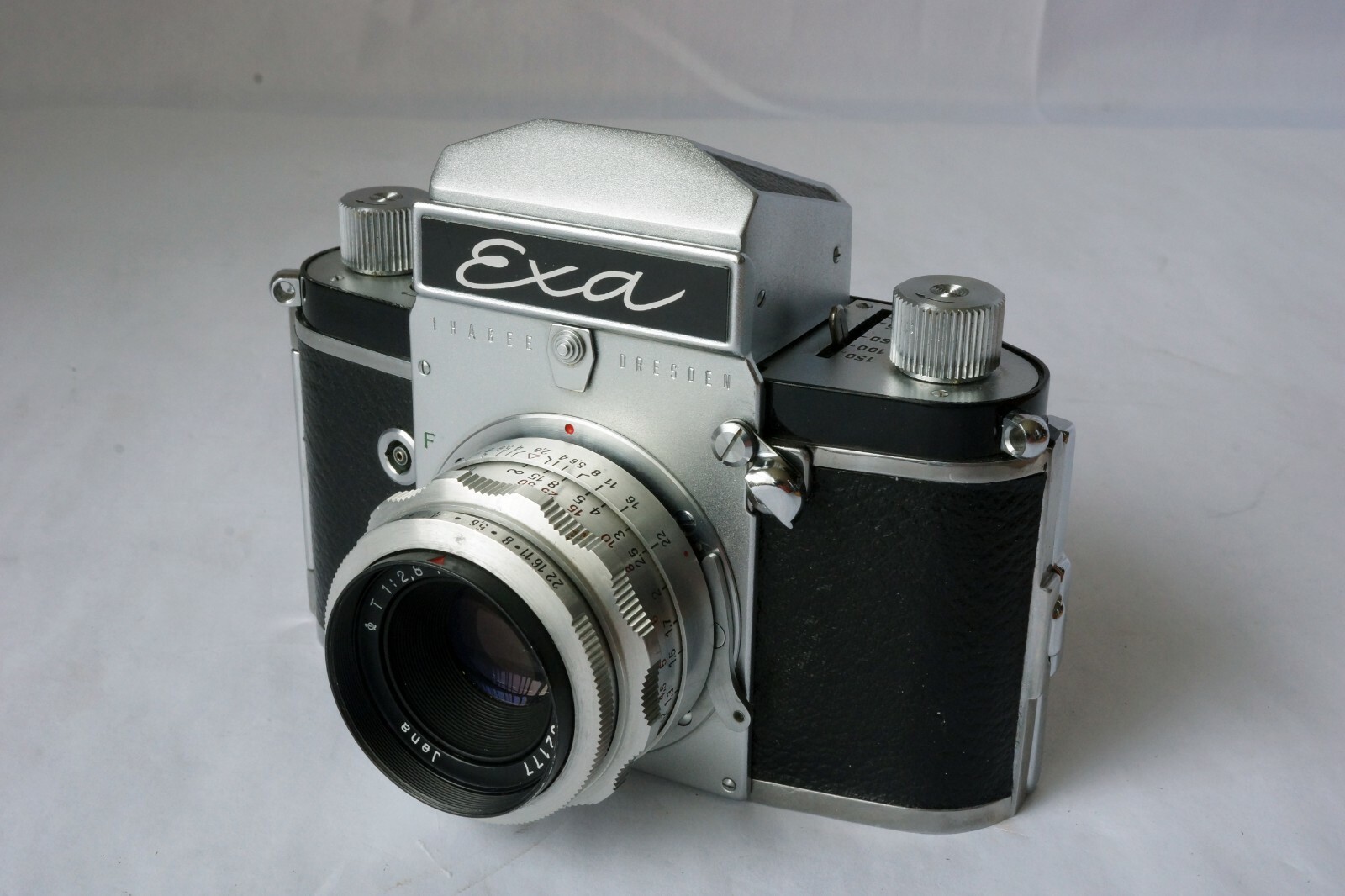
The Ihagee Exa IIa is a 35mm single-lens reflex (SLR) camera produced by the East German manufacturer Ihagee in Dresden, with production beginning in late 1962 and continuing into 1963. It represents a minor but meaningful update to the Exa II model, incorporating refinements in shutter mechanism and viewfinder usability, positioning it as a transitional model in Ihagee’s SLR evolution during the early 1960s.
Overview
The Exa IIa was introduced at a pivotal moment in the development of 35mm SLR cameras, as manufacturers across Europe and Japan began standardizing features such as instant-return mirrors, through-the-lens metering, and interchangeable pentaprisms. Ihagee, historically known for pioneering the first 35mm SLR (the Kine Exakta in 1936), continued its legacy with the Exa series—compact, robust, and engineered for practicality. The Exa IIa was designed as an incremental improvement over the Exa II (1959–1963), primarily addressing user feedback on shutter reliability and viewfinder brightness.
Manufactured in East Germany during a period of increasing economic and political constraints under the GDR regime, the Exa IIa reflects both technical competence and material limitations. It retained the core mechanical design of its predecessors: a focal-plane shutter, fixed non-interchangeable pentaprism, and compatibility with the M42 screw mount (also known as the Universal or Pentax thread mount). The camera was marketed toward advanced amateurs and photojournalists seeking a durable, no-frills SLR with manual control over exposure parameters.
Positioned between the earlier Exa II and the later Exa 500/5000 series, the Exa IIa served as a short-lived but technically significant bridge. Its production spanned only about 18 months, ending in 1964 when Ihagee was absorbed into the state-owned Pentacon conglomerate, which consolidated several East German camera brands under one umbrella. As such, the Exa IIa stands as one of the final independently developed Ihagee SLRs before the Pentacon name became dominant in the region’s photographic output.
Specifications
| Specification | Value |
| Type | 35mm Single-Lens Reflex (SLR) |
| Film Format | 35mm (135 film), 24x36mm frame size |
| Years Produced | 1963–1964 |
| Lens Mount | M42 × 1mm screw mount (Universal/Pentax thread) |
| Shutter | Cloth focal-plane shutter, speeds from 1 sec to 1/1000 sec + B |
| Shutter Speeds | 1, 1/2, 1/4, 1/8, 1/15, 1/30, 1/60, 1/125, 1/250, 1/500 sec, B |
| Sync Speed | 1/60 sec |
| Metering | None (uncoupled meter required) |
| Exposure Modes | Manual only |
| Viewfinder | Fixed pentaprism with ground-glass focusing screen, central split-image rangefinder spot |
| Focusing Screen | Ground glass with central split-image prism for manual focus |
| Film Advance | Lever wind (single stroke, approx. 130° arc), frame counter automatic reset |
| Frame Counter | Counts up from 1, resets when back opened |
| Flash Sync | PC terminal and X-sync via hot shoe |
| Hot Shoe | Yes, accessory shoe (center contact may vary by unit; not all models guaranteed) |
| Self-Timer | Yes, mechanical self-timer with lever on front |
| Dimensions | Approx. 138mm (W) × 84mm (H) × 50mm (D) |
| Weight | Approx. 650g (body only, no battery) |
Key Features
- High-speed focal-plane shutter: Capable of 1/1000 sec, rare among contemporary SLRs and a hallmark of Ihagee’s engineering.
- M42 screw mount compatibility: Enabled use with a vast array of lenses from Zeiss, Meyer, Schneider, and later Japanese manufacturers.
- Improved shutter mechanism: Refined from the Exa II, offering more consistent timing and reduced vibration.
- Fixed pentaprism with split-image focusing: Provided accurate manual focusing, a significant advantage over waist-level finders.
- Compact, all-metal body: Durable construction with ergonomic wind lever and shutter release placement.
Historical Context
The Exa IIa was released during a period of rapid innovation in SLR design. By the early 1960s, Japanese manufacturers like Nikon (with the F-series) and Canon were introducing modular SLRs with interchangeable viewfinders, motor drives, and TTL metering—features absent from the Exa IIa. In contrast, the Exa IIa remained a purely mechanical, manual camera, emphasizing reliability and simplicity over automation. Its design philosophy aligned more closely with earlier European SLRs than with the emerging generation of system cameras.
Despite its conservative approach, the Exa IIa competed in a growing global market for affordable yet capable SLRs. It was positioned below premium models like the Praktina FX or Exakta VX but offered better build quality than budget offerings from VEB Wirgin or Reflecta. Its primary competitors in the mid-range segment included the Praktica FX2 and the Zeiss Ikon SL72, both also M42-mount cameras. However, Ihagee’s brand recognition—rooted in its Exakta heritage—gave the Exa IIa a niche appeal among photographers familiar with the lineage.
Production ceased in 1964 when Ihagee was formally merged into VEB Pentacon Dresden, marking the end of the Ihagee brand as an independent entity. The Exa IIa’s brief production run and historical timing make it a symbol of the transition from pre-war German optical excellence to the state-controlled industrial model of East German manufacturing.
Collectibility & Value
The Ihagee Exa IIa is a moderately rare camera today, with surviving examples often found in Europe, particularly in former Eastern Bloc countries. Due to its short production period and the political upheaval that followed, original, fully functional units in good condition are increasingly scarce. Collectors value the Exa IIa for its historical significance as one of the last true Ihagee designs before Pentacon assimilation.
Current market value ranges from €150 to €300 for working models, with higher prices commanded by cameras with clean viewfinders, smooth shutter operation, and original finish. Key points to inspect when purchasing include shutter accuracy (especially at high speeds), mirror movement smoothness, and the condition of the split-image focusing screen, which can become cloudy or delaminate over time. The leatherette and film pressure plate may also show signs of age.
Common issues include stiff wind levers, shutter curtain fraying, and light seals degradation. As the camera is fully mechanical, it does not rely on batteries, but the PC sync terminal and hot shoe should be tested for electrical continuity. Replacement parts are limited, though some components are interchangeable with other Exa and Praktica models.
Similar Cameras
- Praktica FX2 (1963–1965) – East German M42 SLR with similar shutter speeds and build quality.
- Zeiss Ikon SL72 (1961–1966) – High-quality West German SLR with M42 mount and advanced ergonomics.
- Konica Auto-Reflex (1965) – Japanese SLR introducing aperture-priority automation, representing the next evolution.
- Exakta VX500 (1962) – Later Exakta model with improved ergonomics and flash sync.
- Fujica ST 705 (1964) – Japanese M42 camera emphasizing precision engineering and compact design.
Repair & Maintenance
The Exa IIa requires no batteries and operates entirely mechanically, making it reliable in long-term storage. However, regular maintenance is recommended for consistent performance. Shutter speeds should be tested with a timing meter, particularly 1/500 and 1/1000 sec, where cloth shutters are prone to timing inaccuracies due to spring fatigue. The wind mechanism and mirror linkage benefit from light lubrication during servicing.
Common repair challenges include sourcing replacement shutter curtains and split-image screens, which are no longer manufactured. Skilled technicians familiar with vintage M42 SLRs can often refurbish or adapt components. Cleaning the viewfinder optics and replacing deteriorated light seals are essential for preserving image quality and preventing light leaks. Given the camera’s collectible status, non-original modifications should be avoided to maintain value.
eBay Listings



As an eBay Partner, we earn from qualifying purchases. This helps support our independent vintage technology research.
Related Models
- Ihagee Exa 1a (1964-1977)
- Ihagee Exa 1b (1977-1985)
- Ihagee Exa 1c (1985–1987)
- Ihagee Exa 500 (1966–1969)
- Ihagee Exa I (1963-1964)
- Alpa 6 (1948-1953)
- Agfa Agfaflex
- Agfa Ambiflex
- Agfa Easy
- Agfa Futura Af zoom