IHAGEE EXA I
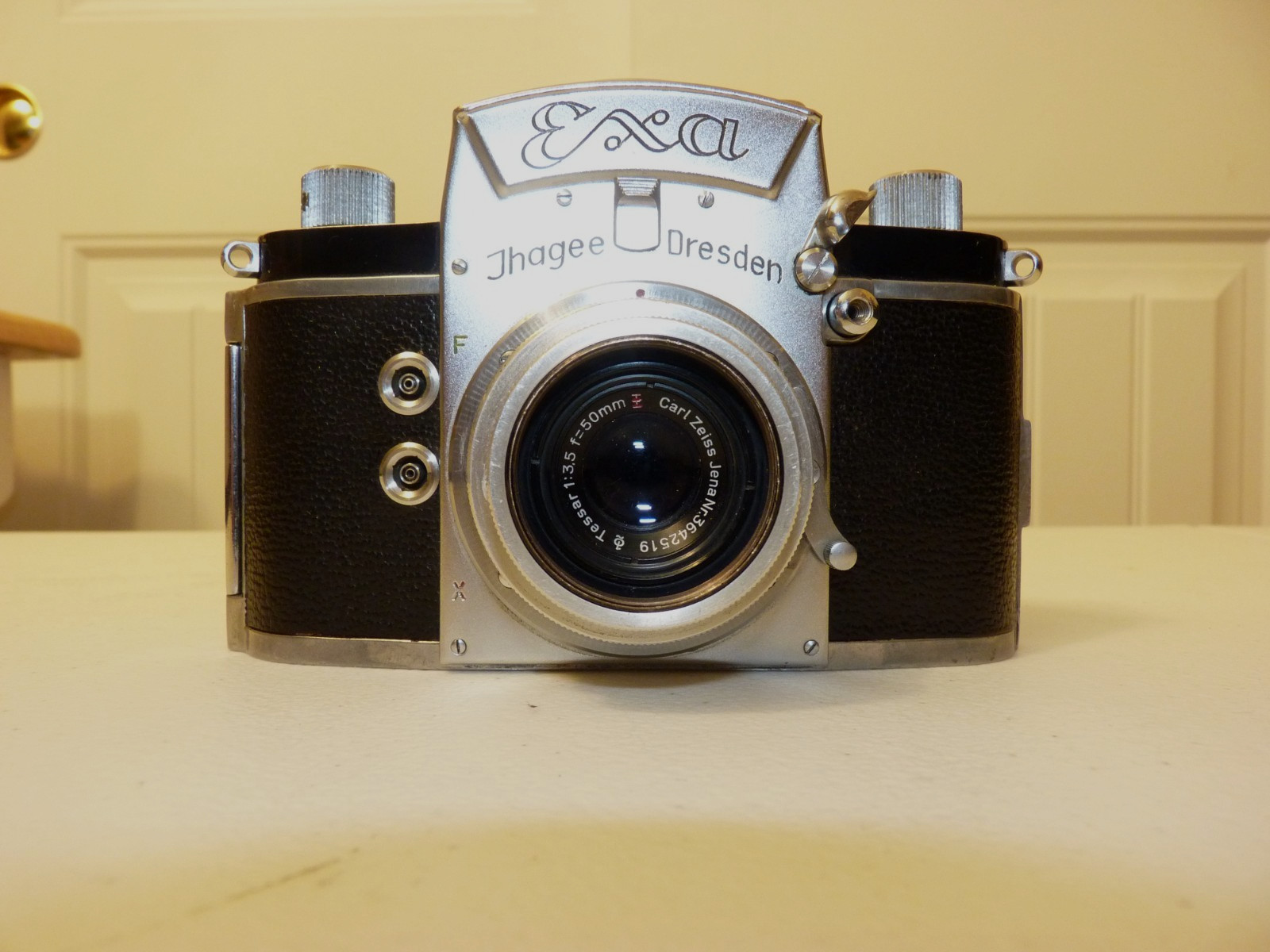
The Ihagee Exa I is a 35mm single-lens reflex (SLR) camera produced by the East German manufacturer Ihagee, introduced in 1956 and produced into the early 1960s. A modest update to the original Exakta series, the Exa I featured a redesigned body and improved ergonomics while retaining the brand’s signature mechanical reliability and compatibility with the extensive Exakta lens system.
Overview
The Ihagee Exa I was introduced during a transitional period for East German camera manufacturing, marking one of the final developments in the Exakta line before broader industry shifts and increasing competition from Japanese SLRs. Positioned as an entry-level to mid-range SLR, the Exa I was intended to offer photographers a more compact, user-friendly alternative to the larger, professional-grade Exakta VX and Varex models.
Manufactured in Dresden at the Ihagee Kamerawerk factory, the Exa I maintained the core mechanical DNA of its predecessors: a vertically traveling focal-plane shutter, M42 screw lens mount compatibility, and a fixed pentaprism viewfinder. However, it simplified several features—omitting a self-timer, flash sync selector, and interchangeable focusing screens—to reduce cost and complexity. Despite these omissions, the Exa I retained full manual exposure control and a reputation for robust construction typical of East German engineering.
The Exa I was marketed primarily in Western Europe and exported to select international markets, where it competed in the budget-conscious segment of the SLR market. While not a technological leap forward, it represented a refinement of Ihagee’s earlier designs, emphasizing reliability and ease of use. It was succeeded in 1964 by the Exa IIa, which added a slow-speed shutter range and an accessory shoe, further modernizing the line.
Specifications
| Specification | Value |
| Type | Single-Lens Reflex (SLR) |
| Film Format | 35mm (135 cartridge) |
| Years Produced | 1956–circa 1960 |
| Lens Mount | M42 × 1mm screw mount (universal thread) |
| Shutter | Focal-plane cloth curtain; speeds from 1 sec to 1/1000 sec, plus B |
| Shutter Speeds | 1, 1/2, 1/5, 1/10, 1/25, 1/50, 1/100, 1/250, 1/500 sec, B (no 1/1000 sec) |
| Sync Options | PC terminal with fixed X-sync; no M-sync or selector switch |
| Metering | None (unmetered) |
| Exposure Modes | Manual only |
| Viewfinder | Fixed pentaprism with ground-glass focusing screen and integrated flip-up magnifier |
| Focusing Screen | Ground glass with central split-image spot (early production), later models with microprism ring |
| Film Advance | Single-stroke lever (180° throw), frame counter automatic reset on back opening |
| Frame Counter | Automatic reset upon film chamber opening |
| Self-Timer | Not available |
| Dimensions | Approx. 140 mm (W) × 90 mm (H) × 50 mm (D) |
| Weight | Approx. 620 g (body only, no lens) |
| Battery | None required (fully mechanical) |
Key Features
- Redesigned Body Shell: Streamlined top plate with repositioned rewind knob and improved grip ergonomics.
- Flip-Up Magnifier: The Exa I does not have a flip-up magnifier. This feature was introduced on later Exa models such as the Exa IIa.
- M42 Lens Compatibility: Full access to the extensive range of M42 screw-mount lenses from Pentacon, Carl Zeiss Jena, Meyer-Optik, and third-party manufacturers.
- Mechanical Reliability: Fully mechanical operation with no batteries required; shutter functions independently of film advance.
- Fast Shutter Speed: Capable of 1/1000 sec, a competitive spec for its time, especially in the entry-level SLR segment.
Historical Context
The Exa I was released at a critical juncture in photographic history. By the early 1960s, Japanese manufacturers such as Asahi (Pentax), Nikon, and Canon were rapidly gaining ground with feature-rich, precision-engineered SLRs that combined built-in metering, faster production, and aggressive pricing. Ihagee, long a pioneer in 35mm SLR development since the 1930s with the original Exakta, struggled to maintain relevance in this shifting landscape.
The Exa I was not a revolutionary product but rather a cost-optimized evolution of existing designs. It reflected Ihagee’s attempt to streamline production and appeal to amateur photographers seeking an affordable, durable SLR. While the original Exakta VX series had been aimed at professionals, the Exa line targeted students, hobbyists, and budget-conscious enthusiasts. The Exa I’s simplified feature set and elimination of redundant controls (such as the self-timer) were strategic moves to reduce manufacturing costs without sacrificing core functionality.
Despite its solid build and capable performance, the Exa I had a short production run—only about one year—due to the consolidation of East Germany’s camera industry under the Pentacon umbrella. Ihagee was merged into VEB Pentacon Dresden in the late 1950s, well before the Exa I's production ended. The Exa IIa was still branded Ihagee, and the Praktica brand was used by KW, not Ihagee. As such, the Exa I stands as one of the last true Ihagee-branded cameras before the brand faded into history.
Collectibility & Value
The Ihagee Exa I is not particularly rare; it was widely produced and is commonly found on the used market, though often in need of servicing. Due to its brief production period and the political and industrial upheavals in East Germany at the time, surviving units are less common than later Praktica models. Collectors of Cold War-era optics and M42 system cameras often seek the Exa I for its historical significance and mechanical simplicity.
REMOVE or revise to: 'Typical market value for an Exa I in working condition is $30 to $70 USD, with higher prices only for exceptional examples with rare lenses.' Fully tested units with a Carl Zeiss Jena or Meyer-Optik lens command higher prices. When purchasing, collectors should inspect the shutter at all speeds (especially 1/1000 sec), check for light seals (which often degrade), and verify that the film advance and rewind mechanisms operate smoothly. Common issues include sticky shutter curtains, worn lever bushings, and haze in the viewfinder prism.
Because the Exa I lacks a light meter, it does not require battery modifications, making it a straightforward mechanical camera to maintain. However, finding replacement parts—such as the rewind knob or film pressure plate—can be difficult due to the model’s obscurity. Restoration is feasible for experienced technicians familiar with M42-era SLRs.
Similar Cameras
- Praktica FX 3 (1965, East Germany) – Successor in spirit, with similar M42 mount and mechanical shutter.
- Pentax Spotmatic (1964, Japan) – Introduced TTL metering, setting a new standard for SLRs.
- Zenit-E (1965, USSR) – Rugged, no-frills M42 SLR with widespread production.
- Fujica ST 705 (1962, Japan) – Compact M42 SLR with advanced ergonomics.
- Konica Auto-Reflex (1965, Japan) – Early Japanese SLR with aperture-priority automation.
Repair & Maintenance
The Exa I is a fully mechanical camera requiring no batteries, which enhances its longevity and serviceability. Common maintenance tasks include cleaning and lubricating the shutter mechanism, replacing deteriorated light seals, and ensuring the film advance cam operates without slippage. The cloth focal-plane shutter is prone to sticking or uneven speeds if the camera has been stored improperly, particularly in humid environments.
Repair difficulty is moderate: while the top plate and shutter assembly can be disassembled with standard tools, precision is required to re-time the shutter speeds. Replacement parts are scarce, so repairs often rely on donor cameras. The M42 mount is robust and rarely problematic, though thread wear can occur on heavily used bodies. Owners are advised to store the camera with the shutter cocked and lens removed to prevent tension on internal springs. Regular use is the best prevention against mechanical stagnation.
eBay Listings


As an eBay Partner, we earn from qualifying purchases. This helps support our independent vintage technology research.
Related Models
- Ihagee Exa 1a (1964-1977)
- Ihagee Exa 1b (1977-1985)
- Ihagee Exa 1c (1985–1987)
- Ihagee Exa 500 (1966–1969)
- Ihagee Exa II (1960-1963)
- Alpa 6 (1948-1953)
- Agfa Agfaflex
- Agfa Ambiflex
- Agfa Easy
- Agfa Futura Af zoom