IHAGEE EXA 500
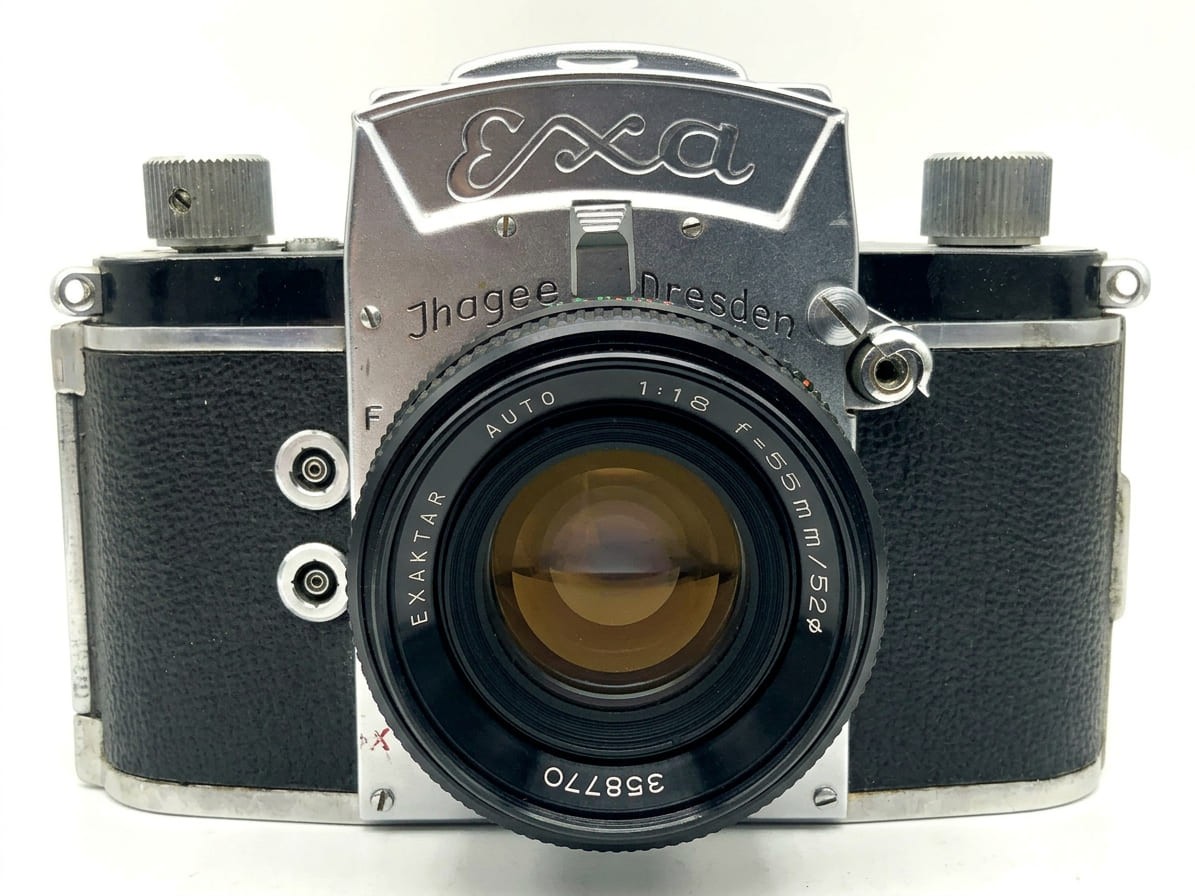
The Ihagee Exa 500 is a 35mm single-lens reflex (SLR) camera produced under the Ihagee name by VEB Pentacon Dresden between 1966 and 1968. Designed as a mid-tier mechanical SLR, it features a maximum shutter speed of 1/500 second and a hinged film back, offering improved loading convenience over earlier Exa models. It represents one of the final developments in the Exa series before Ihagee’s absorption into Pentacon.
Overview
Introduced in 1966, the Ihagee Exa 500 was developed during a period of consolidation within the East German optical industry under the Pentacon umbrella. It succeeded earlier Exa models such as the Exa 50 and Exa 1a, refining their design with a faster shutter mechanism and updated body construction. Marketed toward amateur and semi-professional photographers, the Exa 500 combined mechanical reliability with straightforward manual controls, positioning itself as a robust and affordable SLR in the competitive postwar European camera market.
The Exa 500 retained the core design philosophy of its predecessors: simplicity, durability, and compatibility with the Exakta bayonet mount, which had been a hallmark of Ihagee’s SLRs since the 1930s. Unlike later Pentacon models that adopted the M42 screw mount, the Exa 500 maintained the older Exakta standard (also known as the "DKL" bayonet in some variants, though not applicable here), ensuring continuity for users with existing Exakta-mount lenses. The camera featured a fixed pentaprism viewfinder with a ground-glass focusing screen; split-image focusing aids were not standard and may have been available only on later production runs or as replacements, facilitating accurate manual focusing.
One of the Exa 500’s distinguishing features was its hinged rear door, which opened downward via a latch on the left side of the body—unlike earlier Exa models that required complete back removal for film loading. This improvement simplified reloading and reduced the risk of dust entering the film chamber. The camera was constructed primarily of metal with a black enamel or black wrinkle-finish body, typical of Eastern Bloc camera manufacturing of the era. Despite its modest feature set, the Exa 500 was well-regarded for its solid build and precise mechanical operation.
Specifications
| Specification | Value |
| Type | 35mm Single-Lens Reflex (SLR) |
| Film Format | 35mm (135 cartridge) |
| Years Produced | 1966–1969 |
| Lens Mount | Exakta Bayonet (Standard, also known as Exakta VX) |
| Shutter | Cloth focal-plane shutter; speeds 1 sec to 1/500 sec, plus B |
| Shutter Speeds | 1, 1/2, 1/4, 1/8, 1/15, 1/30, 1/60, 1/125, 1/250, 1/500 sec, B |
| Sync | PC flash sync; single contact in accessory shoe (no dedicated X/M switch) |
| Metering | None (unmetered) |
| Exposure Modes | Manual only |
| Viewfinder | Fixed pentaprism with ground-glass screen and central split-image rangefinder |
| Focusing Screen | Ground glass with central split-image prism |
| Viewfinder Coverage | Approx. 95% |
| Viewfinder Magnification | Approx. 0.78x (with 50mm lens at infinity) |
| Lens Compatibility | All Exakta bayonet-mount lenses (VX type) |
| Film Advance | Single-stroke lever (90° throw), lever located on top right |
| Frame Counter | Automatic reset; counts up from 1 |
| Self-Timer | No |
| Battery | None required (fully mechanical) |
| Dimensions | Approx. 140 mm (W) × 90 mm (H) × 50 mm (D) |
| Weight | Approx. 620 g (body only) |
Key Features
- 1/500 sec shutter speed: One of the faster mechanical shutter speeds available in its class at the time, enabling sharper handheld photography in bright conditions.
- Hinged film back: Simplified film loading compared to earlier Exa models that required complete back removal.
- Exakta bayonet mount: Compatible with a wide range of high-quality East German lenses, including Carl Zeiss Jena and Meyer-Optik designs.
- Fully mechanical operation: No batteries required; reliable in diverse environmental conditions.
- Split-image focusing aid: Integrated into the focusing screen for improved manual focus accuracy.
Historical Context
The Exa 500 was released during a transitional phase for Ihagee, which by the mid-1960s had become part of the VEB Pentacon conglomerate in Dresden, East Germany. As Western manufacturers like Nikon, Canon, and Pentax advanced into electronic metering and faster production cycles, Eastern Bloc producers focused on refining proven mechanical designs. The Exa 500 continued this design philosophy, offering mechanical refinement over earlier Exa models.
It competed indirectly with cameras such as the Praktica FX series (also Exakta-mount) and the Soviet Zenit-E, though it lacked their widespread export presence. In Western markets, the Exa 500 was overshadowed by Japanese SLRs like the Pentax Spotmatic and Nikon F, which offered through-the-lens metering and broader lens ecosystems. Nevertheless, within the Eastern Bloc and among budget-conscious photographers in Western Europe, the Exa 500 was valued for its durability and compatibility with high-performance Carl Zeiss Jena lenses.
Collectibility & Value
Today, the Ihagee Exa 500 is a niche collectible, appreciated by enthusiasts of Cold War-era optics and mechanical SLRs. It is moderately rare outside of Germany, with well-preserved examples typically sell for €100–€200 in the collector market, depending on condition and included accessories. Fully functional units with clean viewfinders and smooth shutter operation are preferred, as aging cloth shutters and lubricants can degrade over time.
When purchasing an Exa 500, collectors should inspect the shutter at all speeds (particularly 1/500 and 1 sec) for consistency, check for mirror slap noise, and verify that the film advance and rewind mechanisms operate smoothly. The hinged back should seal tightly; worn hinges or damaged light seals can compromise film integrity. Original leather cases and manuals increase value. Due to its all-mechanical design, the Exa 500 remains usable with modern 35mm film, making it a functional vintage camera rather than merely a display piece.
Similar Cameras
- Praktica FX 2 (1966) – West German SLR with similar Exakta mount and mechanical shutter, but with later models offering metering.
- Zenit-E (1965) – Soviet 35mm SLR with M42 mount, fully mechanical, widely exported and extremely durable.
- Fujica ST 601 (1968) – Japanese SLR with CdS metering, M42 mount, representing the next generation of user-friendly SLRs.
- Konica Autoreflex (1965) – Japanese SLR with open-aperture metering, competing in the same amateur market segment.
- Topcon RE Super (1963) – Professional-grade Japanese SLR with excellent optics and build, though significantly more advanced and expensive.
Repair & Maintenance
The Exa 500 requires no batteries and is entirely mechanical, making it reliable and long-lasting when properly maintained. Common issues include sticky shutter curtains (especially at intermediate speeds), worn light seals around the hinged back, and dried lubricants in the film transport mechanism. The cloth focal-plane shutter is susceptible to pinholes or tears if mishandled or stored improperly. Lubrication of the mirror and shutter linkage may be necessary after decades of inactivity.
Repair parts are limited but can sometimes be sourced from donor Exa bodies or Praktica models with similar mechanisms. Due to the age and regional specificity of the camera, specialized repair knowledge is recommended. Routine maintenance should include cleaning the viewfinder and focusing screen, replacing light seals, and checking film pressure plate alignment. When stored, the camera should have the shutter released and the film advance disengaged to reduce spring tension.
eBay Listings



As an eBay Partner, we earn from qualifying purchases. This helps support our independent vintage technology research.
Related Models
- Ihagee Exa 1a (1964-1977)
- Ihagee Exa 1b (1977-1985)
- Ihagee Exa 1c (1985–1987)
- Ihagee Exa I (1963-1964)
- Ihagee Exa II (1960-1963)
- Alpa 6 (1948-1953)
- Agfa Agfaflex
- Agfa Ambiflex
- Agfa Easy
- Agfa Futura Af zoom