IHAGEE EXA 1C
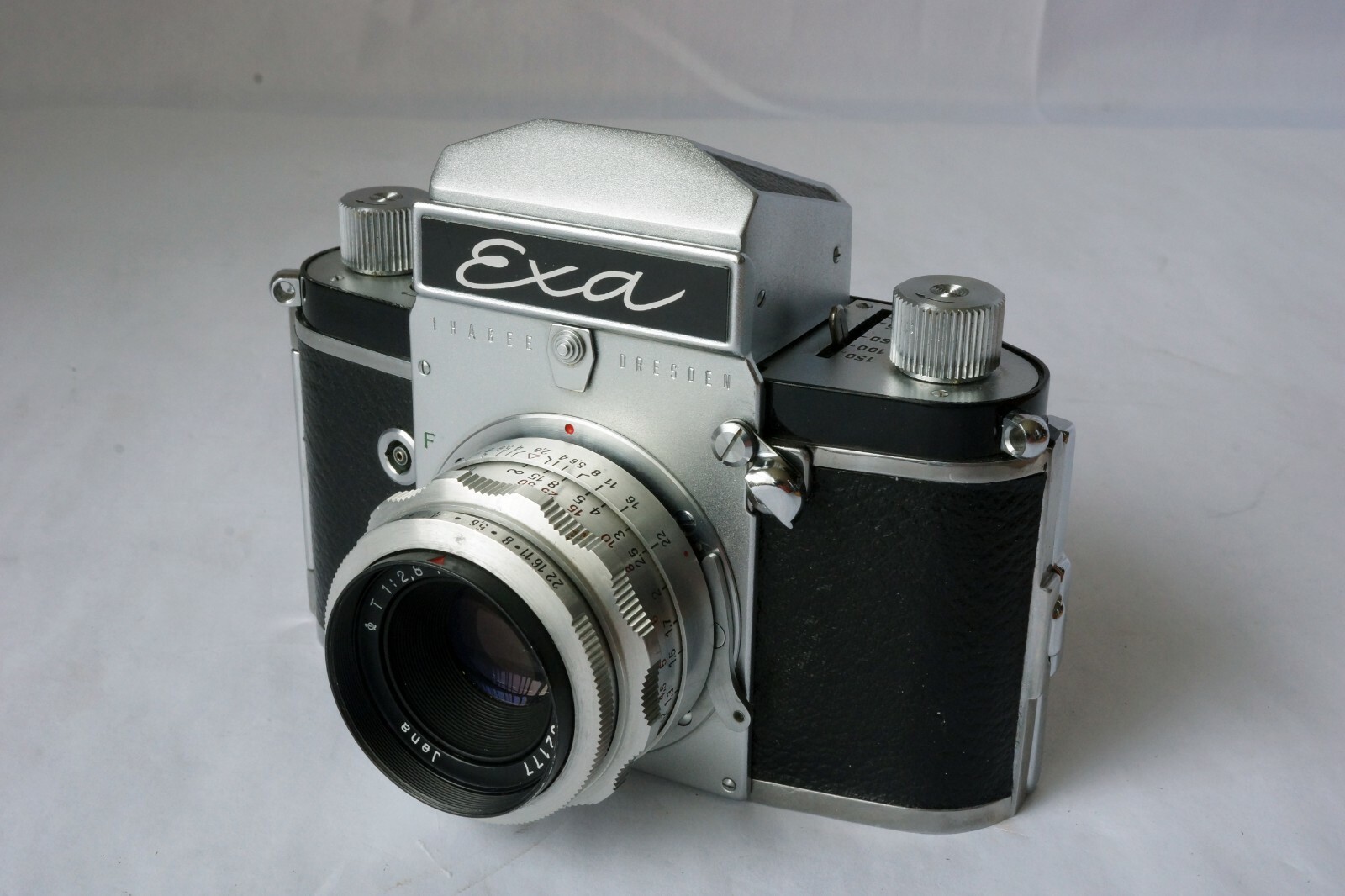
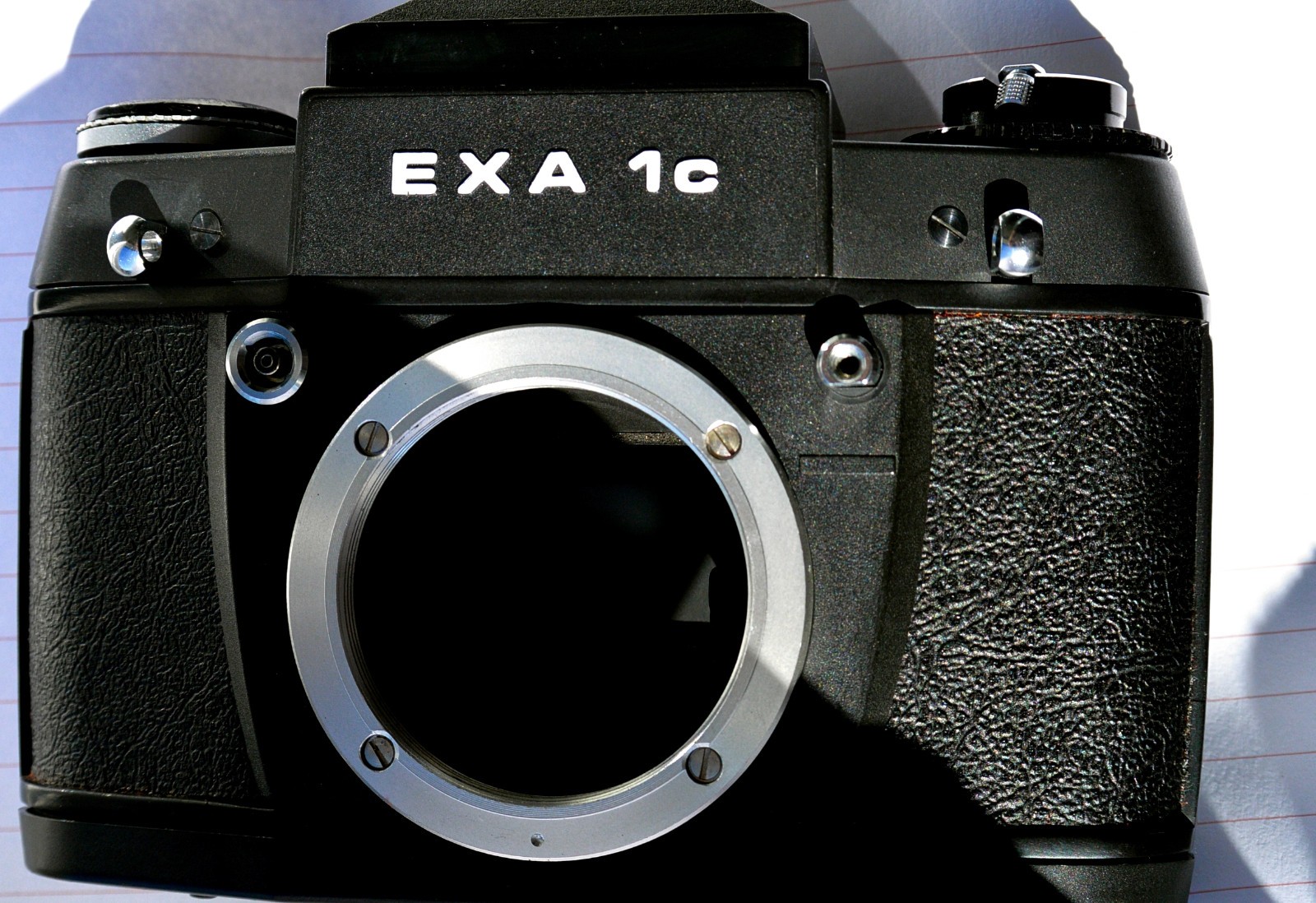
The Ihagee Exa 1c is the final evolution of the Exa series of 35mm single-lens reflex (SLR) cameras produced under the Ihagee name, marking the end of a lineage that originated in post-war East Germany.
Overview
The Ihagee Exa 1c was introduced as the last model in the Exa line, a series that began in the early 1950s with the original Exakta cameras and evolved through numerous variants under the Exa name starting in the 1960s. Designed as an affordable, fully mechanical 35mm SLR, the Exa 1c targeted amateur photographers and students seeking reliable, durable equipment without the complexity or cost of electronic systems. It was produced during the final years of East German camera manufacturing before the political and economic shifts of the late 1980s led to the dissolution of state-owned photographic enterprises.
It features a vertical-travel focal-plane shutter, M42 screw-mount lens compatibility, and through-the-lens (TTL) metering using a cadmium sulfide (CdS) cell. Unlike many of its contemporaries from Japan, the Exa 1c retains a fully mechanical shutter operation at all speeds, allowing functionality even without battery power—except for metering.
The Ihagee brand, once a pioneer in 35mm SLR design with the Exakta series in the 1930s–1950s, was phased out by the late 1960s as Pentacon consolidated East German camera production under its own name. While the original Ihagee company of Dresden was renowned in the 1930s and 1940s for pioneering 35mm SLR design (notably the Exakta VX), by the 1980s the brand had been fully absorbed into the East German conglomerate VEB Pentacon. The Exa 1c was thus not a standalone innovation but rather a rebranded and slightly refined iteration of existing Praktica technology, marketed under the nostalgic Ihagee name for export and domestic use. Its production ceased around 1987, preceding the fall of the Berlin Wall and the eventual privatization and closure of Pentacon’s camera operations.
Specifications
| Specification | Value |
| Type | 35mm Single-Lens Reflex (SLR) |
| Film Format | 35mm (135 cartridge) |
| Years Produced | |
| Lens Mount | M42 × 1mm screw mount (Pentax thread) |
| Shutter | Focal-plane, vertical-travel metal blades; speeds 1–1/1000 sec, B |
| Shutter Speeds | 1, 1/2, 1/4, 1/8, 1/15, 1/30, 1/60, 1/125, 1/250, 1/500, 1/1000 sec, Bulb (B) |
| Metering | |
| Exposure Modes | Manual only; metering requires battery |
| Viewfinder | Fixed pentaprism, eye-level, with split-image rangefinder and microprism collar |
| Film Advance | Manual lever (90° throw), single stroke |
| Frame Counter | Automatic reset; counts up from 1 |
| Flash Sync | X-sync via PC terminal and hot shoe; 1/30 sec sync speed |
| Battery | 1 × PX625 (1.35V mercury) or 1.5V alkaline equivalent (e.g., Wein Cell) |
| Dimensions | Approx. 140 mm (W) × 90 mm (H) × 50 mm (D) |
| Weight | Approx. 580 g (body only, no battery or lens) |
Key Features
- Fully mechanical shutter up to 1/1000 sec ensures reliable operation without batteries.
- TTL CdS metering with match-needle indicator in the viewfinder for accurate exposure guidance.
- M42 screw mount offers compatibility with a vast range of manual-focus lenses from Zeiss, Meyer, Pentacon, and third-party manufacturers.
- Vertical-travel metal shutter provides quieter operation and improved durability over horizontal cloth shutters.
- Compact, lightweight body design enhances portability while maintaining robust metal construction.
Historical Context
The Exa 1c was released at a time when the East German camera industry was struggling to compete with the flood of advanced, electronically controlled SLRs from Japan. By the mid-1980s, models like the Canon AE-1 Program, Nikon FE2, and Pentax ME Super dominated global markets with aperture-priority automation, TTL flash, and integrated motor drives—features far beyond the capabilities of the Exa 1c. Nevertheless, the Exa 1c served a niche market in Eastern Bloc countries and among budget-conscious photographers in Western Europe who valued mechanical reliability and lens interchangeability.
Its release under the Ihagee name was largely symbolic, leveraging the brand’s historical prestige to differentiate it from the more utilitarian Praktica branding. In reality, the Exa 1c was functionally identical to the Praktica Super TL2 and LLC, differing primarily in badging and minor cosmetic details. It was assembled at the Pentacon factory in Dresden using shared components and tooling, reflecting the centralized production model of East German industry. Despite its dated technology, the Exa 1c was well-regarded for its build quality, smooth film advance, and precise shutter mechanism—hallmarks of Pentacon engineering.
Collectibility & Value
Today, the Ihagee Exa 1c is a niche collectible, valued more for its historical significance as the final Exa model than for technical performance. Due to its late production date and mechanical simplicity, many units remain in working condition, though original examples with unblemished finish and clean viewfinders are increasingly rare.
Collectors should inspect the shutter for consistency across all speeds, check the light seals (which often degrade and cause light leaks), and verify the functionality of the CdS meter, which may require recalibration or replacement of the battery adapter if using modern 1.5V cells. The original PX625 mercury battery is obsolete, so users often substitute Wein Cells or zinc-air alternatives to maintain accurate metering. The camera’s all-metal construction makes it durable, but the leatherette and viewfinder coatings may show age-related deterioration.
Similar Cameras
- Praktica Super TL2 – Nearly identical internally; same shutter, meter, and body.
- Pentax Spotmatic SP – Contemporary M42 SLR with similar mechanical design and TTL metering.
- Yashica FX-3 – Compact M42 SLR with match-needle metering and reliable build.
- Fujica ST801 – High-quality M42 camera with advanced metering and robust construction.
- Zenit-12XP – Soviet-era M42 SLR with similar mechanical layout but lower build precision.
Repair & Maintenance
The Exa 1c uses a 1.35V PX625 mercury battery (now obsolete), which powers the CdS meter. Modern replacements such as the Wein Cell (1.35V silver oxide) are recommended to avoid overexposure caused by the higher voltage of standard 1.5V alkaline cells. The camera’s mechanical shutter requires no battery and will function at all speeds independently. Common issues include sluggish shutter speeds due to dried lubricants, sticky film advance levers, and degraded light seals. Repair is feasible through specialists familiar with Praktica/Exa platforms, though original spare parts are limited. Routine maintenance includes cleaning the mirror, replacing light seals, and servicing the shutter and film transport every 5–10 years for regular users.
eBay Listings


As an eBay Partner, we earn from qualifying purchases. This helps support our independent vintage technology research.
Related Models
- Ihagee Exa 1a (1964-1977)
- Ihagee Exa 1b (1977-1985)
- Ihagee Exa 500 (1966–1969)
- Ihagee Exa I (1963-1964)
- Ihagee Exa II (1960-1963)
- Alpa 6 (1948-1953)
- Agfa Agfaflex
- Agfa Ambiflex
- Agfa Easy
- Agfa Futura Af zoom