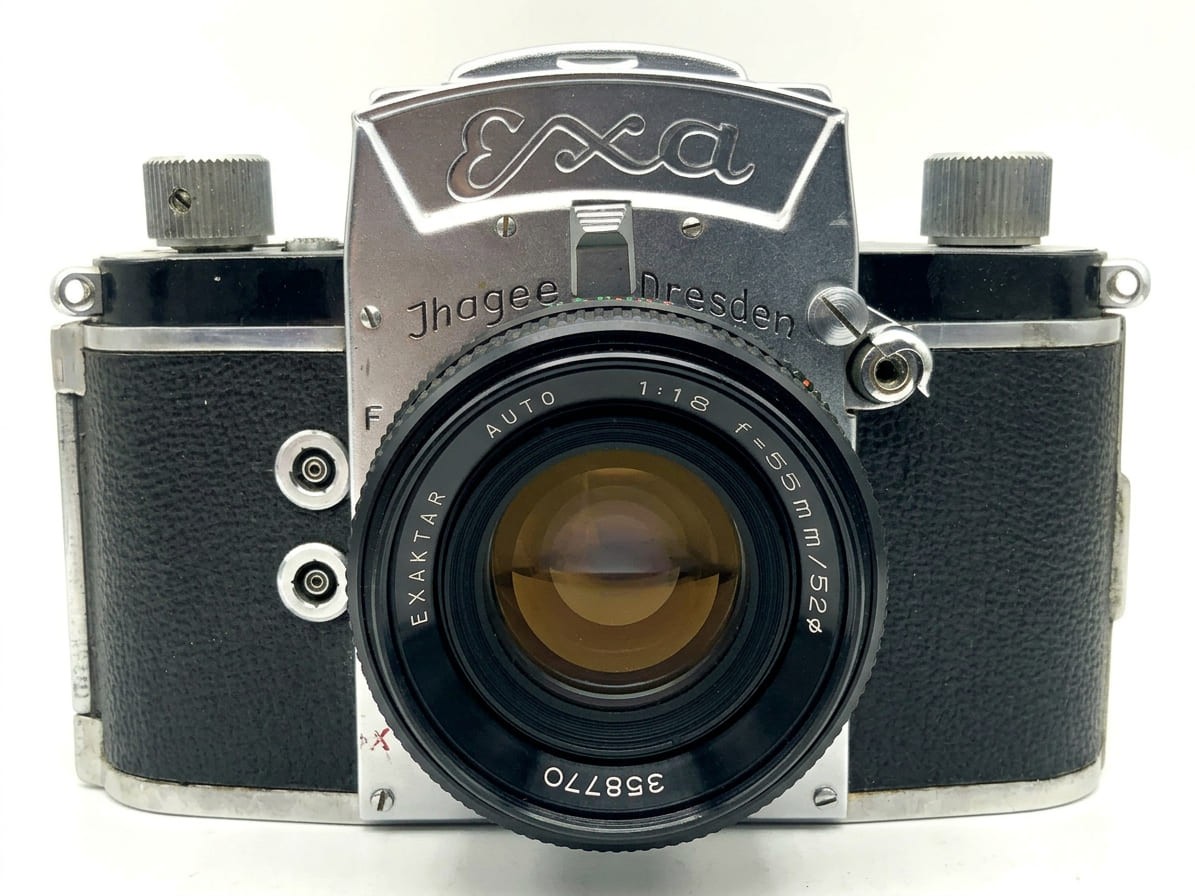
IHAGEE EXA 1A
Born in the heart of Cold War-era Dresden, the Ihagee Exa 1a is a mechanical gem from East Germany’s most storied camera lineage. A stripped-down, no-nonsense 35mm SLR, it carries the torch of the legendary Exakta series—now refined under the Pentacon banner. Built like a tank, fully manual, and threaded for the mighty M42 lens ecosystem, the Exa 1a wasn’t chasing innovation. It was built to last, to work, and to put sharp glass in front of film, year after year.
Overview
From 1964 to 1977, Ihagee churned out the Exa 1a as part of East Germany’s state-driven camera consolidation under VEB Pentacon Dresden. The glory days of pre-war Exakta breakthroughs were behind it; this was a new era of standardized production, shared parts, and cost-conscious design. Yet the Exa 1a wasn’t a downgrade—it was a distillation. It took the essence of Ihagee’s SLR mastery and packed it into a simpler, more reliable form.
Targeted at amateurs and enthusiasts who preferred control over convenience, the Exa 1a skips automation entirely. No batteries, no electronics—just precision mechanics and a satisfyingly direct connection between photographer and camera. It evolved from earlier Exa models with subtle but meaningful upgrades: a redesigned film advance, a refined shutter, and a viewfinder that makes manual focus a pleasure, not a chore.
Positioned between the basic Zenits and the more advanced Exaktas, the Exa 1a carved its niche as a dependable, mid-tier SLR. It shared DNA with the Praktica line—same M42 mount, similar shutter architecture—but wore the Ihagee badge with quiet pride. In markets where Western cameras were out of reach, the Exa 1a wasn’t just an alternative. For many, it was the only real option.
Specifications
| Specification | Value |
| Type | 35mm Single-Lens Reflex (SLR) |
| Film Format | 35mm (135 cartridge) |
| Years Produced | 1964–1977 |
| Lens Mount | M42 × 1mm screw mount (universal thread) |
| Shutter | Vertical-travel metal focal-plane shutter; speeds 1–1/1000 sec, B, X-sync at 1/30 sec |
| Metering | None (unmetered body) |
| Exposure Modes | Manual only (shutter speed and aperture set on lens) |
| Viewfinder | Fixed pentaprism eye-level finder with central split-image rangefinder spot and microprism collar |
| Dimensions | Approx. 140 × 85 × 45 mm; Weight: ~580 g (body only, no lens) |
Key Features
- Metal Vertical-Travel Shutter: A leap from older cloth shutters—faster (1/1000 sec), tougher, and with reliable flash sync across all speeds.
- M42 Screw Mount Compatibility: Opens the door to a universe of glass: Carl Zeiss Jena, Meyer-Optik, Schneider, and even later Japanese M42 lenses.
- Split-Image Focusing Aid: A crisp central spot flanked by a microprism collar—tack-sharp focus, even in dim light or on tricky subjects.
- Cable-Release Socket on Shutter Button: Threaded right into the chrome-tipped release for steady long exposures on a tripod.
- Self-Timer Lever: A mechanical throw on the front plate—8 to 10 seconds of delay, perfect for self-portraits or reducing shake.
Historical Context
By the mid-60s, Ihagee was no longer the maverick innovator. It was a cog in the Pentacon machine—a unified East German camera powerhouse that absorbed Ihagee, KW, and others into a single export-focused entity. The Exa 1a emerged from this era of rationalization: less brand flair, more shared engineering. Its body casting, shutter design, and even tooling echoed those of the Praktica FX series, born from the same factory lines.
Yet timing was on its side. The 1960s and 70s were the golden years of 35mm SLR adoption, and the Exa 1a rode that wave. While it lacked the TTL metering of the Pentax Spotmatic or the sleekness of the Canon FX, it didn’t need to compete head-on. Marketed heavily across the Eastern Bloc and developing nations, it won loyalty through ruggedness and compatibility with Carl Zeiss Jena optics—glass that still sings today.
Collectibility & Value
Today, the Exa 1a isn’t a daily shooter—but it’s a favorite among mechanical purists and Cold War tech collectors. It sells not for its specs, but for its soul: a fully manual SLR that asks you to engage, to think, to *shoot*. Prices range from $75 to $150, depending on condition and whether it comes with a lens. A working shutter and clean viewfinder are non-negotiable—decades in storage often mean dried grease or sticky blades.
Watch for smooth film advance and a mirror that snaps back crisply. The self-timer is a known weak spot—prone to sticking and usually needing a careful cleaning. Chrome models are common; black paint versions are rarer and often fetch a small premium. Since there’s no meter to fail, functionality hinges entirely on mechanical health—making a clean, working example far more valuable than a shiny paperweight.
Similar Cameras
- Praktica FX 2 (1966–1975) – East German M42 SLR with similar build and shutter design, often sharing components.
- Pentax Spotmatic (1964–1976) – Japanese M42 SLR with TTL metering, representing the technological benchmark of the era.
- Zenit-E (1965–1982) – Soviet-built M42 SLR, mechanically simpler and less refined than the Exa 1a.
- Fujica ST 705 (1969–1970s) – Japanese M42 camera with advanced ergonomics, showcasing the evolution of the thread mount platform.
- Carl Zeiss Ikon Contaflex Super BC – Though a leaf-shutter SLR, it competed in the same mid-tier European market.
Repair & Maintenance
One of the Exa 1a’s greatest strengths? It runs on nothing but physics. No batteries, no circuits—just gears, springs, and levers. That also means its longevity depends on mechanical care. The metal vertical shutter is tough, but decades of dormancy can turn lubricants into glue, especially in humid climates. A proper CLA (clean, lubricate, adjust) from a technician familiar with M42-era SLRs can breathe new life into a frozen body.
Common issues include sluggish film advance, mirror lag, and shutter speed inaccuracies at the extremes—1 second and 1/1000 second are often off. The rewind crank can strip if forced; the take-up spool release may jam. Parts are scarce, but donor bodies from Praktica or other Pentacon-era SLRs sometimes offer compatible internals. Repair isn’t easy, but for those with the patience and tools, the Exa 1a is a rewarding project—mechanically honest and fundamentally sound.
eBay Listings


As an eBay Partner, we earn from qualifying purchases. This helps support our independent vintage technology research.
Related Models
- Ihagee Exa 1b (1977-1985)
- Ihagee Exa 1c (1985–1987)
- Ihagee Exa 500 (1966–1969)
- Ihagee Exa I (1963-1964)
- Ihagee Exa II (1960-1963)
- Alpa 6 (1948-1953)
- Agfa Agfaflex
- Agfa Ambiflex
- Agfa Easy
- Agfa Futura Af zoom