IHAGEE EXA
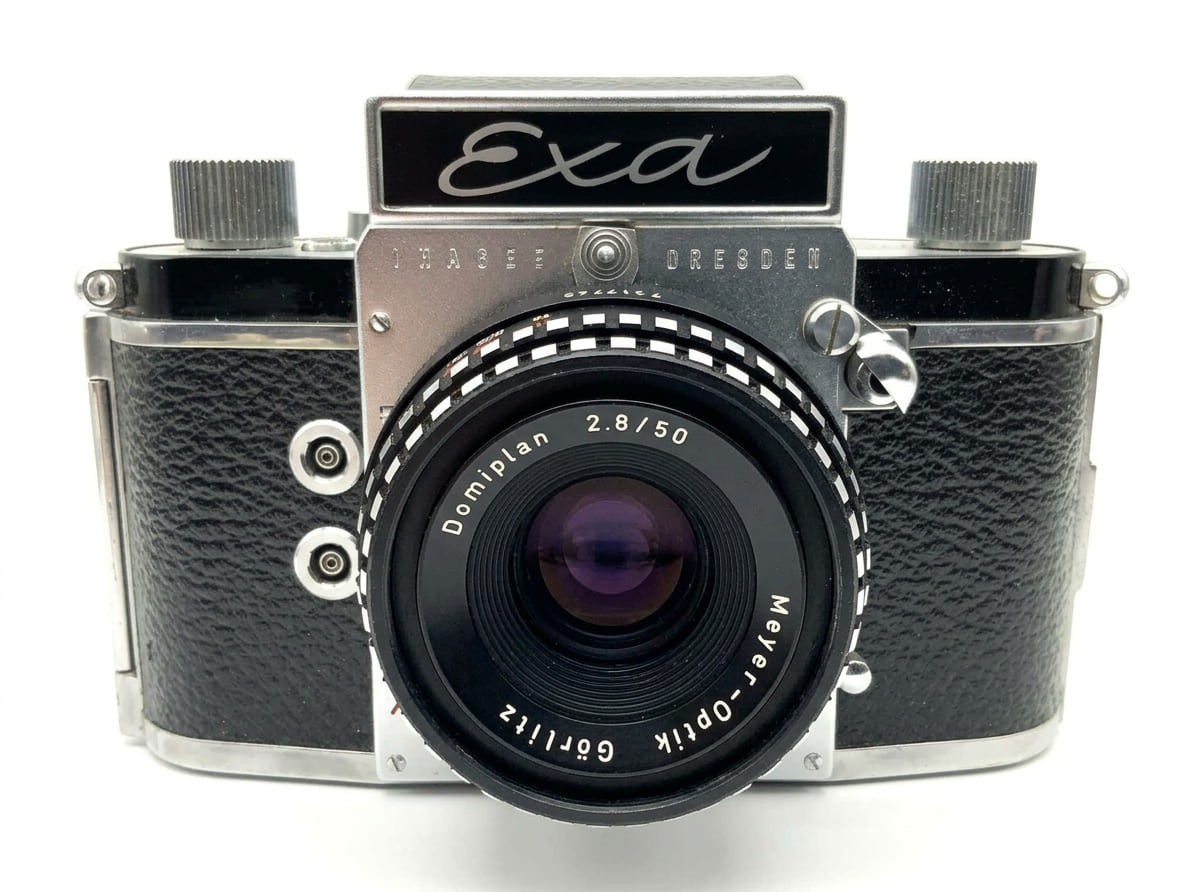
The Ihagee Exa is a 35mm single-lens reflex (SLR) camera produced in East Germany between 1951 and 1962. Designed as a simplified and more affordable alternative to the renowned Exakta Varex series, the Exa brought SLR functionality to amateur photographers and budget-conscious users without sacrificing core mechanical reliability.
Overview
Introduced in 1951 by Ihagee Kamerawerk of Dresden, East Germany, the Exa was developed during a period of postwar industrial recovery and growing demand for accessible photographic equipment in both domestic and export markets. Positioned as a budget-conscious sibling to the professional-grade Exakta VX and Varex models, the Exa retained the core 35mm SLR architecture—focal-plane shutter, interchangeable lenses, and eye-level pentaprism viewfinder—but with deliberate simplifications to reduce manufacturing complexity and cost. The camera was aimed primarily at amateur photographers and students who sought the compositional advantages of an SLR without the premium price tag.
The Exa series evolved through several iterations during its 11-year production run, including the original Exa (Type 500/10), Exa 500/12, and the later Exa 500/16, each introducing minor refinements in shutter mechanism, film advance, and body ergonomics. Despite its simplified design, the Exa maintained the robust all-metal construction typical of Ihagee cameras of the era, featuring a vertically-traveling focal-plane shutter and compatibility with the standard Ihagee bayonet mount (Exakta bayonet), allowing use of a wide range of existing Exakta lenses. This backward compatibility was a strategic advantage, enabling users to leverage existing optics while stepping down from higher-end models.
Historically, the Exa played a key role in democratizing SLR photography in the early 1950s, preceding the broader consumer SLR boom of the 1960s. While overshadowed by the technical sophistication of the Varex line, the Exa was instrumental in expanding Ihagee’s market reach and maintaining production continuity during a politically and economically turbulent period in East Germany. Its export success, particularly in Western Europe and North America, demonstrated strong international demand for reliable, no-frills SLRs at accessible price points.
Specifications
| Specification | Value |
| Type | Single-Lens Reflex (SLR) |
| Film Format | 35mm (135 film) |
| Years Produced | 1951–1962 |
| Lens Mount | Ihagee Exakta Bayonet (44mm thread, three-lug) |
| Shutter | Vertically-traveling focal-plane cloth shutter; speeds 1–1/1000 sec, B, X-sync at 1/30 sec |
| Metering | None (unmetered) |
| Exposure Modes | Manual only (shutter speed and aperture set manually) |
| Viewfinder | Fixed pentaprism with ground-glass focusing screen, no built-in meter coupling |
| Dimensions | Approx. 140 × 85 × 95 mm; weight ~650 g (body only, no lens) |
Key Features
- Simplified Exakta Design: Retains core SLR functionality with reduced complexity for lower cost and improved reliability.
- Exakta Bayonet Compatibility: Supports a wide range of interchangeable lenses from the Exakta system, including Zeiss, Meyer, and Schneider optics.
- High Shutter Speed: Capable of 1/1000 sec—exceptional for its era and class—enabling fast-action photography.
- Vertical Focal-Plane Shutter: Reduces shutter lag and wear compared to horizontal shutters, improving durability.
- Integrated Accessory Shoe: Allows attachment of external viewfinders, light meters, or flash units.
Historical Context
The Ihagee Exa was launched at a pivotal moment in photographic history. In the early 1950s, SLR cameras were still niche instruments, primarily used by professionals and advanced amateurs due to their complexity and cost. The success of the original Exakta VX (1936) and the technologically advanced Varex (1950) had established Ihagee as a leader in SLR innovation, but these models were expensive and mechanically intricate. The Exa filled a critical gap by offering a stripped-down, reliable SLR platform that retained the essential benefits—through-the-lens viewing, interchangeable lenses, and fast shutter speeds—while eliminating features like interchangeable viewfinders, flash synchronization selectors, and auxiliary dials.
Competitors at the time included the Soviet Kiev-2 (a rangefinder), the Japanese Miranda T (introduced 1955), and later the Asahi Pentax (1957). However, in its early years, the Exa faced limited direct competition in the budget SLR segment. Its primary rival in concept was the Argus C3 rangefinder, which dominated the U.S. amateur market but lacked SLR capabilities. The Exa’s export distribution, particularly through U.S. importers like Modernistic Products, helped position it as a value-oriented import alternative to both American and emerging Japanese models.
Market reception was generally favorable, with praise for its solid build, precise shutter, and compatibility with high-quality Exakta lenses. However, the lack of built-in metering and relatively stiff film advance mechanism were noted drawbacks. By the late 1950s, increasing competition from Japanese manufacturers—offering lighter, more ergonomically refined SLRs with integrated metering—began to erode the Exa’s appeal, contributing to its discontinuation in 1962.
Collectibility & Value
Today, the Ihagee Exa is a moderately collectible camera, valued by vintage SLR enthusiasts and East German technology collectors. While not as rare or sought-after as the Exakta Varex or VX models, the Exa is appreciated for its historical significance as one of the earliest budget SLRs and for its mechanical simplicity and durability. Well-preserved examples in working condition typically sell for $150–$300 USD, depending on lens inclusion, finish, and shutter functionality.
When purchasing an Exa, collectors should inspect the shutter for smooth operation across all speeds, particularly 1/1000 sec, which can suffer from uneven travel if the cloth curtain is worn or sticky. The film advance lever and rewind crank should operate without binding, and the lens mount should be free of play or corrosion. The camera uses no batteries, making it fully mechanical and suitable for continued use with expired or fresh 35mm film. Common issues include light leaks from deteriorated body seals, cloudy viewfinder screens, and stiff aperture blades in older lenses. Replacement parts are scarce, so functional examples are preferred.
Similar Cameras
- Exakta VX (Ihagee, 1950) – The premium predecessor with interchangeable viewfinders and flash sync selector.
- Miranda T (Miranda, 1955) – Japanese SLR with similar modular ambitions and Exakta-mount compatibility.
- Praktina FX (KW, 1952) – East German SLR with interchangeable components, more complex and heavier.
- Alpa-Reflex (Alpa, 1944–1953) – Swiss precision SLR, significantly more expensive and refined.
- Foca 2B (Foca, France, 1951) – French 35mm SLR with vertical shutter and Leica-thread mount variant.
Repair & Maintenance
The Ihagee Exa is a fully mechanical camera requiring no batteries. Maintenance focuses on mechanical lubrication, shutter calibration, and light seal replacement. The vertically traveling cloth focal-plane shutter is robust but sensitive to dried grease or impact damage; professional servicing is recommended for full shutter strip-downs. The film transport system uses a gear-coupled sprocket and should be cleaned periodically to prevent film jams. The Exakta bayonet mount is durable but may develop play over time—tightening the retaining ring can mitigate minor wobble. Users are advised to test the camera with expired film before investing in bulk rolls. Due to the age of the model, original spare parts are extremely limited, making preservation of functional units critical.
eBay Listings


As an eBay Partner, we earn from qualifying purchases. This helps support our independent vintage technology research.
Related Models
- Ihagee Exa 1a (1964-1977)
- Ihagee Exa 1b (1977-1985)
- Ihagee Exa 1c (1985–1987)
- Ihagee Exa 500 (1966–1969)
- Ihagee Exa I (1963-1964)
- Alpa 6 (1948-1953)
- Agfa Agfaflex
- Agfa Ambiflex
- Agfa Easy
- Agfa Futura Af zoom