HASSELBLAD 500EL
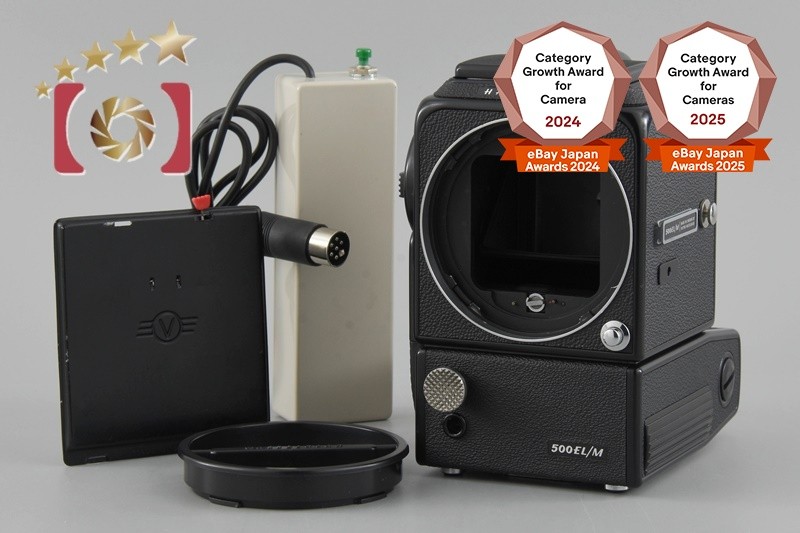
The Hasselblad 500EL is a medium format single-lens reflex (SLR) camera introduced in 1964 as the world’s first medium format SLR with a built-in motorized film transport. Electrically driven and designed for precision and automation, the 500EL represented a significant technological leap in professional photography, combining the modular design of the Hasselblad V-system with electromechanical advancements previously unseen in the 6x6 format.
Overview
The Hasselblad 500EL was developed as a motorized evolution of the highly successful 500C, marking a pivotal moment in the transition from fully mechanical to electrically assisted medium format systems. Released in 1964, it was the first camera in the Hasselblad V-series to incorporate an integrated motor drive, enabling automatic film advance and shutter cocking at approximately one frame per second. This innovation targeted professional photographers—particularly those in studio, portrait, and commercial photography—who required consistent, rapid shooting without the need for manual winding between exposures. The 500EL retained the modular design philosophy of its predecessors, allowing interchangeable lenses, viewfinders, and film magazines, which contributed to its adaptability across diverse photographic applications.
Positioned as a high-end professional tool, the 500EL was engineered for reliability and precision. Its electric motor was powered by a 6V PX28 (4LR44) battery housed in the grip, a novel integration at the time. Despite its advanced features, the 500EL maintained the signature build quality associated with Hasselblad: a die-cast aluminum body, precision-machined components, and a reputation for durability under demanding conditions. The camera was produced until 1970, when it was succeeded by the 500EL/M, which added a mechanical backup winding option. While the 500EL was not as widely adopted as the manual 500C due to its higher cost and dependency on battery power, it laid the groundwork for future motorized variants and remains a landmark model in the evolution of medium format automation.
Specifications
| Specification | Value |
| Type | Single-Lens Reflex (SLR) |
| Film Format | 6x6 cm (120/220 roll film) |
| Years Produced | 1964–1970 |
| Lens Mount | Hasselblad V-mount (interchangeable via lens coupling lever) |
| Shutter | Focal-plane cloth shutter; speeds 1–1/500 sec, plus B |
| Shutter Synchronization | X and M contacts at 1/30 sec (via PC sync) |
| Metering | None (requires external meter or metered prism) |
| Exposure Modes | Manual only (shutter speed and aperture set on lens) |
| Viewfinder | Interchangeable (waist-level, prism, etc.), 90° reflex finder standard |
| Film Advance | Electric motor drive (automatic after exposure), ~1 fps |
| Frame Counter | Automatic reset upon magazine insertion |
| Battery | 6V PX28 (4LR44) in right-hand grip |
| Dimensions | Approx. 105 x 102 x 207 mm (body only) |
| Weight | Approx. 1,050 g (body only, without battery) |
Key Features
- First motorized medium format SLR: The 500EL was the first 6x6 camera to feature a built-in electric motor for automatic film advance and shutter cocking, eliminating the need for manual crank or lever winding.
- Modular V-system compatibility: Fully compatible with Hasselblad’s ecosystem of interchangeable lenses (e.g., Biogon, Planar, Sonnar), viewfinders, and 120/220 film magazines.
- Precision focal-plane shutter: Offers shutter speeds from 1 second to 1/500 second, with flash synchronization at 1/30 second via X or M contacts.
- Automatic frame counter: Resets when a new film magazine is attached, reducing user error in frame tracking.
- Battery-dependent operation: Requires a 6V PX28 battery to power the motor; no manual override, making battery availability critical for operation.
Historical Context
The Hasselblad 500EL was introduced at a time of rapid technological advancement in photography, particularly in the professional and scientific sectors. The early 1960s saw increasing demand for automation and reliability in cameras used for commercial, studio, and industrial applications. While the 500C (1957) had established Hasselblad as the gold standard in modular medium format systems, the 500EL pushed the envelope by integrating electric drive technology—a feature previously limited to 35mm cameras like the Nikon F with motor drives. The 500EL’s development was influenced by NASA’s interest in reliable, repeatable camera systems, although the 500EL itself was not flown in space missions (unlike later 500EL/M models used by Apollo astronauts).
Competitors in the medium format market at the time, such as the Bronica ETR and Mamiya RB67, remained manually operated, giving the 500EL a distinct edge in speed and consistency. However, its high price, battery dependency, and lack of a manual winding backup limited its appeal compared to the more robust and universally compatible 500C. Nevertheless, the 500EL demonstrated Hasselblad’s commitment to innovation and set the stage for future motorized models, including the 500EL/M and eventually the 503CW. It also influenced other manufacturers to explore motorization in medium format systems, contributing to the broader trend toward automation in professional photography.
Collectibility & Value
The Hasselblad 500EL is a sought-after model among collectors of vintage professional cameras, particularly those interested in the evolution of medium format technology. Due to its relatively short production run (1964–1970) and niche market positioning, original examples in working condition are increasingly rare. As of 2024, a fully functional 500EL with matching serial numbers, original battery grip, and accessories can command prices between $1,200 and $2,000 USD, depending on condition and provenance. Cameras with operational issues or missing components may sell for significantly less, often in the $600–$900 range.
When evaluating a 500EL for purchase, collectors should prioritize electrical functionality, as the motor drive is central to the camera’s operation. Common issues include worn motor brushes, degraded wiring in the grip, and corrosion in the battery compartment—especially if stored with old batteries. The absence of a manual winding option means that electrical failure renders the camera unusable unless repaired. Additionally, shutter accuracy should be tested, as cloth focal-plane shutters from this era can suffer from uneven speeds or timing drift. Lenses should be checked for haze, fungus, and smooth aperture operation. Given the complexity of repairs, sourcing a camera serviced by a qualified Hasselblad technician is advisable. Original boxes, manuals, and accessories (such as the rare electric cable release) enhance collectibility and value.
Similar Cameras
- Bronica ETR – A 6x4.5cm SLR with interchangeable film backs and aperture-priority automation, introduced in 1976; more affordable and later than the 500EL but lacked built-in motorization.
- Mamiya RB67 – A 6x7cm modular SLR (1970) with manual operation, prized for its bellows focusing and studio use; heavier and slower but highly durable.
- Pentax 6x7 – A 6x7cm SLR (1969) with manual winding and a large-format aesthetic; popular for portraits but not modular or motorized.
- Kiev 88 – A Soviet-era 6x6cm SLR based on the Hasselblad design, with manual operation and a focal-plane shutter; less precise but more rugged and affordable.
- Hasselblad 500C – The direct predecessor to the 500EL; mechanically identical except for the lack of motor drive, making it more reliable and widely collected.
Repair & Maintenance
The Hasselblad 500EL requires a 6V PX28 (4LR44) battery to operate the motor drive; modern equivalents are available but may require adapter shims due to slight voltage and size differences. The motor system is prone to failure if the battery is left inside for extended periods, leading to leakage and corrosion in the grip’s contacts. Regular cleaning of the battery compartment and periodic testing of motor function are essential for preservation. The cloth focal-plane shutter should be checked for consistent speeds, particularly at 1/500 sec, where timing inaccuracies are common in aging units. Shutter lubrication and calibration require specialized tools and expertise. The film transport mechanism, including the motor gear train, can wear over time, resulting in incomplete frame advances. Repairs are best handled by technicians experienced with Hasselblad V-system cameras, as disassembly requires precision to maintain alignment and light sealing. Given the camera’s age, sourcing replacement parts—especially the motor assembly or wiring harness—can be challenging, making functional examples particularly valuable.
eBay Listings



As an eBay Partner, we earn from qualifying purchases. This helps support our independent vintage technology research.
Service Manuals, Schematics & Catalogs
Related Models
- Hasselblad 2000FC (1977–1988)
- Hasselblad 2000FCW (1984-1988)
- Hasselblad 2003FCW (1988-1994)
- Hasselblad 500C/M (1970-1994)
- Hasselblad 500C (1957-1970)
- Alpa 6 (1948-1953)
- Agfa Agfaflex
- Agfa Ambiflex
- Agfa Easy
- Agfa Futura Af zoom