GRAFLEX SPEED GRAPHIC
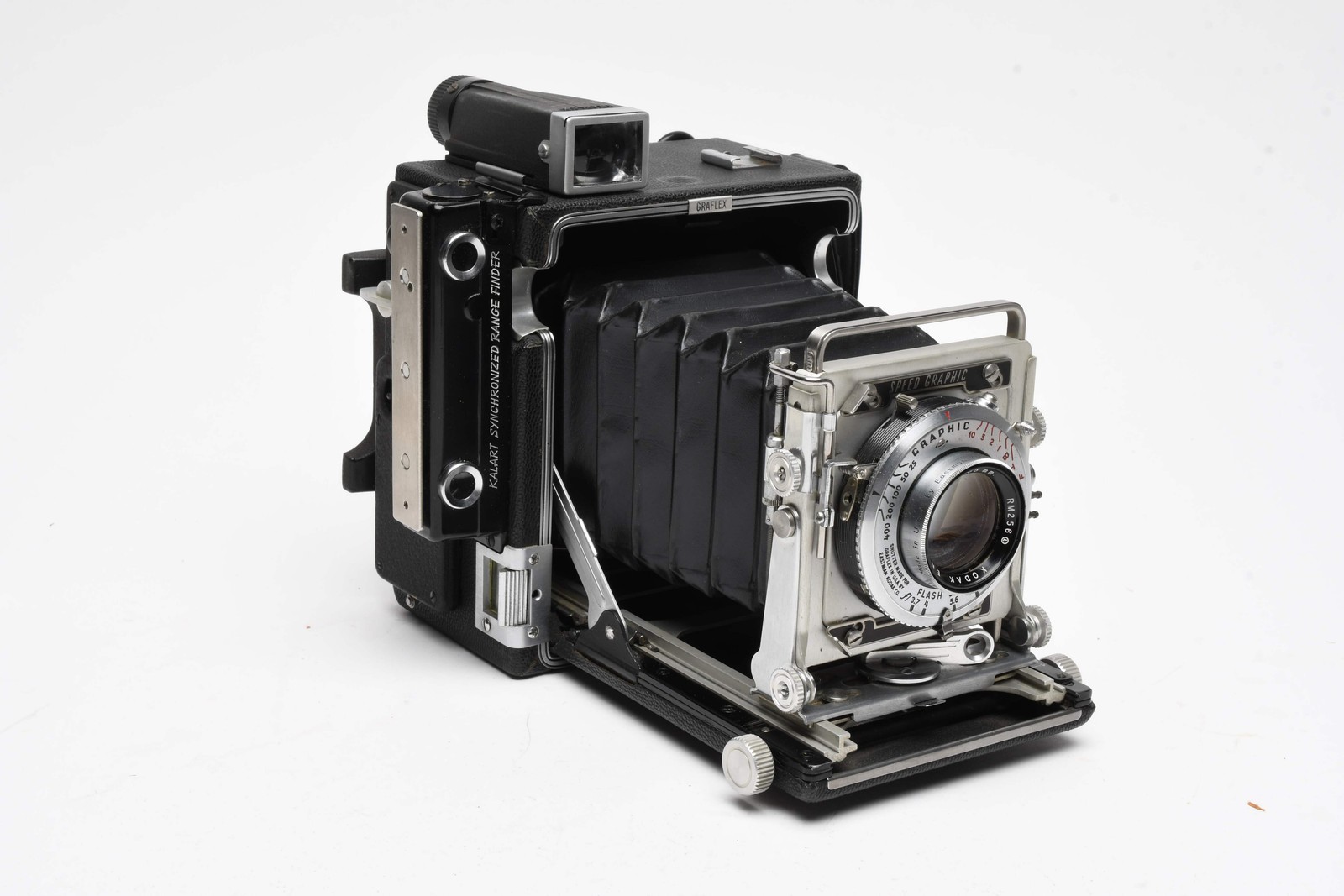
The Graflex Speed Graphic is an iconic American press camera that defined photojournalism in the first half of the 20th century. Renowned for its rugged construction, focal plane shutter, and ability to deliver sharp 4x5 inch images under demanding field conditions, it became the standard tool for newspaper photographers from the 1920s through the 1950s.
Overview
Introduced in 1912 by the Folmer & Schwing Division of Eastman Kodak Company—later spun off as Graflex, Inc.—the Speed Graphic was developed as a lighter, faster alternative to the large, cumbersome view cameras then in use. It combined the ground-glass focusing system of a view camera with a focal plane shutter that enabled high-speed photography, making it ideal for capturing action and fleeting moments in news, sports, and street photography. The camera was specifically designed for the 4x5 inch film format, using sheet film holders, and allowed rapid lens interchangeability via its front standard equipped with a rotating turret (on later models).
The Speed Graphic evolved through several major iterations: the original "Pre-Speed" (1912), the "Big Bertha" (1914–1927), the "Top Handle" (1939–1946), and the final "Crown" model (1947–1973). Each version refined ergonomics, shutter performance, and viewfinder integration. The camera’s signature feature—the vertically traveling focal plane shutter—offered shutter speeds from 1 to 1/1000 second, a remarkable capability for its era. Its rangefinder-equipped variants (from 1939 onward) further enhanced its utility for fast focusing, though many models retained the traditional ground-glass screen for composition.
Historically, the Speed Graphic became synonymous with the golden age of print journalism. Photographers such as Weegee (Arthur Fellig), Margaret Bourke-White, and W. Eugene Smith used it to document pivotal moments in American history, from crime scenes and political rallies to wartime coverage. Graflex positioned the Speed Graphic as the premium press camera, distinguishing it from simpler field cameras and competing models by emphasizing speed, reliability, and image quality. It stood at the top of Graflex’s press camera lineup, above the smaller Graflex Pacemaker and the simpler Graflex K-22.
Specifications
| Specification | Value |
| Type | Press Camera (Folding Field Type with Focal Plane Shutter) |
| Film Format | 4x5 inch (Sheet Film) |
| Years Produced | 1912–1973 (Multiple Variants) |
| Lens Mount | Interchangeable front standard with lensboards; compatible with Graphic-type shutters (e.g., Compur, Ilex, Synchro-Compur) |
| Shutter | Vertically traveling cloth focal plane shutter; speeds 1, 1/2, 1/5, 1/10, 1/25, 1/50, 1/100, 1/200, 1/400, 1/500, 1/1000 second; X and M flash sync (on later models post-1939) |
| Metering | None (camera has no built-in light meter) |
| Exposure Modes | Manual only; shutter speed and aperture set on lens |
| Viewfinder | Dual: Ground-glass focusing screen (folding hood) and optical viewfinder (integral on Top Handle and Crown models; optional on earlier versions); some models include coupled rangefinder (Top Handle and Crown) |
| Dimensions | Approx. 11 x 8 x 6 inches (closed); weight ~6.5 lbs (2.95 kg) depending on lens and configuration |
Key Features
- Focal Plane Shutter: Enabled high-speed shutter performance (up to 1/1000 sec), critical for freezing motion without relying on lens shutters.
- Dual Viewfinding System: Combined ground-glass focusing with a quick-action optical viewfinder for rapid composition in dynamic environments.
- Interchangeable Lenses and Turrets: Later models featured a rotating lens turret (typically 3-lens capacity), allowing swift lens changes in the field.
- Rugged Construction: Built from brass, steel, and wood (mahogany or walnut), designed for durability in harsh conditions.
- Flash Synchronization: Later Crown Graphic models (post-1947) included X-sync for electronic flash, adapting to evolving lighting needs.
Historical Context
The Speed Graphic was introduced at a time when photojournalism was emerging as a dominant force in news media. The rise of illustrated magazines like Life, Look, and The Saturday Evening Post created demand for high-quality, fast-reacting cameras capable of producing large-format negatives for reproduction. The Speed Graphic filled this niche perfectly. Its focal plane shutter allowed photographers to use barrel lenses without built-in shutters—common at the time—and achieve speeds unattainable with leaf shutters of the era.
Competitors included the Ansco Century-View, the Kodak Tourist, and later the Linhof Press 45, but none matched the Speed Graphic’s combination of speed, portability, and reliability. European press cameras often used horizontal shutters or lacked integrated viewfinders, putting them at a disadvantage in fast-paced American newsrooms. The Speed Graphic’s adoption by major wire services (Associated Press, United Press) cemented its status. During World War II, military photographers used modified Speed Graphics for documentation, further enhancing its reputation.
Collectibility & Value
Today, the Graflex Speed Graphic is a highly collectible camera, particularly models from the 1940s and 1950s with rangefinders and flash sync. Values range from $150 for a non-functioning early model to $800–$1,500 for a fully operational Crown Graphic with a coupled rangefinder, clean shutter, and original lenses. Condition is paramount: functional shutter curtains, intact leather bellows, and a clear ground glass are essential. Cameras with original lens turrets and lenses (e.g., Kodak Ektar, Wollensak Raptar, or Graflex Aero-Ektar) command premium prices.
Common issues include sticky or torn focal plane shutters, light leaks from deteriorated bellows, and misaligned rangefinders. Shutter repair requires specialized skill due to the complexity of the spring-tensioned vertical curtain mechanism. Collectors often seek “war-era” models (WWII markings, olive drab finish) or those associated with famous photographers. While not rare, fully functional examples are increasingly scarce, making well-maintained Speed Graphics desirable for both collectors and large-format enthusiasts.
Similar Cameras
- Linhof Press 45 – German-built press camera with superior build quality and modular design; lacked a focal plane shutter in most configurations.
- Ansco Press Director – American-made 4x5 press camera; similar form factor but less refined shutter mechanism.
- Kodak Pacemaker Executive – Streamlined field camera with built-in rangefinder; lighter but without focal plane shutter.
- Busch Pressman – Compact 4x5 press camera with rotating front standard; popular for its portability.
- Graflex Pacemaker Speed Graphic – A later evolution (1947–1973) with improved ergonomics; often grouped with the Speed Graphic lineage.
Repair & Maintenance
The Speed Graphic requires no batteries and is fully mechanical. However, maintenance is critical due to age. The focal plane shutter is prone to uneven speeds, "banana" curvature (from spring tension), or fabric degradation. Cleaning and lubrication of the shutter mechanism should only be performed by technicians experienced with vintage focal plane shutters. Bellows replacement is common, with custom leather or synthetic replacements available. Lensboards may warp; ensure tight fit to prevent light leaks. Regular cleaning of the ground glass and viewfinder optics is recommended. Due to the complexity of the rangefinder coupling (on later models), calibration should be verified with a focus test. With proper care, a Speed Graphic can remain functional for decades, a testament to its original engineering.
eBay Listings


As an eBay Partner, we earn from qualifying purchases. This helps support our independent vintage technology research.
Service Manuals & Schematics
- Parts List — archive.org
- Service Manual — archive.org
Related Models
- Graflex Century Graphic (1949-1970)
- Graflex Crown Graphic (1947-1973)
- Linhof Super Technika 23 (1956-1972)
- Linhof Technika III (1946-1956)
- Linhof Technika IV (1956-1972)
- Linhof Technika V (1972-1986)