GRAFLEX CROWN GRAPHIC
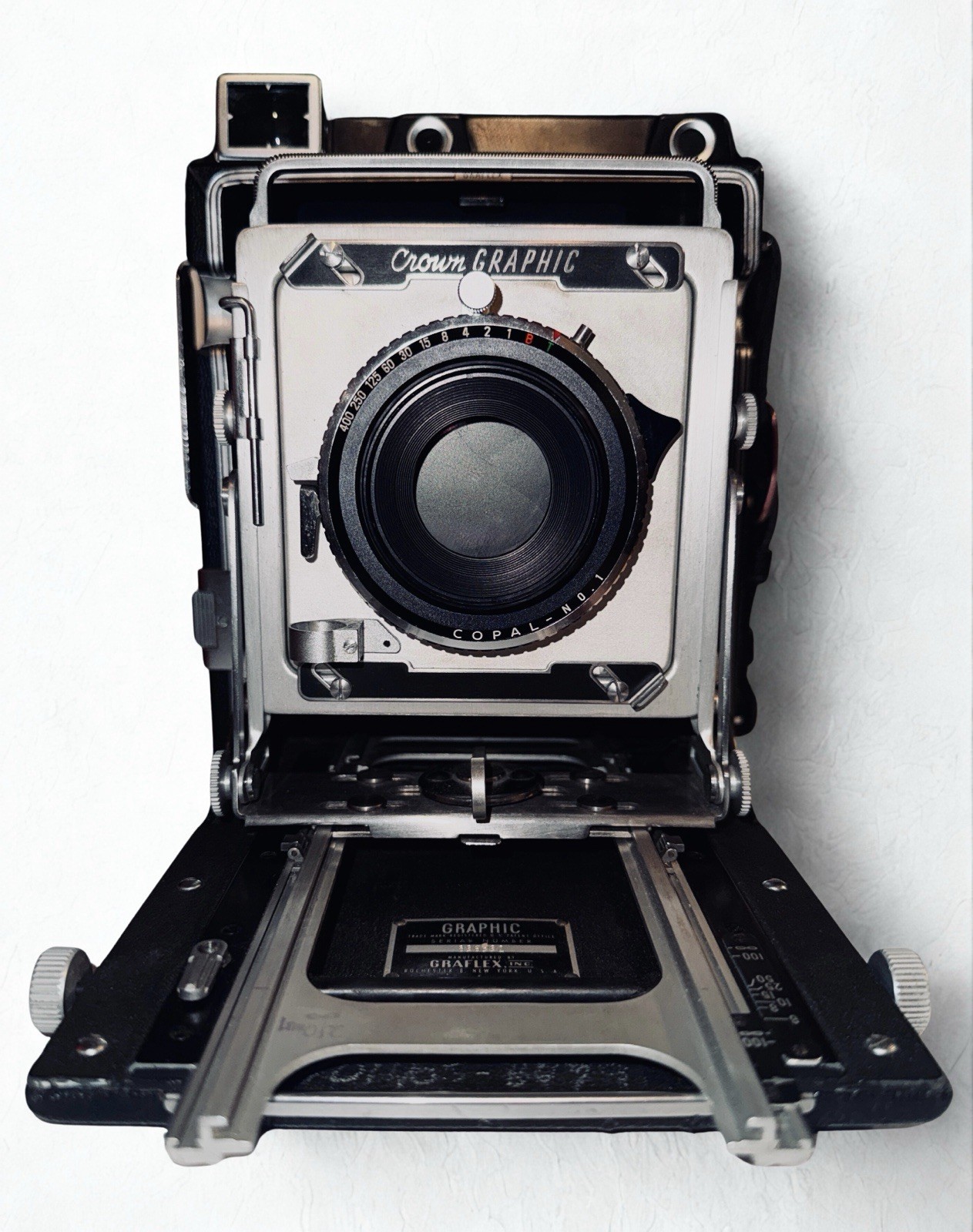
Meet the Graflex Crown Graphic—a no-nonsense 4×5 press camera that quietly ruled the sidelines of mid-century photojournalism. Built from 1947 to 1973, it shed the heavy machinery of its Speed Graphic cousin to deliver a leaner, simpler tool for photographers who valued image quality over speed tricks. No focal plane shutter, no fuss—just a rugged, compact field companion that let the lens do the work. If you’ve ever held one, you know: it feels like a camera built to last, not to impress.
Overview
When Graflex introduced the Crown Graphic in 1947, press photography was at a crossroads. 35mm cameras like the Leica and Contax were turning heads with their agility, but newspapers still demanded the rich detail and tonal depth of 4×5 film. The Crown stepped in with a clever compromise: keep the large format, ditch the complexity. By removing the focal plane shutter, Graflex cut weight and mechanical vulnerability, crafting a camera that was easier to service and a joy to carry.
Designed for photojournalists, event shooters, and field portraitists, the Crown Graphic focused on essentials. Its rigid body folds neatly, the front standard swings and tilts for basic perspective control, and the ground glass delivers sharp focusing—no batteries, no electronics, just pure mechanics. It relied entirely on lenses with built-in leaf shutters, a design choice that traded high-speed action capability for reliability and flash sync at every speed.
The lineup evolved over its 25-year run: the original Crown Graphic gave way to the Rapid model with its quick-release film back, then the beefed-up Super Crown Graphic with improved rigidity and accessory support. While it couldn’t match the Speed Graphic’s shutter tricks for freezing motion, it became the go-to for photographers who prioritized portability, durability, and image quality in equal measure. Its long production life speaks volumes—this wasn’t just a stopgap. It was a workhorse with staying power.
Specifications
| Specification | Value |
| Type | Large-Format Press Camera |
| Film Format | 4x5 inch (sheet film via film holders) |
| Years Produced | 1947–1973 |
| Lens Mount | Graflex Graphic Standard (also known as "Crown" or "No. 5" mount), accepts lenses in shutters with 2.25" diameter mount |
| Shutter | No built-in focal plane shutter; relies entirely on lens-integrated leaf shutters (e.g., Compur, Synchro-Compur, Prontor) |
| Shutter Speeds | Dependent on lens shutter, typically 1 sec to 1/400 sec, with B and T settings |
| Aperture Control | Via lens diaphragm, typically f/4.5 to f/64 depending on lens |
| Metering | None (camera has no built-in light meter) |
| Exposure Modes | Manual only, via lens shutter and aperture |
| Viewfinder | Dual optical viewfinders (frame-finder and reverse Galilean type), plus ground glass focusing screen |
| Focusing | Rack-and-pinion front standard, ground glass screen with Fresnel lens |
| Bellows Extension | Approximately 11 inches (varies slightly by model) |
| Movements | Front standard: rise/fall (limited), tilt, swing; no rear movements |
| Dimensions | Approx. 8.5 × 5.5 × 3.5 inches (closed); weight approx. 4.5 lbs (2.04 kg) without lens |
| Flash Sync | PC terminal and M-sync via shutter; compatible with flash bulbs and early electronic flash via sync cord |
Key Features
- No focal plane shutter: Cuts weight and complexity, streamlining the body for field use.
- Lightweight design: At just 4.5 pounds, it’s one of the most portable 4×5 press cameras ever made.
- Dual viewfinders: Frame finder for quick targeting, reverse Galilean for eye-level composition—both fast and intuitive.
- Compatibility with wide range of lenses: Accepts shutters from 65mm to 360mm, giving shooters serious creative flexibility.
- Rapid Film Holder Back (on Rapid models): Speeds up film changes—a small upgrade that made a big difference in the field.
Historical Context
By 1947, the Speed Graphic’s reign was showing cracks. Its focal plane shutter, once a marvel, had become a liability—finicky, heavy, and costly to maintain. Graflex saw the shift. Photographers didn’t always need to freeze bullets in midair. Sometimes, they just needed to capture a portrait, a courtroom sketch, or a city skyline—crisply, reliably, and on the move. The Crown Graphic answered that call.
Stripped of the focal plane shutter, the Crown was lighter, cheaper, and tougher. It wasn’t built for split-second sports shots, but for the photographer who valued precision, depth of field, and the unmatched resolution of 4×5 film. It found a home in newsrooms, studios, and on location shoots across America, often shoulder-to-shoulder with the Ansco Chief Graphic—a near twin, but with its own loyal following.
Even as 35mm SLRs surged in the 1960s, the Crown Graphic held its ground. Its production lasted until 1973, a testament to its utility in commercial, documentary, and architectural work. For those who needed large format without the studio, it remained the quiet champion.
Collectibility & Value
Today, the Crown Graphic has a cult following. Large-format shooters love its simplicity, collectors prize its clean lines, and film enthusiasts appreciate its mechanical honesty. On the market, prices range from $200 to $600, depending on condition, model (standard, Rapid, or Super), and whether it comes with a sharp lens like a 135mm f/4.0 Kodak Ektar or a 127mm f/4.7 Wollensak Raptar—glass that can double a camera’s value.
When buying, inspect the bellows for pinholes or cracks, test the shutter timing (especially at slower speeds), and check that the focusing rack moves smoothly. Watch for stiff rails, light leaks at the film back, and worn leather—common wear points, but rarely dealbreakers. While OEM parts are scarce, a dedicated network of technicians keeps these cameras alive. And for modern users, the lack of a focal plane shutter isn’t a flaw—it’s a feature. Leaf shutters fire flash at full sync, no compromises.
Similar Cameras
- Speed Graphic (Graflex) – Heavier sibling with focal plane shutter, used for action photography.
- Ansco Chief Graphic – Nearly identical in design and function, produced as a cost-effective alternative.
- Plaubel Peco Profia – German-made press camera with similar format and build quality.
- Linhof Press 45 – Precision-engineered German press camera with extensive movements.
- Toyo View 45C – Modern field camera with press-style portability and full movements.
Repair & Maintenance
Mechanical through and through, the Crown Graphic thrives on basic care. The lens shutter is the heartbeat—over time, dried lubricants can throw off timing, especially below 1/10 sec. A professional CLA every 10–15 years keeps it ticking. Bellows wear out, but custom replacements are available from specialty shops. The film back and seals should be checked regularly to prevent light leaks.
Disassembly isn’t for beginners, but experienced hands can service most issues without factory tools. Just treat the ground glass and viewfinder optics with care—they’re delicate. Clean the rails, lube the rack, and keep the leather intact. With routine attention, a Crown Graphic can focus as smoothly today as it did in 1955.
eBay Listings



As an eBay Partner, we earn from qualifying purchases. This helps support our independent vintage technology research.
Service Manuals & Schematics
- Parts List — archive.org
- Owner's Manual — archive.org
- Parts List — archive.org
Related Models
- Graflex Century Graphic (1949-1970)
- Graflex Speed Graphic (1912–1973)
- Linhof Super Technika 23 (1956-1972)
- Linhof Technika III (1946-1956)
- Linhof Technika IV (1956-1972)
- Linhof Technika V (1972-1986)