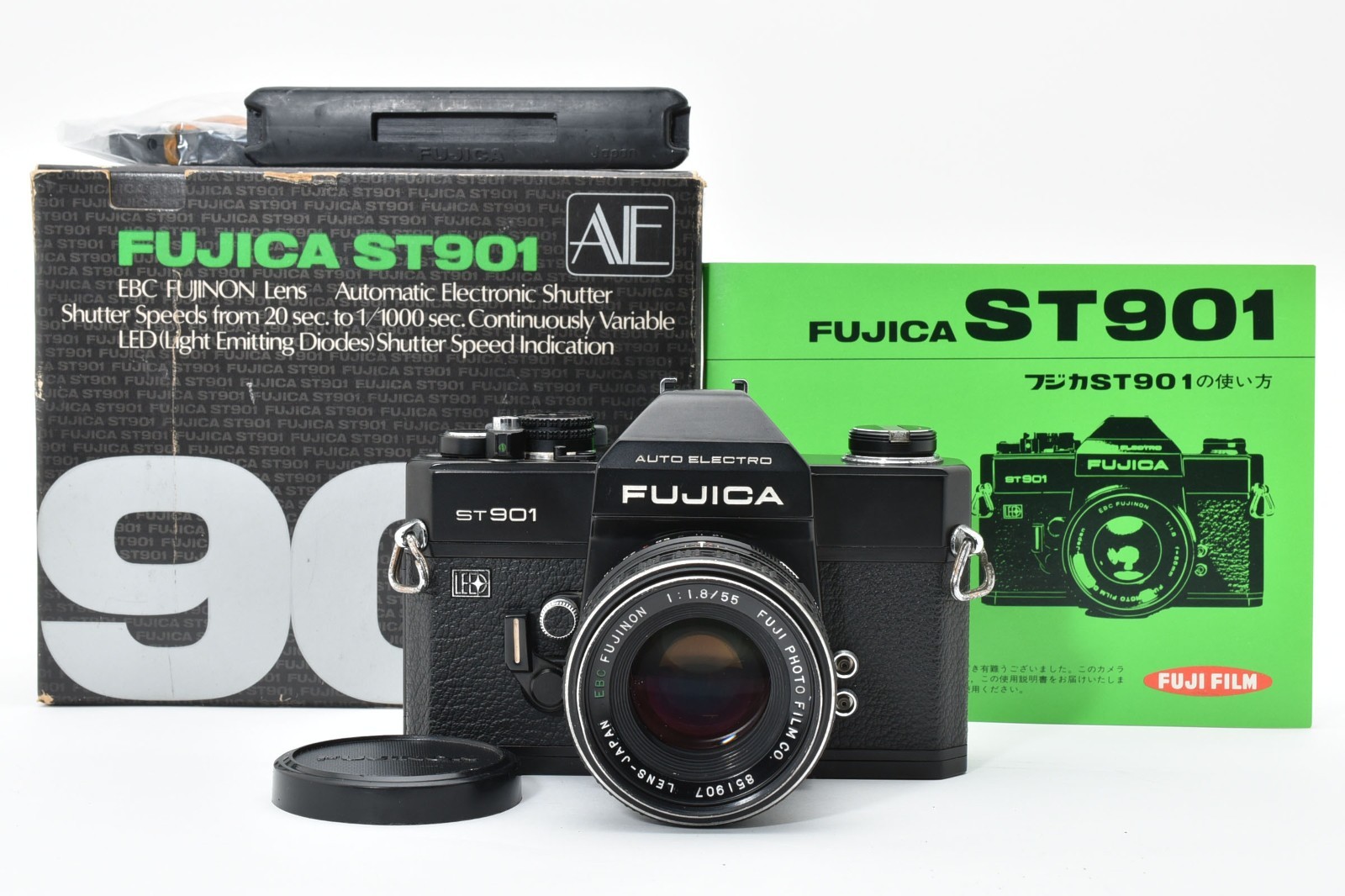
FUJICA ST901
The Fujica ST901 is a 35mm single-lens reflex (SLR) camera introduced by Fujifilm in 1974. It holds the distinction of being the first 35mm SLR from Fujica to feature a fully electronically controlled focal-plane shutter, marking a pivotal transition in the brand’s evolution toward modern electronic exposure systems.
Overview
Released during a period of rapid technological advancement in the SLR market, the Fujica ST901 represented Fujifilm’s commitment to innovation and precision engineering. Positioned as a high-end amateur to semi-professional camera, the ST901 targeted photographers seeking reliable automation without sacrificing manual control. It was part of Fujica’s ST-series, which had already established a reputation for solid build quality and optical excellence, particularly with the earlier ST801 and ST705 models. The ST901 built upon this legacy by introducing an electronically timed vertical-run metal shutter, a significant upgrade over the mechanical shutters of its predecessors.
One of the ST901’s defining characteristics was its hybrid operation: while it retained a mechanical Bulb mode, all other shutter speeds from 1 second to 1/1000 second were electronically controlled. This allowed for more accurate timing and enabled the implementation of aperture-priority autoexposure when used with compatible lenses. The camera used Fujica’s proprietary X-mount (also known as the Fujica breech-lock bayonet), which was incompatible with the later Fujinon-X mount used on autofocus models but supported a growing range of Fujinon lenses with automatic diaphragm coupling.
The ST901 also featured a built-in TTL (through-the-lens) silicon photodiode (SPD) light meter, which supported both center-weighted metering and open-aperture metering. This allowed photographers to compose and meter at full aperture, improving viewfinder brightness and focusing accuracy. The meter was activated by a dedicated button on the camera’s front and displayed exposure information via a needle in the viewfinder, referenced against a scale in the bottom of the frame. The camera required a single 6V PX28 or 4SR44 battery to power both the meter and the shutter electronics, a common configuration for electronic SLRs of the era.
Specifications
| Specification | Value |
| Type | 35mm Single-Lens Reflex (SLR) |
| Film Format | 35mm (135 film) |
| Years Produced | 1974–1979 |
| Lens Mount | Fujica X (breech-lock bayonet) |
| Shutter | Vertical-run metal focal-plane shutter; electronically controlled speeds from 1s to 1/1000s, plus mechanical Bulb |
| Shutter Speeds | 1, 1/2, 1/4, 1/8, 1/15, 1/30, 1/60, 1/125, 1/250, 1/500, 1/1000 sec, B |
| Metering | TTL center-weighted SPD (Silicon Photodiode) metering, open-aperture |
| Exposure Modes | Aperture-priority autoexposure, manual exposure |
| Viewfinder | Fixed pentaprism with microprism collar and split-image rangefinder; 0.92x magnification; 94% coverage |
| Flash Sync | X-sync at 1/60 sec, PC terminal and hot shoe |
| Film Speed Range | ISO 25–1600 (set manually on film speed dial) |
| Battery | 1 × 6V PX28 or 4SR44 (for shutter and meter) |
| Dimensions | 140 × 90 × 50 mm (approx.) |
| Weight | 650 g (body only, no battery) |
Key Features
- First Fujica SLR with electronic shutter control, enabling precise aperture-priority autoexposure.
- Vertical-run metal shutter for improved durability and reliability compared to horizontal cloth shutters.
- TTL center-weighted metering with open-aperture operation, enhancing focusing and composition ease.
- Aperture-priority automation with manual override, catering to both advanced amateurs and professionals.
- Breech-lock X-mount ensures secure lens attachment and accurate flange focal distance.
Historical Context
The Fujica ST901 was launched in 1974 at a time when Japanese camera manufacturers were aggressively integrating electronics into SLR systems. Competitors such as Minolta (with the XD series), Canon (AE-1), and Nikon (FE) were also introducing electronically controlled models, signaling a shift away from fully mechanical designs. Fujifilm, traditionally known for its film and optical expertise, used the ST901 to assert its presence in the advanced SLR market. The camera was engineered to compete directly with the Minolta SRT series and the early Nikon EM, offering similar functionality with a distinct industrial design and Fujinon’s renowned lens quality.
Despite its technological advancements, the ST901 did not achieve the same level of international market penetration as its rivals. This was partly due to Fujica’s relatively smaller global distribution network and the dominance of Canon, Nikon, and Minolta in professional and enthusiast circles. However, the ST901 was well-regarded for its build quality, smooth operation, and accurate metering. It served as a technological testbed for Fujifilm, paving the way for later models like the ST705W and the eventual transition to autofocus systems in the 1980s.
Collectibility & Value
Today, the Fujica ST901 is considered a niche collectible, valued more for its historical significance than its practical utility. It is relatively rare outside of Japan, and complete examples with working electronics are increasingly difficult to find. In the current collector market (as of 2024), a fully functional ST901 in good cosmetic condition typically sells for $150–$250 USD, with mint specimens or boxed sets occasionally reaching $300. The value is heavily dependent on shutter functionality, meter accuracy, and the presence of original accessories.
When purchasing an ST901, collectors should verify that the electronic shutter operates across all speeds and that the meter responds to light changes. Common issues include degraded capacitors in the shutter circuit, oxidation on battery contacts, and sticky shutter blades due to dried lubricants. Because the camera relies on a 6V battery for both metering and shutter operation, long-term storage without battery removal often leads to corrosion. Replacement of the original PX28 with modern equivalents (such as the Wein Cell 4SR44) is recommended, though voltage regulators may be needed to prevent overloading the circuit.
Similar Cameras
- Minolta SRT-101 – Mechanically controlled but renowned for its robust build and excellent metering.
- Canon FTb – Fully mechanical shutter with TTL metering, popular among professionals of the era.
- Nikon FM – Mechanical shutter with aperture-priority option in later models; highly durable.
- Pentax ES – One of the first aperture-priority electronic SLRs, introduced in 1971.
- Yashica TL Electro-X – Early electronic SLR with similar exposure automation and build quality.
Repair & Maintenance
The Fujica ST901 requires a 6V PX28 or 4SR44 battery for operation of both the shutter and the light meter. Due to the age of these cameras, battery leakage is a common problem, especially if original cells were left installed. Cleaning corroded contacts and replacing degraded capacitors in the shutter control board are typical restoration steps. The vertical metal shutter is generally reliable but may suffer from timing inaccuracies or sticking if not regularly serviced. Professional CLA (Clean, Lubricate, Adjust) is recommended every 5–10 years for regular users. Replacement parts are scarce, so repair often involves careful refurbishment rather than part substitution. The breech-lock mount is durable but can become tight over time; gentle servicing ensures smooth lens attachment and removal. Overall, the ST901 is moderately difficult to repair due to its electronic complexity and limited service documentation, but skilled technicians familiar with vintage Japanese SLRs can restore it to full functionality.
eBay Listings


As an eBay Partner, we earn from qualifying purchases. This helps support our independent vintage technology research.
Service Manuals, Schematics & Catalogs
- Catalog (1966) — archive.org
Related Models
- Fujica AX-3 (1980-1985)
- Fujica AX-5 (1980-1985)
- Fujica ST605 (1976-1980)
- Fujica ST605N (1978-1981)
- Fujica ST701 (1971-1975)
- Alpa 6 (1948-1953)
- Agfa Agfaflex
- Agfa Ambiflex
- Agfa Easy
- Agfa Futura Af zoom