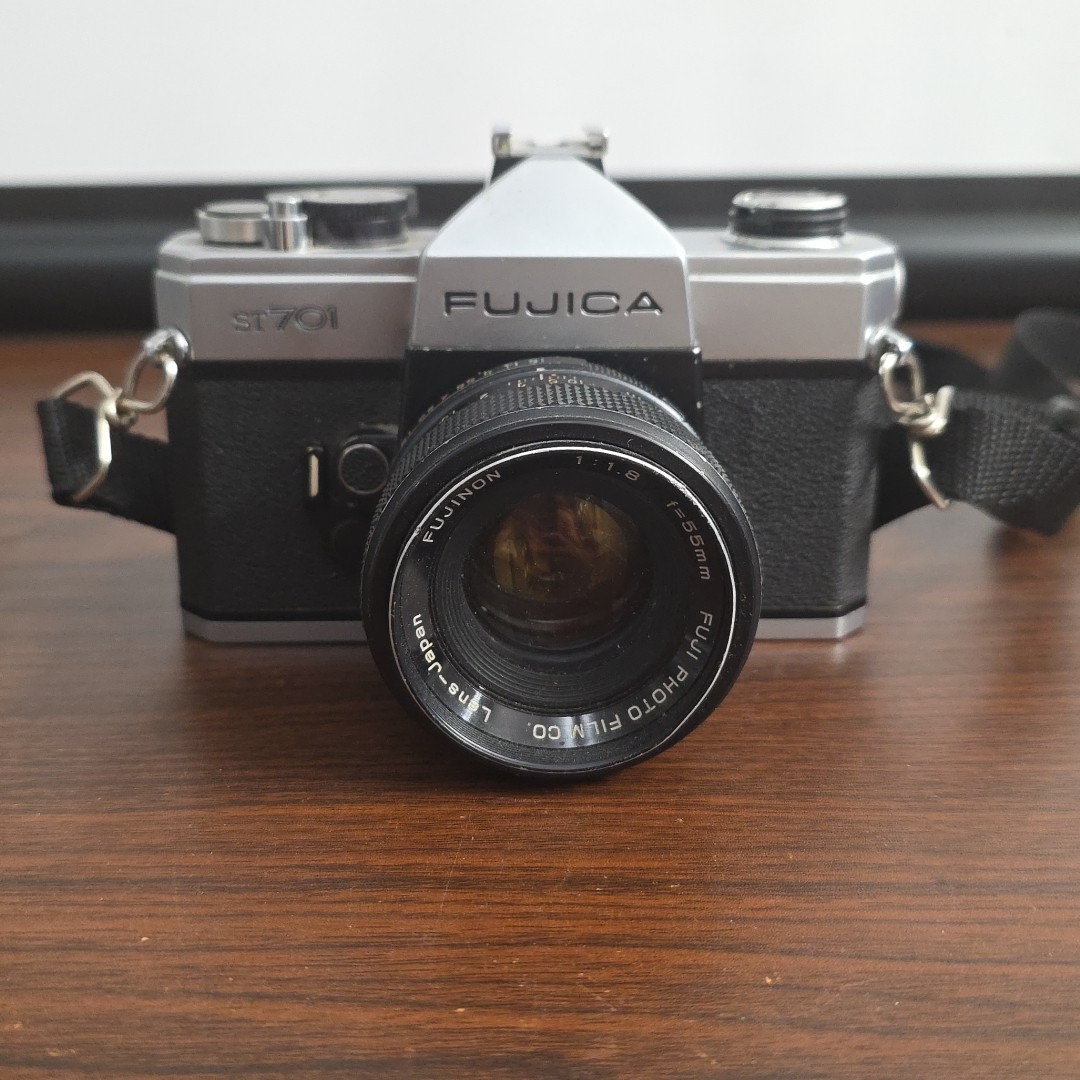
FUJICA ST701
The Fujica ST701 is a compact 35mm single-lens reflex (SLR) camera introduced by Fuji Photo Optical Co., Ltd. in 1971. Designed as an affordable, lightweight SLR with reliable mechanical operation and built-in through-the-lens (TTL) center-weighted metering, the ST701 quickly gained popularity among amateur photographers and students seeking a capable yet accessible system camera.
Overview
Released during a period of rapid expansion in the 35mm SLR market, the Fujica ST701 was positioned as a mid-tier SLR that balanced performance, size, and cost. It was part of Fujica’s broader ST-series, which included models like the ST601 and ST801, each targeting different segments of the growing consumer and enthusiast photography market. The ST701 stood out for its compact form factor—unusually small for an SLR of its era—while still offering full manual exposure control and a robust Copal horizontal cloth focal-plane shutter. Its design emphasized portability without sacrificing core functionality, making it a favorite among photographers who desired SLR image quality in a near-rangefinder-sized body.
The camera featured a fixed pentaprism viewfinder with a microprism focusing aid and split-image rangefinder spot, providing accurate manual focusing. It used the universal M42 screw lens mount, granting users access to a vast ecosystem of lenses from manufacturers such as Pentax, Zeiss, Yashica, and Fujinon. The built-in CdS (cadmium sulfide) TTL metering system operated with a match-needle display in the viewfinder, requiring a single 1.35V mercury battery (PX625 or equivalent). This metering system was advanced for its time, allowing accurate exposure readings regardless of lens focal length when used with M42 lenses that had automatic diaphragm coupling.
The ST701 was introduced in 1971 and remained in production until approximately 1976 and represented Fuji’s effort to compete with dominant Japanese SLR brands like Pentax, Minolta, and Canon. While not the first to feature TTL metering or the M42 mount, the ST701 distinguished itself through its refined ergonomics, solid build quality, and compact dimensions. It was marketed as a "compact professional" tool, though its price point and feature set clearly targeted the advanced amateur. Its success helped establish Fujica as a credible player in the SLR market, paving the way for later models with aperture-priority automation and proprietary bayonet mounts.
Specifications
| Specification | Value |
| Type | 35mm Single-Lens Reflex (SLR) |
| Film Format | 35mm (135 film), interchangeable lenses |
| Years Produced | 1971–1975 |
| Lens Mount | M42 × 1mm screw mount (Pentax Universal) with automatic diaphragm coupling |
| Shutter | Vertical-travel metal focal-plane shutter; speeds from 1 sec to 1/1000 sec, plus Bulb |
| Metering | Through-the-lens (TTL) center-weighted CdS metering with match-needle indicator |
| Exposure Modes | Manual exposure only |
| Viewfinder | Fixed pentaprism with 0.92x magnification, split-image rangefinder surrounded by microprism collar |
| Dimensions | 138 mm (W) × 80 mm (H) × 47 mm (D); weight: approx. 540 g (body only, no battery) |
Key Features
- Compact SLR Design: One of the smallest full-function M42 SLRs ever made, ideal for travel and street photography.
- TTL Center-Weighted Metering: Built-in CdS meter measures light through the lens for accurate exposure, displayed via a needle in the viewfinder matched by rotating the aperture ring.
- M42 Lens Compatibility: Supports a wide range of manual-focus lenses from Fujinon and third-party manufacturers with automatic aperture stop-down.
- Copal Square Shutter: Durable horizontal cloth shutter with precise speeds from 1 sec to 1/1000 sec and flash synchronization at 1/60 sec.
- Ergonomic Shutter Button Placement: Contoured body with recessed shutter release to minimize camera shake.
Historical Context
The Fujica ST701 was launched during a period of rapid growth in the SLR market. By the early 1970s, 35mm SLRs had transitioned from professional tools to mainstream consumer devices, driven by advances in metering, lens coatings, and manufacturing efficiency. The M42 mount, standardized by Asahi Pentax, had become the de facto universal screw mount, enabling cross-brand lens compatibility. Fuji entered this competitive arena with the ST701 as a strategic response to models like the Pentax Spotmatic and Yashica Electro 35, aiming to capture market share through superior ergonomics and compactness.
Despite Fuji’s relative newcomer status in the SLR world, the ST701 received favorable reviews for its build quality, precise metering, and ease of use. It was particularly praised in European and North American markets for offering near-Pentax levels of performance in a smaller, lighter chassis. However, the rise of aperture-priority automation and the eventual shift to proprietary bayonet mounts (such as Canon FD and Minolta SR) limited the ST701’s long-term relevance. By 1975, Fuji had begun transitioning to its own Fujica X-mount, signaling the end of the M42 era for the brand.
Collectibility & Value
Today, the Fujica ST701 is regarded as a cult classic among compact film SLR enthusiasts. While not as widely collected as the Pentax Spotmatic or Olympus OM-1, it holds a niche reputation for its blend of portability and full manual control. In the used market, working examples typically sell for $80–$150 USD, depending on condition, shutter accuracy, and meter functionality. Fully functional meters are increasingly rare due to the discontinuation of 1.35V mercury PX625 batteries; modern replacements (e.g., Wein Cell or hearing aid batteries with voltage adapters) can restore operation but require careful calibration.
Collectors should inspect the shutter for consistency across all speeds, especially 1/1000 sec and 1 sec, as timing drift is common in aging Copal shutters. The light seals should be replaced to prevent light leaks, and the mirror mechanism should be checked for smooth operation. Original leather cases and manuals increase value slightly. Because the ST701 lacks electronic automation, it remains repairable by skilled technicians, though replacement parts are not mass-produced. Its relative obscurity compared to Pentax or Minolta models means fewer restored units on the market, making well-maintained examples desirable.
Similar Cameras
- Pentax Spotmatic (1964–1976) – The benchmark M42 SLR with TTL metering, slightly larger but more widely supported.
- Yashica FR (1977–1980) – A later M42 model with similar manual controls and compact design.
- Praktica LLC (1972–1977) – East German SLR with M42 mount and robust build, favored by budget-conscious photographers.
- Topcon RE Super (1963–1971) – Professional-grade M42 camera with advanced metering, larger and heavier than the ST701.
- Fujica ST601 (1970–1973) – A slightly earlier, more basic sibling with similar size but less refined metering.
Repair & Maintenance
The Fujica ST701 operates mechanically and does not require batteries for shutter function, but the CdS meter needs a 1.35V mercury PX625 battery (or modern substitute) to function. Common issues include sluggish shutter speeds due to dried lubricants, inaccurate metering from aging CdS cells, and worn shutter curtains. The Copal Square shutter is serviceable but requires disassembly by a technician experienced with vintage focal-plane shutters. Light seals degrade over time and should be replaced during servicing. The self-timer mechanism, while functional, can stick if not regularly used. Lubrication of the film advance and rewind gears ensures smooth operation. Given its mechanical simplicity and lack of integrated circuits, the ST701 is considered moderately easy to repair, though availability of spare parts is limited. Regular use and storage in a dry environment significantly extend its operational life.
eBay Listings


As an eBay Partner, we earn from qualifying purchases. This helps support our independent vintage technology research.
Service Manuals, Schematics & Catalogs
- Catalog (1966) — archive.org
Related Models
- Fujica AX-3 (1980-1985)
- Fujica AX-5 (1980-1985)
- Fujica ST605 (1976-1980)
- Fujica ST605N (1978-1981)
- Fujica ST801 (1973-1978)
- Alpa 6 (1948-1953)
- Agfa Agfaflex
- Agfa Ambiflex
- Agfa Easy
- Agfa Futura Af zoom