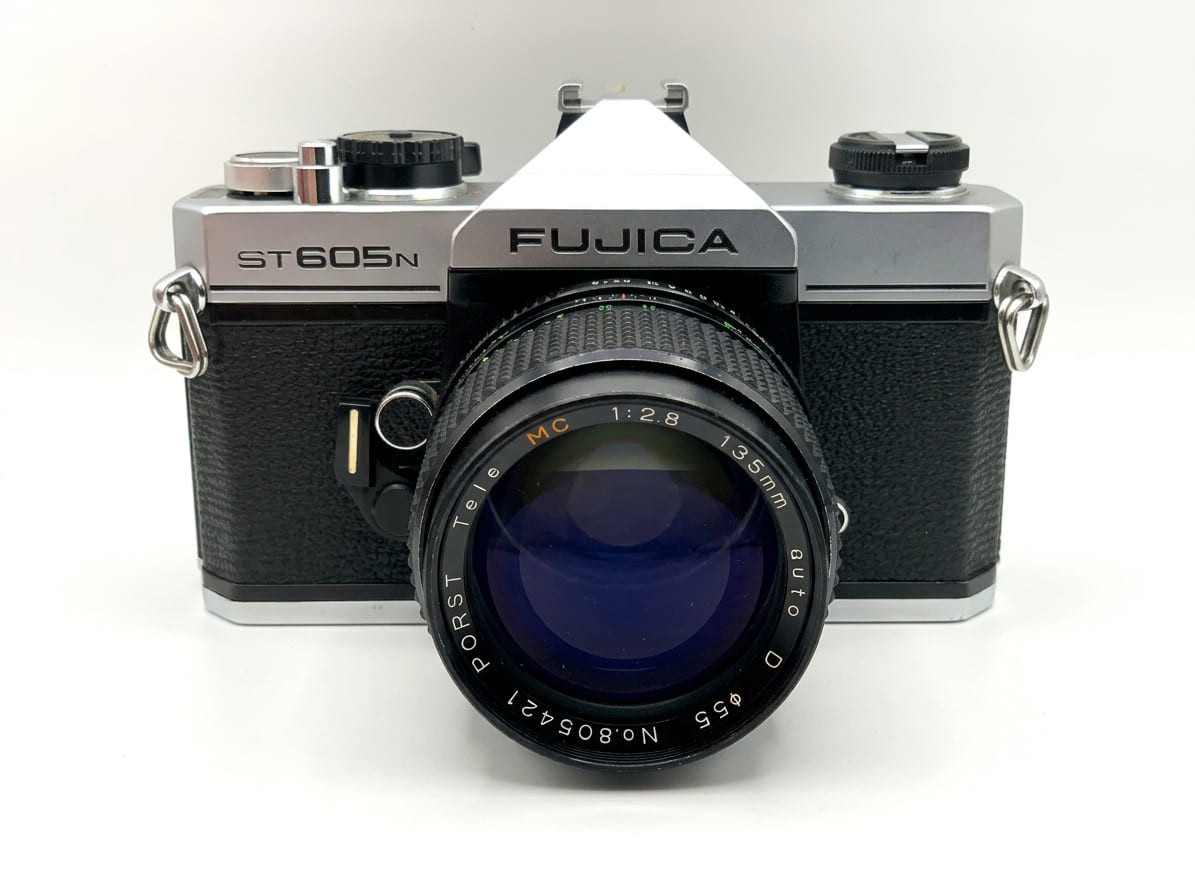
FUJICA ST605
The Fujica ST605 is a compact, entry-level 35mm film SLR camera introduced by Fujifilm in 1976. Designed for amateur photographers seeking an affordable and reliable manual-focus SLR, it features a robust M42 screw mount, full mechanical operation, and a built-in TTL CdS light meter, making it a practical choice during the golden era of 35mm SLR photography.
Overview
Released in 1976, the Fujica ST605 was positioned as an accessible gateway into SLR photography for consumers transitioning from point-and-shoot rangefinders or viewfinder cameras. It succeeded earlier models in Fujica’s ST-series, such as the ST705 and ST801, but was simplified in design and function to reduce cost and appeal to budget-conscious users. Despite its entry-level status, the ST605 retained core mechanical reliability and optical compatibility with the widely adopted M42 lens mount, allowing users access to a broad ecosystem of interchangeable lenses from Fujinon and third-party manufacturers like Pentax, Zeiss, and Soligor.
The ST605 was manufactured until approximately 1980, a period marked by the gradual shift from screw-mount to proprietary bayonet-mount systems and the rise of aperture-priority automation. Fujifilm, while investing in more advanced models like the Fujica ST901 and later the X-series with proprietary X-mount, used the ST605 to maintain a presence in the budget mechanical SLR segment. The camera’s compact size—unusual for M42 SLRs, which often featured bulkier bodies—was achieved through a simplified internal layout and a reduced viewfinder hump. It lacked features such as a self-timer, depth-of-field preview, or multiple exposure capability, underscoring its role as a no-frills, beginner-friendly tool.
Specifications
| Specification | Value |
| Type | 35mm Manual Focus SLR |
| Film Format | 35mm (135) |
| Years Produced | 1976–1980 |
| Lens Mount | M42 Screw Mount (Pentax Thread Mount) |
| Shutter | Focal-plane cloth shutter, speeds 1 sec to 1/1000 sec + B |
| Metering | TTL CdS center-weighted metering |
| Exposure Modes | Manual exposure only |
| Viewfinder | Fixed pentaprism, 0.92x magnification, 94% coverage |
| Dimensions | Approx. 136 × 83 × 50 mm (w/o lens), Weight: ~540 g (body only) |
Key Features
- M42 Screw Mount Compatibility: Full support for M42 lenses with stop-down metering, enabling use of a vast range of manual prime and zoom lenses.
- TTL Center-Weighted CdS Metering: Built-in through-the-lens metering system with a match-needle display in the viewfinder for accurate exposure guidance.
- Mechanical Shutter Operation: Fully functional without batteries, with only the light meter requiring power (1× 1.35V PX625 mercury battery or modern equivalent).
- Compact and Lightweight Design: Among the smaller M42 SLRs, making it ideal for travel and casual photography.
- Cable Release Socket: Integrated 1/4"-20 thread for tripod and cable release use, supporting long exposures and reduced camera shake.
Historical Context
The Fujica ST605 was introduced at a transitional moment in SLR development. By the mid-1970s, Japanese manufacturers such as Nikon, Canon, Pentax, and Minolta were rapidly advancing electronic automation, introducing aperture-priority and shutter-priority models. Fujifilm, primarily known for film and optical coatings, leveraged its expertise to produce competent SLRs under the Fujica brand but faced stiff competition in hardware innovation. The ST605 was not a technological pioneer but rather a pragmatic offering aimed at markets where affordability and mechanical simplicity were prioritized over automation.
It competed directly with models like the Pentax MX, Olympus OM-1 (though smaller and more advanced), and the Praktica LLC series. Unlike the fully mechanical Pentax K1000—released in 1976 and often regarded as the quintessential beginner SLR—the ST605 included a built-in meter, giving it an edge in usability for novice photographers. However, Fujica’s limited global marketing presence compared to Pentax or Nikon meant the ST605 remained relatively obscure outside Japan and select European markets. Its production run ended by 1980 as Fujifilm shifted focus toward the more advanced Fujica ST901 and later the X-mount system, signaling the decline of the M42 platform across the industry.
Collectibility & Value
Today, the Fujica ST605 is a niche collectible, appreciated primarily by M42 system enthusiasts and photographers seeking a lightweight, fully manual SLR with built-in metering. While not rare, it is less commonly encountered than contemporaries like the Pentax K1000 or Praktica PLC3, contributing to modest demand and stable pricing. In working condition, the ST605 typically sells for $75–$120 USD, with higher prices only for mint, boxed examples with original accessories.
When purchasing, buyers should verify the functionality of the shutter across all speeds, the accuracy of the light meter (noting that the original PX625 mercury battery is obsolete; modern silver oxide or alkaline replacements may require voltage adapters for correct metering), and the condition of the mirror and focusing screen. Common issues include stiff shutter curtains due to dried lubricant, inaccurate meter readings from aging CdS cells, and light seals degradation, which can lead to film fogging. The camera’s mechanical simplicity makes most repairs feasible for experienced technicians, though replacement parts are not widely available.
Similar Cameras
- Pentax K1000 (1976–1997) – Iconic entry-level SLR with M42 and later K-mount versions; fully mechanical, no meter in early models.
- Praktica PLC3 (1977–1980) – East German M42 SLR with TTL metering and a similar target market.
- Zenit-TTL (1977) – Soviet-built M42 SLR with through-the-lens metering, known for ruggedness but less refined mechanics.
- Yashica FX-3 (1979) – Compact M42 SLR with TTL metering, comparable size and feature set.
- Cosina CT-1 (1982) – Late-era M42 SLR with modernized ergonomics and reliable build quality.
Repair & Maintenance
The Fujica ST605 operates mechanically without batteries, but the CdS light meter requires a 1.35V PX625 mercury battery (now obsolete). Modern substitutes such as the Wein Cell (zinc-air) or alkaline SR44 with a voltage reducer can be used, though meter accuracy may vary. Users are advised to calibrate the meter when possible or use an external light meter for precision. The shutter mechanism is a vertically traveling cloth focal-plane type, durable but susceptible to sticky speeds if stored improperly. Regular CLA (Clean, Lubricate, Adjust) servicing every 5–10 years is recommended for consistent performance. The film advance lever is robust but may develop play over time. Light seals should be replaced during restoration to prevent light leaks. Due to the camera’s mechanical design and lack of electronic components, repair difficulty is moderate, though spare parts are not readily available from Fujifilm, necessitating donor bodies or third-party sourcing.
eBay Listings



As an eBay Partner, we earn from qualifying purchases. This helps support our independent vintage technology research.
Service Manuals, Schematics & Catalogs
- Catalog (1966) — archive.org
Related Models
- Fujica AX-3 (1980-1985)
- Fujica AX-5 (1980-1985)
- Fujica ST605N (1978-1981)
- Fujica ST701 (1971-1975)
- Fujica ST801 (1973-1978)
- Alpa 6 (1948-1953)
- Agfa Agfaflex
- Agfa Ambiflex
- Agfa Easy
- Agfa Futura Af zoom