FUJICA AX-5
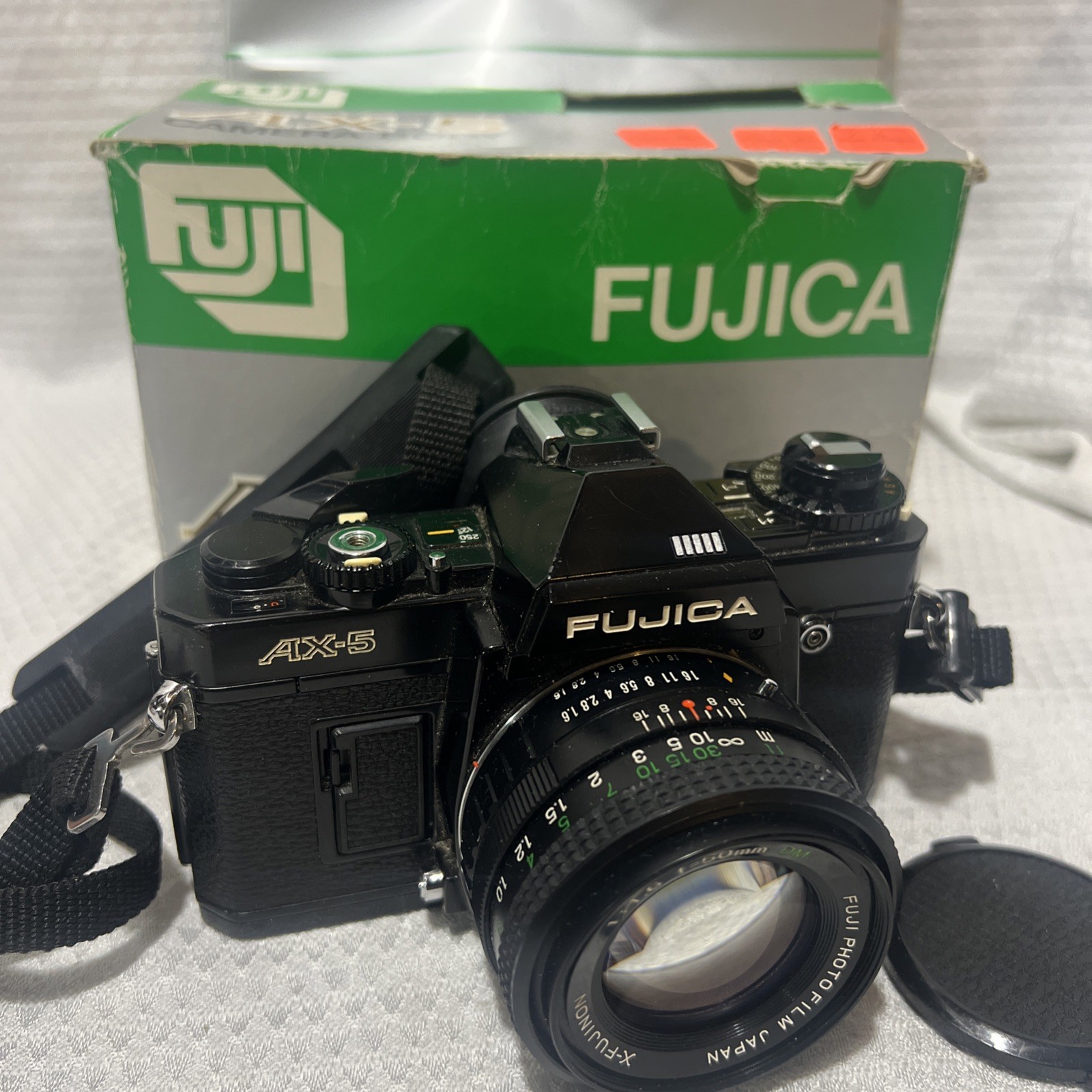
The Fujica AX-5 is a 35mm single-lens reflex (SLR) camera introduced in 1980 as the flagship model in Fujica’s AX series. It was Fujifilm’s first SLR to feature fully automatic Program AE (Auto Exposure) mode, combining advanced electronics with manual control options to appeal to both amateur and advanced photographers.
Overview
Released during a pivotal era in the evolution of consumer SLR technology, the Fujica AX-5 represented Fujifilm’s push into the increasingly competitive mid-to-high-end 35mm SLR market dominated by Nikon, Canon, and Minolta. Positioned as the top-tier model in the AX line—above the AX-1, AX-3, and AX-7—the AX-5 combined cutting-edge automation with traditional mechanical reliability. It was designed to compete directly with cameras like the Minolta X-700 and Pentax ME-F, offering a blend of user-friendly automation and manual override capabilities.
The AX-5 was notable for being Fujica’s first SLR with a fully programmed exposure system, allowing the camera to automatically select both shutter speed and aperture based on scene lighting and lens characteristics. This was a significant advancement over earlier Fujica models, which relied on aperture-priority or manual exposure systems. The camera utilized Fujica’s proprietary X-mount (also known as the Fujica X), which supported TTL (Through-The-Lens) metering and full electronic communication between lens and body—a rarity at the time. The X-mount system, however, was not backward compatible with the older Fujica breech-lock mount, marking a clean break in Fujifilm’s SLR strategy.
Targeted at advanced amateurs and semi-professionals, the AX-5 offered a robust metal chassis, a bright viewfinder with comprehensive exposure information, and a vertical-travel focal-plane shutter. Its ergonomic design, with a pronounced handgrip and logically placed controls, enhanced handling and usability. Despite its advanced features, the AX-5 retained mechanical functionality at 1/100 sec in the event of battery failure, ensuring continued operation under adverse conditions.
Specifications
| Specification | Value |
| Type | 35mm Single-Lens Reflex (SLR) |
| Film Format | 35mm (135 cartridge) |
| Years Produced | 1980–1985 |
| Lens Mount | Fujica X-mount (proprietary bayonet) |
| Shutter | Vertical-travel focal-plane shutter; speeds from 1 sec to 1/1000 sec, plus Bulb; mechanically timed at 1/100 sec |
| Metering | TTL open-aperture center-weighted averaging metering with silicon photodiode sensor |
| Exposure Modes | Program AE (automatic), Aperture-Priority AE, Manual |
| Viewfinder | Fixed pentaprism with microprism collar and split-image rangefinder; displays shutter speed, aperture, and exposure confirmation |
| Dimensions | Approx. 142 x 92 x 50 mm; Weight: approx. 580 g (body only, no battery or lens) |
Key Features
- Program AE Mode: The AX-5 was Fujica’s first SLR with full Program auto-exposure, automatically selecting optimal shutter speed and aperture settings.
- Fujica X-Mount: A modern bayonet mount with electronic contacts enabling TTL metering and lens-to-body communication; supported Fujinon-X lenses with automatic diaphragm.
- Dual Exposure Modes: In addition to Program mode, the camera offered Aperture-Priority and Manual modes, providing flexibility for creative control.
- Mechanical Backup: Shutter retains 1/100 sec speed mechanically, allowing limited operation without batteries.
- Comprehensive Viewfinder Display: Real-image viewfinder with LED indicators for shutter speed, aperture, and exposure status, improving usability in automatic modes.
Historical Context
The Fujica AX-5 was launched in 1980 at a time when Japanese SLR manufacturers were rapidly integrating electronics into their camera systems. The early 1980s saw a shift from fully mechanical cameras to electronically controlled models with automated exposure, driven by consumer demand for ease of use without sacrificing image quality. Fujifilm, traditionally known for its film and optical expertise, sought to establish credibility in the SLR market with the AX series, and the AX-5 was its technological flagship.
It competed directly with the Minolta X-700 (1981), which also featured Program AE and became a massive success, and the Pentax ME-F (1981), one of the first autofocus SLRs. While the AX-5 did not offer autofocus—Fujica’s autofocus efforts came later with the Fujica AZ series—it provided a sophisticated, reliable alternative with excellent build quality and lens performance. Despite positive reviews for its ergonomics and exposure system, the AX-5 suffered from limited third-party lens support and the proprietary nature of the X-mount, which restricted its appeal compared to systems with broader lens ecosystems like Canon FD or Nikon F.
Production of the AX-5 ceased around 1985 as Fujifilm began shifting focus toward compact cameras and later digital imaging. The X-mount system was discontinued, and Fujica SLRs gradually faded from the market, making the AX-5 one of the last significant film SLRs Fujifilm produced before exiting the SLR arena.
Collectibility & Value
Today, the Fujica AX-5 is a niche collectible, valued more for its historical significance and design than for widespread usability. Due to its limited production run and the proprietary X-mount, it is less common than contemporaries from Minolta, Pentax, or Nikon. In good working condition, the AX-5 typically sells for $75–$150 USD, depending on included lenses and functionality. Fully functional units with a Fujinon-X 50mm f/1.8 or f/1.4 lens command higher prices, especially if the original case, manual, and strap are included.
Collectors should inspect the camera for common issues such as shutter accuracy at high speeds, sticky aperture levers on lenses, and TTL metering functionality. The camera uses two 1.5V SR44 (or equivalent) batteries for metering and exposure control, and corrosion in the battery compartment is a frequent problem in older units. Additionally, the electronic components, while generally reliable, can degrade over time, leading to intermittent exposure or display issues. As spare parts are scarce and repair expertise limited, functional units are preferred.
Despite these challenges, the AX-5 remains an interesting artifact of Fujifilm’s analog ambitions—a well-engineered camera that showcased innovation but was ultimately constrained by market dynamics and strategic shifts.
Similar Cameras
- Minolta X-700 (1981) – Program AE, manual override, MD-mount, highly popular and widely supported.
- Pentax ME Super (1979) – Aperture-priority and manual, K-mount, known for compact size and reliability.
- Canon AE-1 Program (1981) – Program and shutter-priority modes, FD mount, part of Canon’s highly successful AE series.
- Nikon EM (1979) – Aperture-priority, compact F-mount SLR aimed at beginners, often paired with 50mm f/1.8.
- Olympus OM-4 (1983) – Professional-grade OM system camera with aperture-priority and manual modes, renowned for metering accuracy.
Repair & Maintenance
The Fujica AX-5 operates on two 1.5V SR44 (or equivalent, such as LR44 or A76) batteries housed in the base plate, which power the metering system, exposure control, and viewfinder LEDs. Battery corrosion is a common issue, particularly if old silver-oxide cells have leaked; cleaning the contacts and replacing the battery holder may be necessary during restoration.
The most frequent mechanical issues involve the shutter mechanism, especially at speeds above 1/500 sec, where timing inaccuracies can occur due to aging foam or worn components. The aperture linkage between body and lens must be checked for smooth operation, as gummed lubricants can cause lenses to stop down incorrectly, leading to overexposure.
Repairing the AX-5 requires specialized tools and knowledge, particularly for shutter calibration and meter circuit troubleshooting. Few technicians today are familiar with the Fujica X-mount system, and replacement parts are not manufactured. However, the camera’s modular design allows for disassembly and cleaning with proper documentation. Regular maintenance—such as lubrication of the film advance and shutter release mechanisms—can extend the life of a functional unit. For collectors and users, sourcing a working body with a matched Fujinon-X lens is the most practical approach to enjoying this historically significant SLR.
eBay Listings


As an eBay Partner, we earn from qualifying purchases. This helps support our independent vintage technology research.
Service Manuals, Schematics & Catalogs
Related Models
- Fujica AX-3 (1980-1985)
- Fujica ST605 (1976-1980)
- Fujica ST605N (1978-1981)
- Fujica ST701 (1971-1975)
- Fujica ST801 (1973-1978)
- Alpa 6 (1948-1953)
- Agfa Agfaflex
- Agfa Ambiflex
- Agfa Easy
- Agfa Futura Af zoom